Blue Lasers, Beam Profiles, Microholes & Recovery
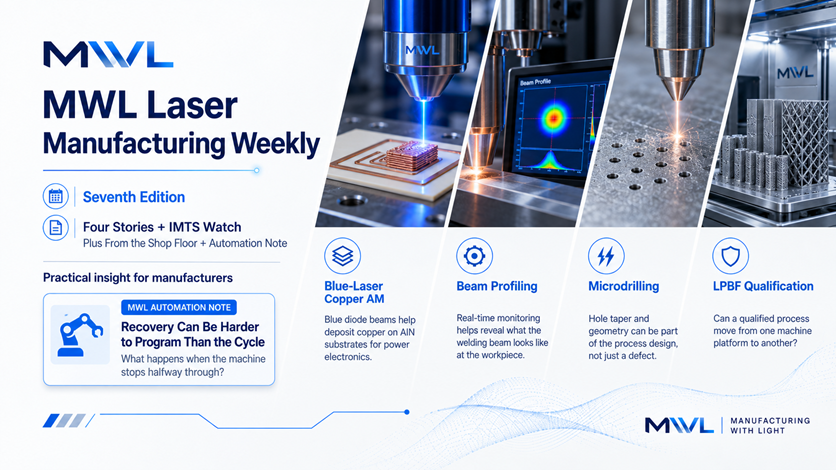
This week we have four stories that touch very different parts of manufacturing with light.
A blue diode laser is being used to deposit copper directly onto ceramic substrates. Tamron is moving into laser welding with a real-time beam profiler. New research shows just how much control is possible over the geometry of laser-drilled microholes. And a major America Makes program is tackling a problem additive manufacturing has to solve if it is going to scale: making a qualified process work across different machine platforms.
With IMTS starting next week, Product Watch is taking another week off and becoming IMTS Watch.
We are also asking again for your stories From the Shop Floor, and this week’s MWL Automation Note looks at something controls programmers know can become surprisingly difficult:
Recovery can be harder to program than the normal machine cycle.
IN THIS EDITION
1 — Why Blue Lasers Are Making Copper AM More Practical
2 — Your Laser Says 2 kW. What Does the Beam Actually Look Like?
3 — A Laser-Drilled Hole Isn’t Always Straight — And Sometimes That’s the Point
4 — Can an LPBF Process Move From One Machine to Another?
IMTS WATCH — IPG Photonics
FROM THE SHOP FLOOR
CONSULTANTS CORNER
MWL AUTOMATION NOTE — Recovery Can Be Harder to Program Than the Cycle
1 — Why Blue Lasers Are Making Copper AM More Practical
Shimadzu announced this week that it has worked with Osaka University’s Joining and Welding Research Institute and DOWA Power Device to put a multi-beam additive manufacturing process for copper-aluminum nitride substrates into practical use.
The process feeds copper powder onto an aluminum nitride substrate while simultaneously irradiating it with multiple blue diode laser beams.
The result is a direct copper-to-ceramic structure without the silver-containing brazing material used in conventional approaches. Shimadzu says the process can create fine-line and complex circuit patterns and reports heat-cycle durability more than three times that of conventional substrates. Shimadzu also describes the technology as a world first.
Why It Matters
Copper is an interesting material for laser processing because wavelength matters.
Shimadzu specifically points out that pure copper efficiently absorbs blue laser light. That makes blue diode technology attractive for applications where conventional infrared laser processing of copper can be more challenging.
But what caught my attention here isn’t simply the laser color.
It is that the process combines laser wavelength, powder delivery, additive manufacturing and electronics packaging to solve a very specific manufacturing problem.
The application is currently aimed at heat-dissipation substrates for power semiconductor devices, with Shimadzu also identifying potential future uses in areas including optical communications and AI servers.
This is a good example of why “manufacturing with light” keeps expanding into places we might not immediately think of as laser applications.
Source: Shimadzu — Multi-Beam Additive Manufacturing with a Blue Diode Laser
2 — Your Laser Says 2 kW. What Does the Beam Actually Look Like?
Tamron is a company many people probably associate more with camera lenses than laser welding.
That may be changing.
Tamron announced September 7 that it intends to enter the laser-welding solutions market and is developing a real-time beam profiler along with a laser processing head.
The beam-profiler prototype is intended to measure and visualize characteristics including beam diameter and heat distribution in real time. Tamron plans to publicly demonstrate the prototype at the Japan International Welding Show beginning September 16 and is targeting 2027 for product launches.
Why It Matters
One point in Tamron’s announcement is particularly important.
Running the laser at the same output setting does not guarantee that everything at the workpiece is unchanged.
Tamron notes that changes in focal position and spatial intensity distribution can contribute to processing irregularities, focal misalignment and spatter.
That gets to a larger issue in laser manufacturing.
We monitor laser power. We monitor travel speed. We monitor gas pressure. We monitor temperatures.
But ultimately the process responds to the energy distribution actually arriving at the workpiece.
For production laser welding, better visibility into the beam itself could become another useful piece of the process-monitoring puzzle.
Tamron’s device is still under development, so we’ll have to see how the commercial product performs. But the direction is worth watching.
Source: Tamron — Entering the Laser Welding Solutions Sector
3 — A Laser-Drilled Hole Isn’t Always Straight — And Sometimes That’s the Point
A recent discussion about laser microdrilling sent me down a path I had not thought much about before.
When we specify a drilled hole, most of us instinctively think:
Diameter.
But a laser-drilled microhole can have an entrance diameter, an exit diameter and an internal geometry that are all important to how the part performs.
Recent research from the University of Stuttgart looked at helical drilling of high-aspect-ratio microholes using ultrafast lasers in aluminum, copper, stainless steel and tungsten-carbide/cobalt.
By adjusting the helical diameter and beam angle, the researchers reproducibly produced both cylindrical and negatively conical holes, including holes with aspect ratios as high as 30 in 3-mm-thick samples. The work also found that material properties affect the final geometry.
Why It Matters
Hole taper isn’t always simply a defect that needs to be eliminated.
Depending on the application, designers may want a conventional positive taper, a nearly cylindrical hole, or even a hole that becomes larger toward the exit.
Getting there requires more than pointing a laser at a position and firing.
Beam inclination, helical motion, pulse strategy, material response and reflections inside the developing hole can all influence the result.
This becomes especially interesting in applications such as turbine cooling holes, nozzles, filters and other precision flow components.
Prima Power LASERDYNE is also highlighting precision drilling at IMTS this year along with technologies including SmartPierce, SmartSense, SmartComp and CylPerf that combine motion, beam delivery and process control.
For me, the takeaway is simple:
Sometimes the question isn’t “What diameter is the hole?”
It is:
“What shape does the hole need to be?”
Sources:
2026 Procedia CIRP research — Material-dependent geometry formation in helical drilling
Prima Power LASERDYNE — Advanced Laser Processing at IMTS 2026
4 — Can an LPBF Process Move From One Machine to Another?
One of the recurring challenges in additive manufacturing is moving from:
“We successfully printed the part.”
to:
“We have a qualified manufacturing process.”
America Makes and the National Center for Defense Manufacturing and Machining recently selected General Atomics Aeronautical Systems to lead Project GOTHAAM — Generation Of Technical-data for High-strength Aluminum Alloy Material.
The $5.5 million program is intended to develop material allowables for a high-strength, 7075-T73-equivalent aluminum alloy across three classes of laser powder bed fusion systems, covering small-, medium- and large-format machines.
The project team includes organizations such as Lockheed Martin, Northrop Grumman, Airbus Space & Defense/APWORKS, Nikon AM, EOS America, Equispheres, Dyndrite and others.
Why It Matters
This is where additive manufacturing becomes a manufacturing-system problem rather than just a printing problem.
If a material and process are qualified on one specific machine, what happens when production needs another machine?
Or a larger machine?
Or equipment from another platform?
Earlier GOTHAAM program information describes the goal of testing the process across small, medium and large multi-laser LPBF machines to evaluate machine-to-machine equivalency and develop material allowables suitable for qualified production.
That is a much harder question than demonstrating that a good part can be printed once.
It also matters if additive manufacturing is going to become more resilient and scalable. Production capacity can’t always depend on one exact machine configuration in one exact location.
The real goal is repeatability.
Source: America Makes — GOTHAAM Project Call Winner
IMTS WATCH
IPG Photonics: Handheld Welding, Robotic Welding and Implementation Lessons
IMTS opens September 14 in Chicago, and IPG Photonics is planning several laser-welding demonstrations at Booth 135015.
According to IPG, the booth will include its FlexCell robotic welding platform, hands-on LightWELD demonstrations in a laser-safe trailer, and live demonstrations of the SYS 3000 precision laser workstation.
On Thursday, September 17 from 2:15–3:10 p.m., Daniel Earley, Senior Product Line Manager at IPG Photonics, will present:
“Handheld Laser Welding 2026: Tips for Successful Implementation and Avoiding Common Pitfalls.”
The session is expected to cover selecting laser-friendly applications, training, identifying an equipment champion and understanding where handheld laser welding fits alongside traditional arc welding.
Why I’m Watching This One
We have spent quite a bit of time at MWL discussing handheld laser welding.
The technology itself is no longer the only interesting question.
The bigger questions are increasingly:
Who should use it?
Which applications make sense?
What training is required?
How do manufacturers introduce it successfully?
That makes a presentation focused on lessons learned from actual implementation much more interesting to me than another demonstration of how fast a handheld laser can make a weld.
Sources:
IPG Photonics — IMTS 2026
IMTS — Handheld Laser Welding 2026 Session
FROM THE SHOP FLOOR
We’re Still Looking for Your Stories
MWL was never intended to be only my view of manufacturing.
I would like to hear from the people actually building, operating, troubleshooting and improving these systems.
Maybe you solved an annoying machine problem.
Maybe a process didn’t work the way you expected.
Maybe you learned something during commissioning that you wish someone had told you five years earlier.
It doesn’t need to be a polished technical article.
Send me the basic story and we can work together to turn it into something useful for other MWL readers.
If we receive enough contributions, From the Shop Floor can become a regular part of MWL Weekly.
If you have something worth sharing, send MWL a message.
CONSULTANTS CORNER
MWL is also looking for independent consultants and specialists working in laser processing, optics, beam delivery, welding, cutting, additive manufacturing, automation, safety and related technologies.
The idea behind Consultants Corner is simple: give knowledgeable people a place to share useful technical content while giving MWL readers access to expertise beyond my own.
If you’re interested in contributing, get in touch.
MWL AUTOMATION NOTE
Recovery Can Be Harder to Program Than the Cycle
One thing I have learned building automated machines is that programming the normal cycle is sometimes the easy part.
The difficult question comes later:
What happens when it stops halfway through?
A normal sequence starts from a known condition.
The machine is homed.
The part is loaded.
The clamps are in the expected position.
The process is ready.
You press Cycle Start.
Recovery starts with something like:
The machine stopped on Step 37.
Axis 2 may or may not have completed its move.
The clamp command is on, but you don’t know whether the clamp actually made it.
The laser process stopped somewhere in the middle of the part.
And someone would really like you to press one button and continue as though nothing happened.
“Can It Recover From Anything?”
Customers understandably want machines that recover gracefully.
So do I.
But recovery requirements can grow quickly.
What if the operator presses E-stop?
What if air pressure disappears?
What if the servo faults halfway through a move?
What if the PLC loses power?
What if someone manually moves an axis while the machine is stopped?
Eventually you can get to the controls-programmer version of:
“Okay. What if the building burns down in a hurricane? Should we resume at Step 38?”
At some point we have to define what recovery actually means.
The Machine State Is Only Half the Problem
Recovering the machine hardware is often straightforward.
Re-home an axis.
Reset a drive.
Open a valve.
Return something to a known position.
The harder question is often the process state.
Was the weld completed?
Did the laser already fire on this feature?
Was material deposited?
Was the hole drilled?
Is the current part still usable?
Can the operation safely be repeated?
The PLC may know exactly where the machine is, but still have no reliable way to know the partis condition.
That is why recovery deserves to be designed as part of the machine sequence—not added at the end when someone asks for a Reset button.
Define What Can Be Recovered
A practical recovery strategy doesn’t necessarily have to recover automatically from everything.
It needs to clearly define what happens after each type of interruption.
Some conditions may allow an automatic resume.
Some may require returning to a known machine state and restarting a process step.
Some may require operator inspection.
And sometimes the correct recovery is:
Scrap the part and start again.
That isn’t bad automation.
Sometimes it is the only way to guarantee that the process is still valid.
Make Recovery Understandable
Good recovery programming should also help the person standing in front of the machine.
Tell them:
What stopped.
What the machine knows.
What it doesn’t know.
What has to happen next.
Defined machine states, meaningful alarms, and useful event histories become extremely valuable here.
They help today’s technician understand how the machine arrived at its current condition.
And someday they may give AI-assisted maintenance systems enough context to help do the same thing.
One Final Thought
When reviewing a machine sequence, don’t only ask:
“Does the cycle work?”
Stop it halfway through.
Remove an interlock.
Fault an axis.
Lose a utility.
Then ask:
“Now what?”
That may tell you more about the quality of the automation than watching another perfect cycle.
Closing Thought
This week’s stories range from blue lasers and copper electronics to beam profiling, shaped microholes, additive qualification and machine recovery.
They are very different technologies, but there is a common theme:
A process becomes valuable when we can understand it, control it, repeat it and recover when something goes wrong.
That’s the difference between demonstrating a technology and putting it to work in manufacturing.
Manufacturing With Light
#ManufacturingWithLight #LaserManufacturing #LaserWelding #AdditiveManufacturing #Automation #IMTS2026