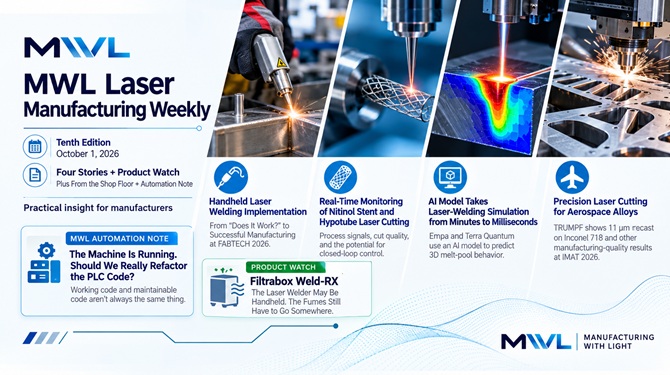
Active index
- Handheld Laser Welding: How to Implement It
- Real-Time Monitoring of Nitinol Stent & Hypotube Cutting
- AI Takes Laser-Welding Simulation to Milliseconds
- Aerospace Laser Cutting: Making the Shape Isn’t Enough
- MWL Product Watch: Filtrabox Weld-RX
- MWL Automation Note: Should We Refactor the PLC Code?
- Closing Thought
1. Handheld Laser Welding: The Question Is Becoming How to Implement It
Handheld laser welding has spent the last several years getting attention for its speed, relatively low heat input, and ability to simplify certain welding applications.
But an upcoming FABTECH 2026 technical session suggests the conversation is beginning to mature.
The October 21 session, “What Fabricators Need to Know About Hand Held Laser Joining: Implementation and Qualification,” includes a presentation specifically addressing successful implementation and common pitfalls.
The premise is interesting: after almost six years of practical portable handheld laser welding systems, the benefits are becoming broadly accepted, but successful implementation isn’t necessarily as simple as buying the machine.
Topics include selecting applications that are well suited to laser welding, training, assigning someone to champion the technology internally, and understanding where handheld laser welding fits alongside conventional arc welding.
A second presentation addresses something that may become increasingly important as HHLW moves into structural and code-governed work: procedure and operator qualification, mechanical testing, and documentation.
Why It Matters
This is exactly where I think the handheld laser welding conversation needs to go.
It’s not only about how fast it can weld, but also about how we successfully turn it into a manufacturing process.
That involves application selection, joint design, fixturing, training, safety, parameter development, qualification where required, fume extraction, maintenance, and understanding what the finished weld actually needs to do.
Handheld laser welding doesn’t have to replace MIG or TIG everywhere to be successful.
It has to be used where its advantages make sense, and implemented properly when it is.
Source: FABTECH 2026 — Hand Held Laser Joining: Implementation and Qualification
<a id=”nitinol-monitoring”></a>
2. Can We Monitor a Nitinol Stent While We’re Cutting It?
An interesting paper presented at SMST 2026 looks at real-time laser-cutting monitoring for nitinol stent and hypotube manufacturing.
The researchers developed a monitoring system that captures process-related signals while the laser is actually cutting.
Those signals can then be correlated with the final cut quality.
The goal is to detect process problems earlier rather than waiting until after the component has been completely manufactured and inspected.
The researchers also point toward a longer-term possibility: using the information as the foundation for closed-loop laser-cutting process control.
Why It Matters
Medical tube cutting is a great example of how demanding laser manufacturing can become.
We aren’t simply trying to move an axis to the correct position.
The machine has to coordinate precision motion, tube rotation, laser power, focus, assist gas, cutting parameters, and the mechanical support of a very small tube while producing extremely small features repeatedly.
And ultimately, what matters isn’t whether the CNC reached the commanded coordinates.
What matters is whether the cut is good.
Today, much of that answer still comes from inspecting the component after processing.
If useful process signals can identify a deteriorating cut while it is happening, the machine potentially gains another level of process awareness.
Eventually, that raises an even more interesting possibility:
Could the machine recognize that the process is moving out of its acceptable window and correct it before making a bad part?
That’s a much bigger step than simply monitoring the laser.
3. From Minutes or Hours to Milliseconds: AI and Laser-Welding Simulation
Empa and Terra Quantum announced a new AI surrogate model called the Laser Processing Fourier Neural Operator (LP-FNO).
The model predicts three-dimensional temperature fields and melt-pool boundaries based on laser power and scan speed.
According to the researchers, conventional high-fidelity simulations can take approximately six minutes at 10-micron resolution and more than an hour at 5-micron resolution.
Once trained, LP-FNO reportedly produces a full 3D prediction in approximately 8 milliseconds at standard resolution and 88 milliseconds at twice that resolution.
The model was trained using high-fidelity simulations of Ti-6Al-4V across laser powers from 40 to 190 watts and scan speeds from 0.1 to 1 meter per second, covering conduction and stable keyhole welding regimes.
Why It Matters
Simulation has always had an interesting limitation in manufacturing.
A very accurate model isn’t necessarily useful for machine control if it takes longer to calculate the answer than it takes to make the part.
Milliseconds change that discussion.
If models like this can eventually be validated broadly enough for production use, simulation could become much more closely connected to parameter optimization, digital twins, and potentially real-time process control.
But there is an important distinction.
Fast simulation is not automatically closed-loop control.
The model still has to represent the real process accurately enough, the machine needs useful real-time information about what is actually happening, and there needs to be something meaningful that the controller can adjust.
Still, reducing a complex calculation from minutes or hours to milliseconds changes what is technically possible.
That makes this development worth watching.
Source: Empa / Terra Quantum — LP-FNO laser-welding prediction model
4. Aerospace Laser Cutting: Making the Shape Isn’t Enough
At IMAT 2026 this week, TRUMPF is presenting process-development work involving precision fiber-laser cutting of aerospace materials including Ti-6Al-4V, Inconel 718, 6061-T6 aluminum, and 316L stainless steel.
The work used 4-kW fiber-laser systems and focused on minimizing manufacturing defects while meeting aerospace quality requirements.
One particularly interesting result was a reported 11-micron recast layer on standard-gauge Inconel 718, compared with a 25-micron customer threshold.
The work also examined heat-affected zones, surface quality, cracking, spatter, and oxide contamination.
Demonstrated applications include thermal-protection panels, turbine components, and precision trimming of formed castings.
Why It Matters
When we talk about precision laser cutting, it is easy to focus on positional accuracy.
Can the machine hold ±10 microns?
How accurate is the motion system?
How small is the laser spot?
Those things matter.
But the aerospace example demonstrates something equally important:
The edge itself is part of the manufactured component.
A dimensionally perfect part with unacceptable recast, cracking, oxidation, or heat-affected material may still be a bad part.
That means high-precision laser cutting isn’t simply a motion-control problem or a laser-power problem.
It’s a complete process problem.
And the closer we get to medical, aerospace, and other high-value applications, the more important that distinction becomes.
Source: IMAT 2026 — Improvements in Laser Cutting for Aerospace, Dr. Eliana Fu, TRUMPF Inc.
MWL Product Watch
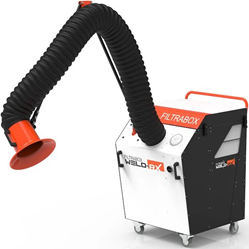
Filtrabox Weld-RX — The Laser Welder May Be Handheld. The Fumes Still Have to Go Somewhere.
As handheld laser welding moves further into production environments, shops need more than the laser welder itself.
One requirement is effective source capture of welding fumes.
The Filtrabox Weld-RX is a mobile fume extractor designed specifically for production laser-welding applications.
The system provides up to 1,200 CFM airflow and uses three stages to handle welding particulate: a steel-mesh spark arrestor, an F9 prefilter, and an H14 HEPA filter.
Filtrabox specifies HEPA efficiency of 99.999% at 0.3 micron and 22 m² of filter media.
An integrated pressure gauge provides a simple indication of filter loading rather than relying only on scheduled filter replacement.
The Weld-RX operates from standard 120-V power and is mounted on casters so it can move around a production area.
Why It Caught My Attention
Handheld laser welding is often promoted partly because the equipment is compact and flexible.
But portability doesn’t make the rest of the manufacturing requirements disappear.
You still need to capture the fumes.
Workers still need appropriate protection.
The application still needs to be evaluated.
And the complete work area still needs to be designed around the process.
I also like the Weld-RX’s approach to filter maintenance. The less-expensive prefilter protects the downstream HEPA filter, while the pressure gauge gives maintenance personnel something meaningful to monitor.
That’s not particularly glamorous technology.
But neither is changing a clogged filter.
Good manufacturing equipment doesn’t always need to be exciting. Sometimes it just needs to make the process easier to operate and maintain.
Source: Filtrabox — Weld-RX Laser Welding Fume Extractor
Product Watch is not a paid endorsement. Products are selected because MWL thinks there is something interesting or useful for manufacturers to consider.
MWL Automation Note
The Machine Is Running. Should We Really Refactor the PLC Code?
There is an old piece of advice that every production manager—and probably every controls engineer—has heard:
“If it ain’t broke, don’t fix it.”
And when we’re talking about a production machine that is making good parts every day, that isn’t necessarily bad advice.
Working production equipment is not the place to practice software elegance just because someone doesn’t like the way the original programmer structured the code.
Refactoring PLC software introduces risk.
Change working logic and you can introduce a new bug. Change a machine state and you may discover an operating condition nobody remembered. Clean up old interlocks and suddenly find out that one of those ugly pieces of logic was there for a reason.
So why refactor anything?
Working Code and Maintainable Code Aren’t Always the Same Thing
Most controls engineers have opened an older PLC program and immediately seen things they would do differently today.
Repeated logic.
Cryptic tag names.
Sections that have been bypassed but never removed.
Changes added during startup that were supposed to be cleaned up later.
Maybe an alarm called:
“Machine Fault 37.”
The machine may run perfectly.
The problem appears when someone has to modify or troubleshoot it.
And I have certainly opened programs years after writing them and wondered what the original programmer was thinking.
Unfortunately, sometimes the original programmer was me.
Technical Debt Doesn’t Usually Arrive All at Once
Industrial software tends to accumulate changes.
A sensor gets replaced.
A new option is added.
Production asks for another mode.
A customer needs a special sequence.
Someone makes a field modification at 2:00 in the morning because production needs the machine running.
Each individual change may make perfect sense.
After enough of them, however, the program can become considerably harder to understand than the machine itself.
That’s software technical debt.
So When Should We Refactor?
Probably not Tuesday morning while the machine is running production.
But planned shutdowns, major upgrades, and significant machine modifications can create opportunities.
If we’re already replacing a drive, updating the HMI, or modifying the process, it may be worth asking:
Is there anything in the software we should make easier to maintain while we have the opportunity?
That doesn’t necessarily mean rewriting the entire PLC.
It may mean cleaning up one troublesome section.
Improving tag names.
Standardizing an axis structure.
Replacing repeated logic with a tested reusable function.
Improving alarms and diagnostics.
Removing obsolete logic after verifying that it really is obsolete.
Or simply documenting the technical debt we know exists so the next programmer doesn’t have to rediscover it.
Refactoring and Standardization Go Together
For machine builders, there may be an even bigger opportunity.
Instead of cleaning up every machine independently, we can start identifying the software structures that should be common across machines.
Axes.
Valves.
Lasers.
Process heads.
Machine states.
Alarms.
Diagnostics.
Communications.
The goal isn’t to make every machine identical.
The goal is to make the common parts common.
That can make new machines easier to build and existing machines easier to support.
And someday it may also make machine software much easier for AI-assisted troubleshooting tools to understand.
Next Week: Standardization
Refactoring one machine can make that machine easier to maintain.
Standardization can keep us from creating the same technical debt on the next ten machines.
Next week’s MWL Automation Note will look at standardization—what should be standardized, what probably shouldn’t be, and how far a machine builder should go before a reusable architecture becomes more complicated than the problem it was supposed to solve.
Closing Thought
What I like about this week’s stories is that none of them is really just about a laser.
Successful handheld laser welding requires the right application and manufacturing approach.
Medical tube cutting increasingly involves understanding what is happening during the process rather than simply inspecting afterward.
AI may make complex process models fast enough to become useful while manufacturing is happening.
Aerospace cutting reminds us that dimensional accuracy doesn’t guarantee an acceptable part.
And even something as straightforward as fume extraction becomes part of making a laser process practical on the shop floor.
That is really what Manufacturing With Light is about.
Not simply what a laser can do.
How do we turn it into a manufacturing process that works every day?
Manufacturing With Light
#ManufacturingWithLight #LaserManufacturing #LaserWelding #HandheldLaserWelding #MedicalDeviceManufacturing #LaserCutting #PrecisionManufacturing #Automation #PLC #AdvancedManufacturing