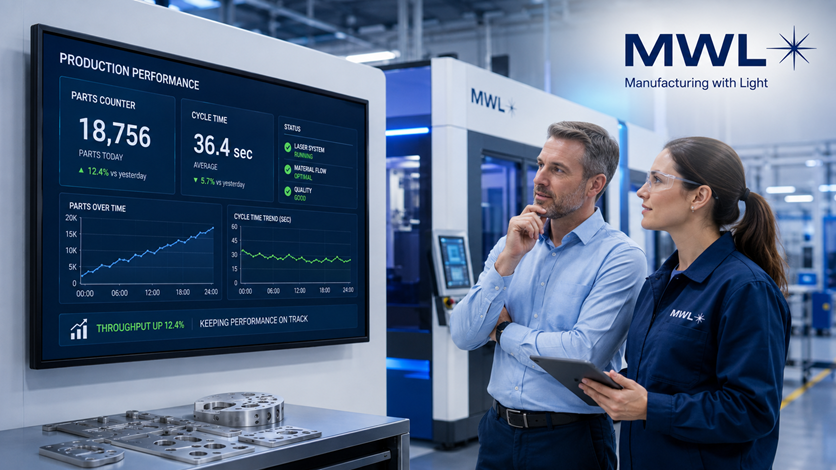
Why higher programmed speed does not always mean more good parts per hour
By William Kane | Manufacturing with Light (MWL)
Eventually, almost every successful production machine gets the same request:
“We need more parts per hour.”
With a laser cutting machine, the first reaction is often obvious: increase the feed rate.
If the process is running at 75 mm/s, perhaps we can run it at 100 mm/s. If 100 works, maybe we can push it to 125.
Sometimes that works.
But precision laser machines are rarely limited by a single speed number. Once a machine is pushed beyond the operating range where it was originally developed, limitations that were almost invisible can suddenly become important.
The better question is not:
How fast can we make the machine move?
It is:
How fast can we reliably make good parts?
Those are not necessarily the same thing.
Programmed Speed Is Not Average Speed
Consider a part containing long straight cuts, small holes, slots, radii, sharp corners, and short connecting moves.
The machine may be programmed to cut at 100 mm/s, but it cannot instantly accelerate to 100 mm/s every time it begins a feature. It must accelerate, follow the path, and then decelerate before the next change in direction.
On a sufficiently short feature, the machine may never reach the programmed cutting speed.
This is why increasing a program from 75 mm/s to 100 mm/s does not necessarily reduce cycle time by 25%.
The machine may spend much of the cycle accelerating and decelerating rather than traveling at its maximum commanded velocity.
For parts containing a lot of small geometry, acceleration, deceleration, jerk, trajectory planning, and corner behavior can matter just as much as maximum feed rate.
Small Features Happen Very Quickly
The numbers become interesting when we look at how quickly a precision laser machine moves through small geometry.
At 100 mm/s:
- A 1 mm feature takes only 10 milliseconds
- A 0.5 mm feature takes only 5 milliseconds
- The machine travels 0.1 mm in just 1 millisecond
That is not much time.
During those few milliseconds, several things may need to happen correctly.
The motion controller has to generate the trajectory. The servo system has to follow it. The mechanics have to respond. And depending on the process, the laser may need to turn on, turn off, change power, pulse, or perform another process event at a specific location.
As feature size decreases and processing speed increases, things that were once insignificant can become part of the process capability.
Controller performance, servo response, mechanical stiffness, feedback quality, and laser synchronization can all start to matter more.
Corners Can Become the Real Speed Limit
A machine cannot change direction instantaneously.
At a sharp corner, it must generally do some combination of three things:
- Slow down.
- Accept some amount of path deviation.
- Create a smoother transition through the geometry.
Slowing down protects accuracy but costs cycle time.
Allowing additional path error may improve speed but could change the finished part.
The interesting area is often what the motion controller can do between those two extremes.
Look-ahead, blending, splines, trajectory optimization, and path-smoothing algorithms can sometimes allow the machine to maintain a higher average velocity while remaining within an acceptable path tolerance.
That can be considerably more valuable than increasing the machine’s maximum speed.
For many precision parts, the machine capable of maintaining 80 mm/s through more of the geometry may outperform a machine advertised with a much higher maximum velocity that repeatedly slows down for every feature.
Faster Motion Can Expose Mechanical Problems
Increasing throughput often means asking the machine for more acceleration.
That is where the mechanical system can begin to show its limitations.
Higher acceleration can expose:
- Structural vibration
- Mechanical resonance
- Increased following error
- Motor or drive limitations
- Feedback limitations
- Longer settling times
- Flexibility in stages, frames, or tooling
A faster move is not particularly useful if the machine then spends additional time waiting for vibration to settle.
This is an important point when evaluating advanced motion-control features.
An algorithm that modifies the motion profile to reduce vibration may make an individual commanded move slightly longer. But if it eliminates settling time, improves accuracy, or prevents rejected parts, the complete machine cycle may still become faster.
Conversely, an advanced control feature does not automatically improve throughput simply because it sounds impressive.
The machine has to be measured.
Do Not Forget the Laser Process
Motion is only one side of the problem.
The laser process itself still has to work at the increased speed.
Depending on the application, increasing velocity may require changes to:
- Laser power
- Pulse parameters
- Assist gas
- Focus position
- Beam delivery
- Piercing strategy
- Process timing
There is little benefit in reducing machine cycle time if the result is increased dross, incomplete cuts, poor edge quality, dimensional error, or additional scrap.
That is why throughput optimization should involve both the motion-control engineer and the laser-process engineer whenever possible.
The fastest motion profile is not necessarily the fastest production process.
Laser Synchronization Becomes More Important as Speed Increases
Another issue that can become more noticeable at higher speeds is laser synchronization.
Imagine a laser command occurs several milliseconds later than intended.
At a low machine velocity, the resulting positional difference may be insignificant.
At a high velocity, the machine travels farther during that same period.
This is particularly important when processing small features or when laser events must occur at precise positions along a contour.
For demanding applications, it may be worth examining whether important laser events are being coordinated primarily by software timing or directly with machine position.
Position-based triggering and tightly coordinated motion/process events can provide another path toward maintaining consistency as machine speed increases.
Not every application requires this level of control.
But when a process that worked reliably at one speed begins changing as velocity increases, synchronization deserves a place on the troubleshooting list.
Before Upgrading Anything, Find the Bottleneck
This is probably the most important part of the exercise.
Before changing motors, drives, controllers, mechanics, or laser equipment, determine where the cycle time is actually being spent.
I would start with questions such as:
Is the laser process itself limiting the speed?
Can the material actually be cut faster while maintaining quality?
Is the machine spending significant time accelerating and decelerating?
If so, increasing maximum velocity may accomplish very little.
Is it slowing excessively around corners or small features?
Trajectory settings and path optimization may deserve investigation.
Is following error increasing?
The servo system, tuning, mechanics, or feedback may be reaching a limit.
Are vibration and settling becoming significant?
More aggressive motion may actually be hurting total cycle time.
Is laser synchronization changing as velocity increases?
Process timing that was insignificant at lower speed may have become important.
Are non-cutting operations consuming the cycle?
Piercing, loading, unloading, repositioning, gas changes, clamps, autofocus, inspection, or machine sequencing may offer larger opportunities than the cutting motion itself.
Has the machine simply reached its practical mechanical limit?
Sometimes that is the answer too.
Measure the Machine Before Trying to Improve It
A throughput improvement project should start with data.
If the control system makes the information available, useful measurements can include:
- Total cycle time
- Time spent actually processing
- Actual axis velocity
- Acceleration
- Following error
- Corner velocity
- Settling time
- Time spent piercing
- Non-processing motion
- Process delays
- Laser on/off timing
- Machine sequence delays
Breaking the cycle into pieces can be extremely revealing.
You may discover that increasing cutting speed by another 10% would save very little because cutting motion represents only part of the total cycle.
Or you may discover that one group of small features is responsible for a surprisingly large percentage of the production time.
Once the bottleneck is identified, the engineering problem becomes much easier to define.
The Controller May Have Capabilities You Are Not Using
Before replacing hardware, it is also worth understanding what the existing motion-control system can already do.
Modern motion controllers may include capabilities such as:
- Look-ahead trajectory planning
- Advanced blending
- Spline motion
- Path smoothing
- Feedforward
- Input shaping
- Frequency-response analysis
- Position-based triggering
- High-speed digital events
- Advanced servo tuning tools
These features will not magically make every machine faster.
But when properly applied to the right limitation, they may allow an existing machine to operate closer to its mechanical and process capability.
That can be considerably less expensive than replacing the motion platform—or the entire machine.
The Specification That Really Matters
Maximum velocity is an easy machine specification to publish.
Maximum acceleration is another.
But neither necessarily tells you how productive a precision laser machine will be on your actual part.
The specification I care about is harder to put in a brochure:
What is the shortest repeatable cycle time that still produces a good part?
That number includes the laser process, motion system, mechanics, controls, automation, and part geometry.
And ultimately, that is what production needs.
So when someone asks:
“Can we make this laser machine run faster?”
The answer should probably begin with another question:
“What is keeping us from making more good parts per hour?”
Find that first.
Then make the right thing faster.