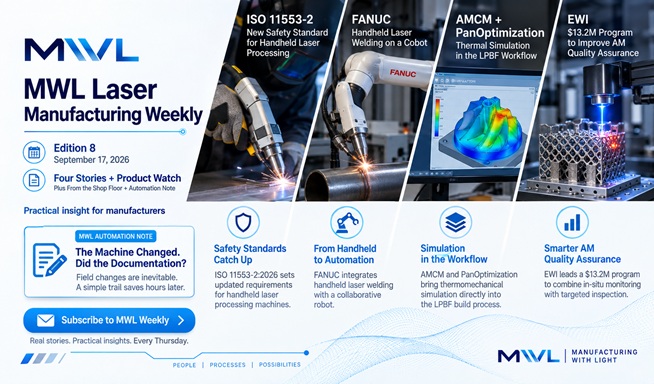
From Handheld Laser Safety to Smarter AM Quality
September 17, 2026
Handheld laser welding continues to move into mainstream manufacturing, while metal additive manufacturing is becoming more focused on prediction, inspection, and repeatability.
This week, a newly revised ISO standard addresses hand-held and hand-operated laser-processing machines. FANUC combines a manual laser-welding system with a collaborative robot. AMCM and PanOptimization bring thermal simulation into the LPBF build-preparation workflow. And EWI leads a major program intended to connect in-process monitoring with targeted post-build inspection.
We also return to MWL Product Watch with ESAB’s first handheld laser welder.
The Automation Note looks at a problem familiar to anyone who has supported machinery in the field:
The machine changed. Did the documentation?
IN THIS EDITION
- ISO Publishes a New Safety Standard for Handheld Laser Processing Machines
- FANUC Puts a Manual Laser-Welding System on a Cobot
- AMCM Brings Thermal Simulation Into the LPBF Build Workflow
- EWI Leads a $13.2 Million Program to Improve AM Quality Assurance
- MWL Product Watch — ESAB Dueler EHL 1500
- MWL Automation Note — The Machine Changed. Did the Documentation?
- From the Shop Floor — MWL Wants Your Stories
- Consultants’ Corner — Share Your Expertise With MWL Readers
1. A New Safety Standard Specifically for Handheld Laser Processing
The rapid growth of handheld laser welding and cleaning has created plenty of discussion about how these machines should be designed and used safely.
A newly revised international standard now targets this equipment category.
ISO 11553-2:2026, Safety of machinery — Laser processing machines — Part 2: Safety requirements for hand-held or hand-operated laser processing machines, was published on August 28, 2026. It is the second edition and replaces ISO 11553-2:2007.
The standard covers significant hazards associated with hand-held and hand-operated industrial laser-processing machines. It defines general design requirements and addresses hazard analysis, risk assessment, and protective measures.
The scope includes systems in which the processing head is held or guided by the operator, as well as certain systems in which the workpiece is moved manually relative to the laser beam.
The ISO description also states that these machines are intended for industrial use and are to be operated only by trained and authorized personnel.
Why It Matters
I think this is an important development for handheld laser welding.
One concern with the rapid growth of handheld systems has been that the technology is sometimes presented more like a conventional welding tool than a high-power laser-processing system.
ISO 11553-2:2026 does not suddenly create a new U.S. workplace law. It also does not replace the need to evaluate the ANSI Z136 series, OSHA requirements, state rules, consensus standards, and the employer’s responsibility to conduct an appropriate hazard assessment.
What it does provide is a current international machine-safety framework written specifically for the types of handheld and hand-operated laser-processing equipment entering factories today.
That matters to manufacturers, equipment suppliers, and integrators.
Source: ISO — ISO 11553-2:2026
2. FANUC Puts a Manual Laser-Welding System on a Cobot
This story caught my attention because it blurs the line between handheld laser welding and automated laser welding.
FANUC has developed a CRX laser-welding system that integrates what the company describes as a manual laser-welding machine with a collaborative robot.
In FANUC’s pipe-welding demonstration, the torch remains in a downward-facing position while the robot and pipe motion are coordinated. Laser power is adjusted automatically as robot speed changes.
FANUC also demonstrates welding and automated discoloration removal using the same laser source.
Programming uses dedicated laser-welding icons along with the CRX robot’s hand-guiding and tablet-based programming tools.
Why It Matters
I have been wondering whether handheld laser technology could become a lower-cost path into automated laser welding.
This looks like one possible answer.
A manual laser-welding system already packages the laser source, welding head, controls, and often wire feeding into a relatively compact unit.
Put that process on a cobot, and the same basic technology that made handheld welding easier to adopt becomes a building block for automation.
That does not mean any handheld welder can simply be fastened to a robot. Automation changes the risk assessment, safeguarding, controls, fixturing, process development, and integration requirements.
A collaborative robot does not make the laser beam collaborative.
But the direction is interesting.
Instead of starting with a traditional robotic laser-welding system and trying to simplify it, FANUC is approaching the problem from the other direction:
Take a laser-welding technology that has already become more accessible, then automate it.
For high-mix, lower-volume fabrication, that could become an important direction to watch.
Source: FANUC — High-Speed, Low-Distortion Pipe Welding
3. AMCM Moves Simulation Closer to the Actual LPBF Build
Metal additive manufacturing simulation is not new.
What is interesting here is where the simulation is being placed in the workflow.
AMCM announced an integration between PanOptimization’s PanX finite-element-analysis platform and EOSPRINT, bringing thermomechanical simulation into build preparation for EOS and AMCM metal additive systems.
According to the announcement, PanX reads an openjz file from EOSPRINT and extracts the build geometry, plate layout, and processing parameters needed for simulation.
Additional printer-specific information, such as processing time per layer, can be brought into PanX through the EOSPRINT API.
After simulation, optimized dwell times, compensated geometry, and optimized laser powers can be written back into the build file for implementation on the printer.
Why It Matters
We recently looked at distortion prediction in LPBF, and I think this development takes that conversation another step.
Simulation becomes much more useful when it is not a separate engineering exercise performed only on unusual builds.
The interesting part is the attempt to make it part of normal build preparation.
For large, expensive metal builds, local heat accumulation can contribute to distortion, residual stress, dimensional error, internal defects, partially sintered powder, and difficult depowdering.
Finding those problems after a long build is expensive.
If simulation becomes another normal step between preparing the part and pressing Build, its role changes considerably.
The goal moves from:
“Let’s simulate this part and see what might happen.”
to:
“Simulation is simply part of how we prepare the machine.”
That feels like an important step toward making metal additive manufacturing a more predictable production process.
Source: TCT Magazine — AMCM integrates PanOptimization into the AM build workflow
4. EWI Leads a $13.2 Million Program to Improve AM Quality Assurance
One of additive manufacturing’s persistent challenges is not making the part.
It is proving that the part is good.
EWI announced on September 8 that it had been selected by America Makes to lead the three-year, $13.2 million INSITE program — INtegrated System for In-situ Testing & Evaluation.
The program is focused on directed energy deposition for critical defense parts. Its goal is to combine information collected during manufacturing with a more targeted approach to post-build nondestructive inspection.
The proposed system will track process data, thermal and visual images, and eddy-current-array signals in real time.
AI and machine-learning tools will flag areas that may require closer examination and feed that information into a recommended post-build inspection plan. A qualified professional will review and approve each plan before inspection is carried out.
The team includes Boeing, GKN Aerospace, Lockheed Martin, Northrop Grumman, Norsk Titanium, Addiguru, Computational Tools, FormAlloy, and TRI Austin.
Why It Matters
This gets at one of the biggest questions surrounding production additive manufacturing:
How much inspection is enough?
Traditional inspection can become difficult and expensive as parts become larger, denser, and more geometrically complex.
At the same time, critical aerospace and defense components cannot rely on the assumption that a build probably went well.
INSITE’s approach is interesting because it connects what happened during the manufacturing process with what needs to be inspected afterward.
Instead of treating in-process monitoring and final inspection as separate activities, the goal is to let one inform the other.
That may be more useful than simply collecting more sensor data.
The better question is:
Can the manufacturing data tell us where we should look?
Source: EWI — EWI selected to lead the $13.2 million America Makes INSITE program
MWL PRODUCT WATCH
ESAB Dueler EHL 1500
This week, we return to MWL Product Watch after our one-week IMTS Watch.
This product may be more interesting because of who is selling it than because of its specifications.
ESAB has entered handheld laser welding with the Dueler EHL 1500, the company’s first laser-welding system.
The air-cooled unit combines a 1,500 W laser source, ESAB’s PreciDrive wire feeder, and touchscreen control in one package.
Output is adjustable from 150 to 1,500 W. ESAB positions the Dueler as a complement to MIG and TIG rather than a replacement for them and says it is available through authorized distributors and online sales channels.
Why It Caught My Attention
There are already plenty of handheld laser welders.
What makes this announcement interesting is that ESAB is a major welding company entering the market.
Handheld laser welding has largely grown from the laser side of manufacturing.
ESAB brings an established welding customer base, filler-metal knowledge, wire-feed technology, distributors, consumables, and support infrastructure.
That may help move handheld laser welding another step toward being viewed as another welding process available to fabricators.
And I think that is ultimately where handheld laser welding needs to go.
Not:
“Anyone can weld because the machine is easy to use.”
But:
“This is another welding process, with its own advantages, limitations, skills, safety requirements, and process knowledge.”
That distinction matters.
Source: ESAB — Dueler EHL 1500 handheld laser welder
MWL Product Watch highlights products and technologies that may be interesting to manufacturers. Inclusion is not an endorsement, and companies do not pay to be included.
MWL AUTOMATION NOTE
MWL AUTOMATION NOTE
The Machine Changed. Did the Documentation?
Machines change.
Usually not because somebody set out to redesign them.
A sensor fails and gets replaced with a different model. A customer asks for a small sequence change. A timer gets adjusted during startup. A technician adds an interlock. A contractor modifies the PLC to solve a production problem. An HMI screen gets updated.
Sometimes somebody makes a change at 2:00 in the morning because production is down and the only objective at that moment is:
Get the machine running.
And honestly, that is often the right priority.
The problem starts when the machine changes but the documentation does not.
The Drawings Say One Thing. The Machine Says Another.
Anyone who has worked around older equipment has seen this.
You open the electrical drawings and find a sensor that has not existed on the machine for five years.
The PLC program references an input that does not match the drawing.
The HMI calls something by one name, the PLC calls it something else, and the operator has a completely different name for it.
There are three software backups in a folder named:
Final
Final_New
and
Final_New_2
Nobody is completely sure which one is running.
Somewhere, there is probably a handwritten note taped inside the electrical cabinet that explains the whole thing.
Maybe.
I Have Been Part of the Problem
As a contractor, I have made plenty of field changes over the years.
Sometimes the customer wants a change. Sometimes I find something during startup that needs to be fixed. Sometimes the machine simply does not behave the way everyone expected when the original program was written.
You make the change, test it, get the machine running, and move on to the next problem.
You know the drawings should be updated. You know the software should be archived. You know somebody should record exactly what changed.
But commissioning schedules do not usually include a line item called:
“Spend three hours cleaning up everything we changed after the machine finally works.”
So the machine ships.
Or production starts.
Everybody promises to update the documentation later.
We all know how that usually goes.
The Problem Is Not That Machines Change
Machines should change.
Processes improve. Components become obsolete. Customers learn more about how they want to run the equipment. Software gets better. Maintenance finds problems that were not obvious during design.
The goal should not be to freeze the machine forever.
The goal should be to leave enough of a trail that the next person can understand what happened.
For most changes, that does not require a complicated documentation system.
Someone should be able to determine:
- What changed?
- Why was it changed?
- When was it changed?
- Who made the change?
- Which software revision contains it?
- Which drawings, manuals, or other documents were affected?
That alone would prevent a lot of future troubleshooting.
Small Changes Can Cause Big Confusion
Imagine someone replaces a normally open sensor with a normally closed version and changes the PLC logic to match.
The machine works perfectly.
Two years later, the sensor fails. Maintenance looks at the original drawing, orders the original sensor, installs it, and suddenly the machine behaves incorrectly.
The PLC is not necessarily wrong.
The drawing is not necessarily wrong for the machine as originally built.
The problem is that the two stopped describing the same machine.
That is where undocumented field changes become technical debt.
Do Not Solve This With More Paperwork
I do not think the answer is a complicated change-control system for every machine.
Make the process difficult enough, and nobody will use it.
A basic field-change record may be enough:
September 15 — Replaced clamp-open sensor with normally closed version because the original model was obsolete. PLC logic updated in software revision 2.14. Electrical drawing E-104, page 7 requires revision. Changed by BK.
Five lines.
Now somebody has somewhere to start.
That is much better than discovering the change three years later while tracing PLC logic with a meter in your hand.
Put the Change Log on the HMI
On many modern machines, adding a simple change-log entry form to the HMI would not be difficult.
The person making the change is already standing at the machine. Give them a screen where they can enter:
- What changed
- Why it changed
- Who made the change
- The software revision
- Any drawings or manuals that need to be updated
The HMI could automatically add the date, time, machine identification, and logged-in user. The entries could be stored locally and periodically exported or included with the machine backup.
This would not replace formal change control where formal change control is required.
It would simply make it easier to leave a useful trail.
The best documentation system is usually the one people will actually use.
If documenting a field change requires finding a form on a network drive, printing it, filling it out, and figuring out who should receive it, there is a good chance it will become another task everyone plans to complete later.
Put the form on the machine, keep it short, and make documenting the change part of finishing the job.
Of course, the HMI change log also needs to be included in the machine’s backup process. Otherwise, we have created another important record that can disappear when the HMI fails.
That would be a little too appropriate for an article about missing documentation.
And Yes, This Matters for AI Too
Another reason to get better at this is AI-assisted maintenance.
AI-assisted maintenance will depend heavily on machine context.
Imagine an AI tool eventually having access to the PLC program, electrical drawings, manuals, alarm history, maintenance records, software revisions, and HMI change log.
That could be extremely useful—but only if those sources describe the machine that actually exists.
If the drawing says one thing, the PLC says another, and the physical machine contains five years of undocumented field changes, the AI assistant will have exactly the same problem the technician has today:
Which information should I believe?
Good documentation is not only for the next maintenance technician.
Eventually, it may become part of the machine’s usable data.
Closing Thought
The machine you designed and the machine that exists five years later are rarely exactly the same machine.
That is normal.
The important question is:
Did the documentation change with it?
Eventually, someone who was not there when the change was made is going to open that cabinet, PLC program, HMI, or drawing and try to understand what happened.
Give them a fighting chance.
FROM THE SHOP FLOOR
MWL Still Wants Your Stories
Some of the best manufacturing lessons never appear in a press release.
They happen during startup, troubleshooting, process development, and production.
Maybe you solved a strange laser-processing problem. Maybe a fixture worked differently than expected. Maybe a small automation change prevented hours of downtime. Maybe something failed spectacularly and taught you more than the successful jobs did.
That is what From the Shop Floor is meant to capture.
If you work around laser cutting, welding, additive manufacturing, automation, optics, motion control, maintenance, or advanced manufacturing and have a lesson worth sharing, send it to MWL.
It does not have to be a polished article. Tell us what happened, what you learned, and what someone else might find useful.
If we receive enough contributions, From the Shop Floor can become a regular part of MWL Weekly.
CONSULTANTS’ CORNER
Are you an independent consultant working in laser materials processing, welding, optics, beam delivery, additive manufacturing, controls, automation, motion, safety, or another area related to advanced manufacturing?
MWL is looking for knowledgeable people willing to contribute practical articles.
The goal of Consultants’ Corner is simple: give readers useful information while giving experienced independent specialists an opportunity to show what they know.
Articles can include a link to the contributor’s website or professional profile.
If you have an idea, send MWL a message.
Closing Thought
There is an interesting connection among this week’s stories.
The technology is becoming more capable, but making the process dependable is becoming just as important as making it possible.
A handheld laser needs an appropriate safety framework.
A cobot needs a repeatable welding process and appropriate safeguarding.
A large additive build benefits from simulation before the first layer is printed.
Process-monitoring data becomes valuable when it helps guide inspection.
And a machine modification becomes much easier to support when somebody documents what actually changed.
Manufacturing with light keeps advancing.
But the real progress happens when the technology becomes something people can safely operate, consistently reproduce, troubleshoot, and maintain.
Manufacturing With Light
Practical reporting and commentary on laser manufacturing, automation, and advanced production.
#ManufacturingWithLight #LaserManufacturing #LaserWelding #AdditiveManufacturing #Automation #AdvancedManufacturing
WordPress website version
From Handheld Laser Safety to Smarter AM Quality
MWL Laser Manufacturing Weekly — Edition 8
September 17, 2026
Handheld laser welding continues to move into mainstream manufacturing, while metal additive manufacturing is becoming more focused on prediction, inspection, and repeatability.
This week, a newly revised ISO standard addresses hand-held and hand-operated laser-processing machines. FANUC combines a manual laser-welding system with a collaborative robot. AMCM and PanOptimization bring thermal simulation into the LPBF build-preparation workflow. And EWI leads a major program intended to connect in-process monitoring with targeted post-build inspection.
We also return to MWL Product Watch with ESAB’s first handheld laser welder.
The Automation Note looks at a problem familiar to anyone who has supported machinery in the field:
The machine changed. Did the documentation?
IN THIS EDITION
- ISO Publishes a New Safety Standard for Handheld Laser Processing Machines
- FANUC Puts a Manual Laser-Welding System on a Cobot
- AMCM Brings Thermal Simulation Into the LPBF Build Workflow
- EWI Leads a $13.2 Million Program to Improve AM Quality Assurance
- MWL Product Watch — ESAB Dueler EHL 1500
- MWL Automation Note — The Machine Changed. Did the Documentation?
- From the Shop Floor — MWL Wants Your Stories
- Consultants’ Corner — Share Your Expertise With MWL Readers
1. A New Safety Standard Specifically for Handheld Laser Processing
The rapid growth of handheld laser welding and cleaning has created plenty of discussion about how these machines should be designed and used safely.
Now there is a newly revised international standard aimed specifically at this category of equipment.
ISO 11553-2:2026, Safety of machinery — Laser processing machines — Part 2: Safety requirements for hand-held or hand-operated laser processing machines, was published on August 28, 2026. It is the second edition and replaces ISO 11553-2:2007.
The standard covers significant hazards associated with hand-held and hand-operated industrial laser-processing machines. It defines general design requirements and addresses hazard analysis, risk assessment, and protective measures.
The scope includes systems in which the processing head is held or guided by the operator, as well as certain systems in which the workpiece is moved manually relative to the laser beam.
The ISO description also states that these machines are intended for industrial use and are to be operated only by trained and authorized personnel.
Why It Matters
I think this is an important development for handheld laser welding.
One concern with the rapid growth of handheld systems has been that the technology is sometimes presented more like a conventional welding tool than a high-power laser-processing system.
ISO 11553-2:2026 does not suddenly create a new U.S. workplace law. It also does not replace the need to evaluate the ANSI Z136 series, OSHA requirements, state rules, consensus standards, and the employer’s responsibility to conduct an appropriate hazard assessment.
What it does provide is a current international machine-safety framework written specifically for the types of handheld and hand-operated laser-processing equipment entering factories today.
That matters to manufacturers, equipment suppliers, and integrators.
Source: ISO — ISO 11553-2:2026
2. FANUC Puts a Manual Laser-Welding System on a Cobot
This story caught my attention because it blurs the line between handheld laser welding and automated laser welding.
FANUC has developed a CRX laser-welding system that integrates what the company describes as a manual laser-welding machine with a collaborative robot.
In FANUC’s pipe-welding demonstration, the torch remains in a downward-facing position while the robot and pipe motion are coordinated. Laser power is adjusted automatically as robot speed changes.
FANUC also demonstrates welding and automated discoloration removal using the same laser source.
Programming uses dedicated laser-welding icons along with the CRX robot’s hand-guiding and tablet-based programming tools.
Why It Matters
I have been wondering whether handheld laser technology could become a lower-cost path into automated laser welding.
This looks like one possible answer.
A manual laser-welding system already packages the laser source, welding head, controls, and often wire feeding into a relatively compact unit.
Put that process on a cobot, and the same basic technology that made handheld welding easier to adopt becomes a building block for automation.
That does not mean any handheld welder can simply be fastened to a robot. Automation changes the risk assessment, safeguarding, controls, fixturing, process development, and integration requirements.
A collaborative robot does not make the laser beam collaborative.
But the direction is interesting.
Instead of starting with a traditional robotic laser-welding system and trying to simplify it, FANUC is approaching the problem from the other direction:
Take a laser-welding technology that has already become more accessible, then automate it.
For high-mix, lower-volume fabrication, that could become an important direction to watch.
Source: FANUC — High-Speed, Low-Distortion Pipe Welding
3. AMCM Moves Simulation Closer to the Actual LPBF Build
Metal additive manufacturing simulation is not new.
What is interesting here is where the simulation is being placed in the workflow.
AMCM announced an integration between PanOptimization’s PanX finite-element-analysis platform and EOSPRINT, bringing thermomechanical simulation into build preparation for EOS and AMCM metal additive systems.
According to the announcement, PanX reads an openjz file from EOSPRINT and extracts the build geometry, plate layout, and processing parameters needed for simulation.
Additional printer-specific information, such as processing time per layer, can be brought into PanX through the EOSPRINT API.
After simulation, optimized dwell times, compensated geometry, and optimized laser powers can be written back into the build file for implementation on the printer.
Why It Matters
We recently looked at distortion prediction in LPBF, and I think this development takes that conversation another step.
Simulation becomes much more useful when it is not a separate engineering exercise performed only on unusual builds.
The interesting part is the attempt to make it part of normal build preparation.
For large, expensive metal builds, local heat accumulation can contribute to distortion, residual stress, dimensional error, internal defects, partially sintered powder, and difficult depowdering.
Finding those problems after a long build is expensive.
If simulation becomes another normal step between preparing the part and pressing Build, its role changes considerably.
The goal moves from:
“Let’s simulate this part and see what might happen.”
to:
“Simulation is simply part of how we prepare the machine.”
That feels like an important step toward making metal additive manufacturing a more predictable production process.
Source: TCT Magazine — AMCM integrates PanOptimization into the AM build workflow
4. EWI Leads a $13.2 Million Program to Improve AM Quality Assurance
One of additive manufacturing’s persistent challenges is not making the part.
It is proving that the part is good.
EWI announced on September 8 that it had been selected by America Makes to lead the three-year, $13.2 million INSITE program — INtegrated System for In-situ Testing & Evaluation.
The program is focused on directed energy deposition for critical defense parts. Its goal is to combine information collected during manufacturing with a more targeted approach to post-build nondestructive inspection.
The proposed system will track process data, thermal and visual images, and eddy-current-array signals in real time.
AI and machine-learning tools will flag areas that may require closer examination and feed that information into a recommended post-build inspection plan. A qualified professional will review and approve each plan before inspection is carried out.
The team includes Boeing, GKN Aerospace, Lockheed Martin, Northrop Grumman, Norsk Titanium, Addiguru, Computational Tools, FormAlloy, and TRI Austin.
Why It Matters
This gets at one of the biggest questions surrounding production additive manufacturing:
How much inspection is enough?
Traditional inspection can become difficult and expensive as parts become larger, denser, and more geometrically complex.
At the same time, critical aerospace and defense components cannot rely on the assumption that a build probably went well.
INSITE’s approach is interesting because it connects what happened during the manufacturing process with what needs to be inspected afterward.
Instead of treating in-process monitoring and final inspection as separate activities, the goal is to let one inform the other.
That may be more useful than simply collecting more sensor data.
The better question is:
Can the manufacturing data tell us where we should look?
Source: EWI — EWI selected to lead the $13.2 million America Makes INSITE program
MWL PRODUCT WATCH
ESAB Dueler EHL 1500
This week, we return to MWL Product Watch after our one-week IMTS Watch.
This product may be more interesting because of who is selling it than because of its specifications.
ESAB has entered handheld laser welding with the Dueler EHL 1500, the company’s first laser-welding system.
The air-cooled unit combines a 1,500 W laser source, ESAB’s PreciDrive wire feeder, and touchscreen control in one package.
Output is adjustable from 150 to 1,500 W. ESAB positions the Dueler as a complement to MIG and TIG rather than a replacement for them and says it is available through authorized distributors and online sales channels.
Why It Caught My Attention
There are already plenty of handheld laser welders.
What makes this announcement interesting is that ESAB is a major welding company entering the market.
Handheld laser welding has largely grown from the laser side of manufacturing.
ESAB brings an established welding customer base, filler-metal knowledge, wire-feed technology, distributors, consumables, and support infrastructure.
That may help move handheld laser welding another step toward being viewed as another welding process available to fabricators.
And I think that is ultimately where handheld laser welding needs to go.
Not:
“Anyone can weld because the machine is easy to use.”
But:
“This is another welding process, with its own advantages, limitations, skills, safety requirements, and process knowledge.”
That distinction matters.
Source: ESAB — Dueler EHL 1500 handheld laser welder
MWL Product Watch highlights products and technologies that may be interesting to manufacturers. Inclusion is not an endorsement, and companies do not pay to be included.
MWL AUTOMATION NOTE
The Machine Changed. Did the Documentation?
Machines change.
Usually not because somebody set out to redesign them.
A sensor fails and gets replaced with a different model. A customer asks for a small sequence change. A timer gets adjusted during startup. A technician adds an interlock. A contractor modifies the PLC to solve a production problem. An HMI screen gets updated.
Sometimes somebody makes a change at 2:00 in the morning because production is down and the only objective at that moment is:
Get the machine running.
And honestly, that is often the right priority.
The problem starts when the machine changes but the documentation does not.
The Drawings Say One Thing. The Machine Says Another.
Anyone who has worked around older equipment has seen this.
You open the electrical drawings and find a sensor that has not existed on the machine for five years.
The PLC program references an input that does not match the drawing.
The HMI calls something by one name, the PLC calls it something else, and the operator has a completely different name for it.
There are three software backups in a folder named:
Final
Final_New
and
Final_New_2
Nobody is completely sure which one is running.
Somewhere, there is probably a handwritten note taped inside the electrical cabinet that explains the whole thing.
Maybe.
I Have Been Part of the Problem
As a contractor, I have made plenty of field changes over the years.
Sometimes the customer wants a change. Sometimes I find something during startup that needs to be fixed. Sometimes the machine simply does not behave the way everyone expected when the original program was written.
You make the change, test it, get the machine running, and move on to the next problem.
You know the drawings should be updated. You know the software should be archived. You know somebody should record exactly what changed.
But commissioning schedules do not usually include a line item called:
“Spend three hours cleaning up everything we changed after the machine finally works.”
So the machine ships.
Or production starts.
Everybody promises to update the documentation later.
We all know how that usually goes.
The Problem Is Not That Machines Change
Machines should change.
Processes improve. Components become obsolete. Customers learn more about how they want to run the equipment. Software gets better. Maintenance finds problems that were not obvious during design.
The goal should not be to freeze the machine forever.
The goal should be to leave enough of a trail that the next person can understand what happened.
For most changes, that does not require a complicated documentation system.
Someone should be able to determine:
- What changed?
- Why was it changed?
- When was it changed?
- Who made the change?
- Which software revision contains it?
- Which drawings, manuals, or other documents were affected?
That alone would prevent a lot of future troubleshooting.
Small Changes Can Cause Big Confusion
Imagine someone replaces a normally open sensor with a normally closed version and changes the PLC logic to match.
The machine works perfectly.
Two years later, the sensor fails. Maintenance looks at the original drawing, orders the original sensor, installs it, and suddenly the machine behaves incorrectly.
The PLC is not necessarily wrong.
The drawing is not necessarily wrong for the machine as originally built.
The problem is that the two stopped describing the same machine.
That is where undocumented field changes become technical debt.
Do Not Solve This With More Paperwork
I do not think the answer is a complicated change-control system for every machine.
Make the process difficult enough, and nobody will use it.
A basic field-change record may be enough:
September 15 — Replaced clamp-open sensor with normally closed version because the original model was obsolete. PLC logic updated in software revision 2.14. Electrical drawing E-104, page 7 requires revision. Changed by BK.
Five lines.
Now somebody has somewhere to start.
That is much better than discovering the change three years later while tracing PLC logic with a meter in your hand.
And Yes, This Matters for AI Too
There is another reason to get better at this.
AI-assisted maintenance will depend heavily on machine context.
Imagine an AI tool eventually having access to the PLC program, electrical drawings, manuals, alarm history, maintenance records, and spare-parts information.
That could be extremely useful—but only if those sources describe the machine that actually exists.
If the drawing says one thing, the PLC says another, and the physical machine contains five years of undocumented field changes, the AI assistant will have exactly the same problem the technician has today:
Which information should I believe?
Good documentation is not only for the next maintenance technician.
Eventually, it may become part of the machine’s usable data.
Closing Thought
The machine you designed and the machine that exists five years later are rarely exactly the same machine.
That is normal.
The important question is:
Did the documentation change with it?
Eventually, someone who was not there when the change was made is going to open that cabinet, PLC program, or drawing and try to understand what happened.
Give them a fighting chance.
FROM THE SHOP FLOOR
MWL Still Wants Your Stories
Some of the best manufacturing lessons never appear in a press release.
They happen during startup, troubleshooting, process development, and production.
Maybe you solved a strange laser-processing problem. Maybe a fixture worked differently than expected. Maybe a small automation change prevented hours of downtime. Maybe something failed spectacularly and taught you more than the successful jobs did.
That is what From the Shop Floor is meant to capture.
If you work around laser cutting, welding, additive manufacturing, automation, optics, motion control, maintenance, or advanced manufacturing and have a lesson worth sharing, send it to MWL.
It does not have to be a polished article. Tell us what happened, what you learned, and what someone else might find useful.
If we receive enough contributions, From the Shop Floor can become a regular part of MWL Weekly.
CONSULTANTS’ CORNER
Are you an independent consultant working in laser materials processing, welding, optics, beam delivery, additive manufacturing, controls, automation, motion, safety, or another area related to advanced manufacturing?
MWL is looking for knowledgeable people willing to contribute practical articles.
The goal of Consultants’ Corner is simple: give readers useful information while giving experienced independent specialists an opportunity to show what they know.
Articles can include a link to the contributor’s website or professional profile.
If you have an idea, send MWL a message.
Closing Thought
There is an interesting connection among this week’s stories.
The technology is becoming more capable, but making the process dependable is becoming just as important as making it possible.
A handheld laser needs an appropriate safety framework.
A cobot needs a repeatable welding process and appropriate safeguarding.
A large additive build benefits from simulation before the first layer is printed.
Process-monitoring data becomes valuable when it helps guide inspection.
And a machine modification becomes much easier to support when somebody documents what actually changed.
Manufacturing with light keeps advancing.
But the real progress happens when the technology becomes something people can safely operate, consistently reproduce, troubleshoot, and maintain.
Manufacturing With Light
Practical reporting and commentary on laser manufacturing, automation, and advanced production.
#ManufacturingWithLight #LaserManufacturing #LaserWelding #AdditiveManufacturing #Automation #AdvancedManufacturing