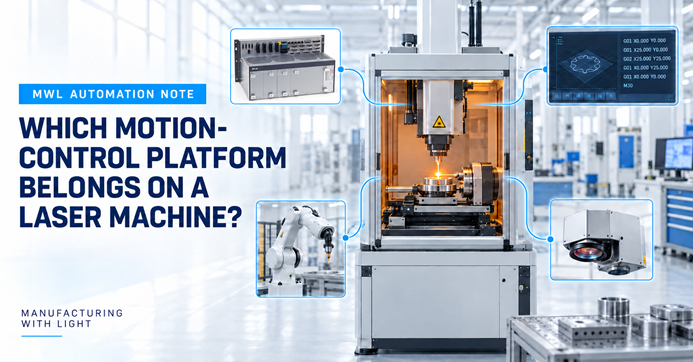
When someone says a machine has “motion control,” that does not tell you very much.
A PLC controlling two positioning axes has motion control.
A CNC following thousands of G-code blocks has motion control.
A six-axis robot carrying a laser head has motion control.
A galvanometer scanner moving a beam across a small field has motion control.
They can all move a laser relative to a part, but they solve very different problems.
Over the years, I have worked with several of these approaches. One lesson I have learned is that it is easy to select the control platform before completely understanding what the laser process will require.
Sometimes the platform is chosen because the customer already uses it.
Sometimes it is the system the machine builder normally installs.
Sometimes it is simply the platform the programmer knows best.
Those are legitimate considerations. Familiarity, support, standardization, and spare-parts availability matter.
But the motion platform is also part of the laser process.
If it cannot maintain the required path, store and execute the part program, or synchronize the laser with motion, familiarity will not rescue the application.
A PLC Can Be the Right Answer
Modern PLCs can do far more motion control than they could years ago.
For a machine that moves between positions, operates fixtures, loads parts, or performs relatively simple coordinated motion, PLC-based motion can be a very good choice.
The advantages are familiar:
- One platform for machine logic, safety, I/O, and motion
- Strong diagnostic and networking capabilities
- Broad support from integrators and plant personnel
- Easier integration with the rest of the production line
- One programming environment for most of the machine
For a straightforward laser station with a few axes and modest path requirements, a PLC may be all you need.
I am not suggesting that every laser machine needs a specialized motion controller.
But I have also learned that using a PLC for a CNC-style laser process can uncover limitations that aren’t obvious at the start of the project.
When the G-Code Program Became Too Large
On one system, I used a PLC for laser processing and built a G-code interpreter into the PLC software.
The interpreter parsed the G-code and converted it into motion commands. Conceptually, it worked.
The problem was memory.
Small programs were manageable. As the CNC programs became larger, the available memory and practical file-handling capability became a limitation.
The PLC could control the machine, but it was not designed to behave like a full CNC that routinely stores and processes large part programs.
That experience taught me that saying a PLC can interpret G-code is not the same as saying it provides a complete CNC environment.
You also have to ask:
- How large can the part program become?
- Where will it be stored?
- Can the controller read the program incrementally?
- How easily can files be transferred and managed?
- What happens when a program contains thousands—or hundreds of thousands—of motion blocks?
- Can an operator select and run programs without involving the controls engineer?
- How will programs, offsets, and revisions be backed up?
Many PLCs have removable storage, but access to it may be limited or designed around specific built-in functions rather than general-purpose CNC program management.
A PLC may have enough motion capability to execute the path while still lacking the memory or file-handling structure needed to manage the application well.
That distinction matters.
Synchronizing the Laser With Motion
Another issue is synchronizing the laser process with the motion.
For a simple application, the controls program may command a move and turn the laser on or off through ordinary PLC logic.
At moderate speeds and with generous tolerances, that may be perfectly adequate.
But as feature sizes become smaller and processing speeds increase, timing becomes part of the geometry.
If the laser turns on a few milliseconds late, the start of the feature moves.
If it turns off late, the feature becomes longer.
If laser power is supposed to change with velocity but the motion and laser commands are not using the same time or position reference, corners, acceleration zones, and small features can receive the wrong amount of energy.
At that point, the laser should not simply be treated as another output.
The application may require:
- Position-synchronized laser triggering
- Power commands coordinated with velocity
- Deterministic high-speed outputs
- Pulse generation tied to distance traveled
- Controlled behavior during acceleration and deceleration
- Defined laser response during feed holds and interruptions
- Synchronization among motion, gas, wire, powder, or other process devices
Some PLC motion systems provide these capabilities.
Some do not.
The important question is not whether the controller has a high-speed output.
The question is whether the laser command is truly synchronized with the executed trajectory.
That is a very different requirement from turning on a valve after an axis reaches position.
CNC Platforms
CNC systems are a natural fit for many laser-cutting applications.
They are built around toolpaths, coordinate systems, G-code, feed rates, interpolation, offsets, and continuous contouring.
Operators and process engineers may already understand the programming model. CAD/CAM software can generate programs using a familiar workflow, and the CNC can coordinate linear and rotary axes while maintaining the programmed path speed.
For sheet, tube, and profile cutting, that is a strong foundation.
A CNC is especially attractive when the part program should remain separate from the underlying machine logic.
The controls programmer builds and validates the machine.
The part programmer creates or modifies the toolpath.
Those jobs should not always be the same.
The limitation is that some CNC platforms can be difficult to customize outside their intended machine architecture.
Integrating unusual process devices, special kinematics, vision corrections, custom laser controls, or experimental processes may require more effort than expected.
A CNC can be excellent at running the type of machine it was designed to run.
The question is how well it handles the machine you are actually trying to build.
Dedicated and Open Motion Controllers
Dedicated motion controllers are often used when path performance, process synchronization, and customization are central to the machine.
These platforms may provide:
- Deterministic multi-axis control
- Advanced trajectory generation
- Continuous contouring
- Flexible kinematics
- Position-based triggering
- Laser-power synchronization
- High-speed registration
- Motion simulation and tuning tools
- Application programming interfaces
- Support for custom HMI and database applications
That makes them attractive for precision cutting, welding, drilling, cladding, directed energy deposition, cold spray, medical tube processing, and other applications where motion and process control are closely connected.
This is also where I think OEMs should consider the value of an open motion-control platform.
By “open,” I do not necessarily mean open-source.
I mean a controller that gives the machine builder access to the motion program, machine sequence, communications, process data, file handling, HMI interfaces, and software-development tools needed to build a complete product around it.
One Platform Across Several Machine Types
An OEM may not want a different control architecture for every machine it builds.
The company may develop laser cutters, welding systems, cladding machines, additive systems, or custom machines that combine several processes.
In that situation, an open motion controller may provide a common foundation.
The OEM can develop modular, validated software for:
- Axis and drive control
- Homing and machine setup
- Safety and process interlocks
- Laser communication
- Gas, wire, and powder delivery
- Manual operation
- Alarms and diagnostics
- Program and recipe management
- G-code execution
- HMI communication
- Data collection
- Recovery and maintenance functions
Those modules can then be reused and extended across a family of machines.
A two-axis welding machine may use only part of the platform.
A tube cutter may add rotary kinematics and G-code.
A cladding or cold-spray system may add powder control and multi-axis path planning.
A more advanced machine may add vision, process monitoring, databases, or a custom PC application through the controller’s software interface.
The benefit isn’t limited to motion performance.
It is the ability to build and maintain a common machine-control architecture across several applications.
That can be valuable for an OEM trying to standardize its software without limiting every future machine to the capabilities of a basic PLC or a narrowly configured CNC.
Openness Does Not Eliminate the Engineering
An open controller is not automatically the correct answer.
It may require the OEM to develop more of the machine structure itself.
A traditional CNC or PLC may include more familiar tools, established operator workflows, and a larger pool of available programmers.
With an open motion platform, the machine builder may be responsible for creating:
- The machine-state model
- Program-management tools
- The operator interface
- Alarm and diagnostic structures
- Security and user access
- Backup and restoration procedures
- Software revision control
- Service and commissioning tools
That is additional work.
But for an OEM building multiple machines, it can become reusable intellectual property rather than engineering that must be repeated for every project.
The first machine may require more development.
The fifth machine should not.
Robots and Scanners Still Have Their Place
An open motion controller will not replace every other platform.
Industrial robots remain a strong choice when the process requires a large working envelope, flexible orientation, or access to complex three-dimensional parts.
Galvanometer scanners remain the better choice when extremely fast beam positioning is required over a limited field.
Hybrid systems may combine scanners, Cartesian stages, rotary axes, robots, or positioners.
The goal is not to force every application onto the same hardware.
The goal is to determine where a common control architecture provides value—and where a different motion technology is clearly better suited to the process.
Start With the Process—and the Product Roadmap
For a single machine, I would start by asking:
- What path accuracy is required?
- What speeds and accelerations are needed?
- How large will the part programs become?
- How many axes must move together?
- Does laser output need to follow position or velocity?
- Are special kinematics required?
- Will programs come from CAD/CAM, recipes, or an operator?
- How will the system be maintained?
For an OEM, I would add another group of questions:
- Will this platform support the next machine as well as this one?
- Can validated software modules be reused?
- Can the OEM create its own HMI and machine identity?
- Can the system be private-labeled?
- Can it support cutting, welding, cladding, or additive processes?
- Does it provide APIs for vision, databases, and future process-monitoring tools?
- Will the OEM control its product roadmap, or will the controller define it?
Those questions may justify looking beyond the simplest platform that can operate the first machine.
Closing Thought
No single motion-control platform is best for laser processing.
A simple PLC with motion can be the right answer for some applications.
A CNC may be the natural choice for a conventional cutting machine.
A robot or scanner may be essential for a particular geometry or processing speed.
But when an OEM wants to develop modular code, build several types of laser-processing machines, and maintain one control architecture across a product family, an open motion controller deserves serious consideration.
The platform should not be selected simply because it can move the axes.
It should be selected because it can manage the path, synchronize the laser, support the size and structure of the part programs, and give the OEM room to build the next machine, not just the one currently on the drawing board.