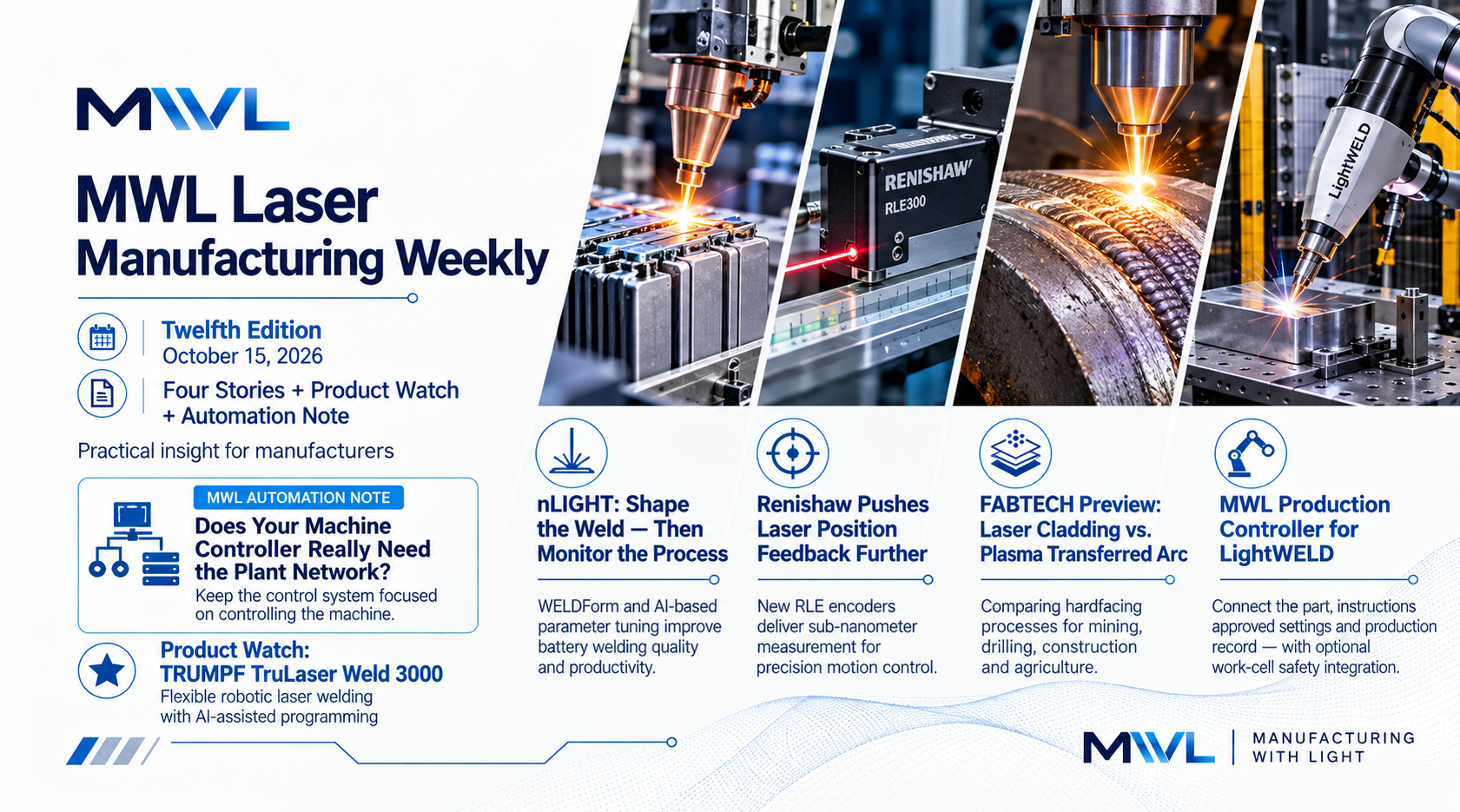
FABTECH 2026 opens next week in Las Vegas, and this week’s edition has a bit of a FABTECH-preview flavor—but I didn’t want the entire newsletter to become a list of machines sitting in booths.
Instead, we’re looking at some of the engineering surrounding laser manufacturing.
We start with nLIGHT’s work combining beam control and process monitoring for laser welding. Renishaw has introduced a new generation of interferometric laser encoders that pushes position measurement even further. At FABTECH, a technical session will compare laser cladding with plasma transferred arc welding for heavy-wear applications.
And in Story #4, I want to change gears and talk about something MWL is working on: a customizable LightWELD Production Controller for handheld and robotic production, with optional work-cell safety integration when the application becomes more complicated.
Product Watch looks at TRUMPF’s new TruLaser Weld 3000, and this week’s Automation Note asks a simple question that machine builders may want to consider before adding another Ethernet cable:
Does your machine controller really need the plant network?
In This Edition
- nLIGHT: Shape the Weld — Then Monitor the Process
- Renishaw Pushes Laser Position Feedback Toward the Sub-Nanometer Level
- FABTECH Preview: Laser Cladding vs. Plasma Transferred Arc Hardfacing
- MWL Is Developing a Production Controller for LightWELD
- MWL Product Watch: TRUMPF TruLaser Weld 3000
- MWL Automation Note: Does Your Machine Controller Really Need the Plant Network?
1. nLIGHT: Shape the Weld — Then Monitor the Process
This isn’t a brand-new product announcement, but it is technology I think is worth revisiting because it shows where industrial laser welding may be heading.
nLIGHT’s WELDForm combines spatial and high-speed temporal control of laser energy to influence what happens in the melt pool. The company reports that the approach can reduce spatter and porosity, improve penetration consistency, and change the shape of the weld cross-section.
Alongside that is the monitoring side of the process.
nLIGHT’s Automatic Parameter Tuning, or APT, uses its Plasmo process-monitoring technology and AI to automate the development of settings used to detect welding defects. Its ProcessGUARD technology integrates process monitoring more directly with the laser system. nLIGHT
Why It Matters
What caught my attention isn’t simply the AI portion.
It addresses two problems.
The first is making the physical welding process more stable.
The second is determining whether something went wrong while the weld was being made.
Those are related, but they aren’t the same problem.
A manufacturer ultimately wants both.
You want the laser process engineered so defects are less likely to occur in the first place. But when something does change—part fit-up, contamination, focus, laser power, shielding gas, or another process variable—you also want enough information to recognize it.
That starts moving laser welding from:
Set the parameters → Make the weld → Inspect it later
toward:
Control the process → Monitor the process → Record what happened
That’s an important direction for high-volume laser manufacturing.
Source: nLIGHT — E-mobility Requires New Innovations for High-Productivity Laser Welding
Back to Index
2. Renishaw Pushes Laser Position Feedback Toward the Sub-Nanometer Level
We talk a lot about laser power, spot size, beam quality, scanners, and process parameters.
But precision laser manufacturing eventually comes back to another basic question:
Do we actually know where the part is?
Renishaw has introduced a new family of RLE interferometric laser encoder systems: the RLE100, RLE200, and RLE300.
The RLE100 is aimed at in-air applications, while the RLE200 targets higher-performance applications including vacuum environments. At the high end, Renishaw says the RLE300 can achieve measurement uncertainty down to ±0.2 nanometers.
The new family also extends the linear operating range to 2 meters and adds improved diagnostics and condition monitoring. Its modular design allows laser units, detector heads, and fiber assemblies to be replaced independently, which should also make service and maintenance easier. Renishaw
Why It Matters
I want to be careful with the terminology here.
A laser encoder capable of ±0.2 nm measurement uncertainty does not mean the complete machine will position to ±0.2 nm.
The mechanics, structure, bearings, thermal environment, servo system, vibration, and many other factors still matter.
But measurement is where the control system gets its information.
As laser processes become smaller and more precise, motion-control performance can’t be separated from position feedback.
I’ve spent a lot of time around precision motion systems, and one of the recurring lessons is that you can’t control what you can’t measure well.
There is another feature here I like from a machine-building perspective:
diagnostics and maintainability.
The highest-resolution encoder in the world isn’t much fun at 2:00 in the morning if nobody can determine why the position feedback disappeared.
Precision matters.
So does maintaining the machine that provides it.
Source: Renishaw — Next-Generation RLE Interferometric Laser Encoders
3. FABTECH Preview: Laser Cladding vs. Plasma Transferred Arc Hardfacing
FABTECH 2026 runs October 21–23 in Las Vegas, and one of the technical sessions that caught my attention has very little to do with sheet-metal cutting.
On October 23, Fusion Technologies will present “Plasma Transfer Arc Welding and Laser Cladding for Hard Surfacing.”
The discussion focuses on wear-resistant surfaces used in industries including drilling, mining, construction, and agriculture, with particular attention to metal-matrix composites incorporating materials such as tungsten carbide powders and diamonds. Fabtech Expo
Why It Matters
This is the kind of laser-manufacturing comparison I find useful because the answer probably isn’t:
Laser is newer, therefore laser is better.
Both plasma transferred arc welding and laser cladding can produce metallurgically bonded wear-resistant overlays.
Research comparing hardfacing processes has found that laser cladding can provide lower dilution than many conventional weld-hardfacing methods, while the appropriate process still depends heavily on coating requirements, substrate, material system, wear mechanism, geometry, and economics. A 2023 experimental comparison of laser cladding and powder plasma transferred arc welding using a NiSiB + WC composite, for example, found similar clad microhardness but better abrasive-wear resistance from the plasma-transferred-arc sample under the conditions tested. MDPI
That’s exactly why I think this FABTECH session is worth watching.
The manufacturing question isn’t:
Which process sounds more advanced?
It’s:
Which process creates the surface the component actually needs at a cost that makes sense?
For some high-value parts, laser cladding’s tighter energy delivery and process control may be very attractive.
For other heavy-wear applications requiring substantial deposition, another process may make more economic sense.
I’ll be interested to see how the presenters draw that line.
Source: FABTECH — Advanced Laser Manufacturing Applications
4. MWL Is Developing a Production Controller for LightWELD
I come from a background of building automated laser systems for production.
Because of that, when I look at LightWELD, I tend to look beyond the weld itself.
A production laser machine usually has quite a bit surrounding the laser: recipes, part numbers, operator instructions, diagnostics, production counts, machine status, traceability, communications, and sometimes a fairly substantial safety system.
As LightWELD moves beyond a standalone handheld tool and deeper into production, I think there is an opportunity to add that surrounding infrastructure.
And that is something Manufacturing With Light is starting to work on.
Start With the Part
I don’t want the first version to become another giant MES package.
The core idea is much simpler:
Part → Instructions → Approved Settings → Verify → Count → Record
The manufacturing part would be associated with its approved LightWELD settings.
Before production starts, the MWL controller could verify the actual LightWELD parameters against the parameters approved for that part.
During production, it could maintain a part count and retain the relevant setup and available machine information associated with the run.
Records could remain local or be made available to a customer’s production system through a database connection or an industrial interface such as OPC.
LightWELD already provides Ethernet connectivity for access to advanced parameter settings, so there is a foundation for this type of supervisory production interface. IPG Photonics Corporation
It Isn’t Just for Cobots
LightWELD is increasingly being paired with collaborative robots.
IPG now offers its own ABB GoFa-based LightWELD Cobot System specifically for repetitive work and high-mix, low-volume fabrication. THG Automation is also integrating LightWELD with Universal Robots and its own graphical programming environment. IPG Photonics Corporation
But I don’t think every LightWELD part belongs on a robot.
IPG itself has published an interesting example from Mass Precision. The company already had robotic laser welding capability, but low production quantities and fixturing requirements made the robotic approach prohibitive for one project. Handheld LightWELD was the more practical solution. LightWELD
That’s important.
For five or ten expensive parts, programming and proving out a robot could take longer than actually welding them.
So for handheld production, the MWL controller could also become an electronic work-instruction station.
Select a part and the operator could see its revision, approved weld settings, setup notes, weld sequence, photographs showing weld locations or fixture orientation, target quantity, and completed quantity.
For low-volume or high-value manufacturing, connecting the operator to the right information may be more valuable than automating the motion.
Add Work-Cell Safety When the Cell Needs It
There is another option I now want to incorporate into the concept.
As a simple LightWELD workstation grows into a robotic production cell, the safety system can become considerably more complicated.
You may now have multiple access doors, several emergency stops, a robot or cobot, positioners, laser-enable circuits, and other safeguards.
At that point, I don’t want the solution to become:
just wire everything into a long safety loop and hope somebody can troubleshoot it later.
ISO/TR 24119 specifically addresses fault masking that can occur when multiple guard-interlocking devices with potential-free contacts are connected in series. ISO 14119:2024 also makes clear that the interlocking device is only part of the overall safety-related control system. ISO
For more complicated applications, MWL could therefore optionally integrate a properly engineered safety-rated controller or safety subsystem into the production controller.
The safety-rated system would own the actual safety functions.
The MWL HMI could provide useful diagnostics so that instead of seeing:
SAFETY NOT OK
maintenance could determine which door, E-stop, robot interface, or other monitored safety function is preventing the cell from becoming ready.
That distinction matters.
The HMI does not make the machine safe.
The safety architecture, safety-rated hardware, risk assessment, and validation do that.
The HMI should help people understand what that system is telling them.
Related MWL article: When a Safety Loop Can Hide a Fault
Why Customization Matters
I don’t think MWL’s opportunity is simply to build features that aren’t in the standard LightWELD interface today.
Manufacturer interfaces change.
What MWL can do differently is customize the production layer around how the customer actually makes parts.
One customer may identify work by part number.
Another may scan a traveler or barcode.
One may need photographs and detailed operator instructions.
Another may just want recipe verification and counts.
One may want SQL.
Another may want OPC.
And a system integrator may want the whole application carrying its own company name and branding.
That creates another direction for the MWL controller:
private-label versions for LightWELD distributors and system integrators.
An integrator could provide the LightWELD, cobot, enclosure, fixtures, controls, and safety system while using an MWL-based production interface customized and branded for that customer’s cell.
The concept becomes:
Standard core. Customer-specific workflow.
Or for an integrator:
Your cell. Your brand. Your customer’s process.
One Important Limitation
Parameter verification is not weld inspection.
Knowing that the approved LightWELD settings were loaded doesn’t prove that the resulting weld met every quality requirement.
Depending on the application, qualification, visual inspection, process monitoring, destructive testing, metallurgical evaluation, or other controls may still be required.
The initial MWL controller is about process verification, production control, diagnostics, and traceability.
The goal is to connect:
the part → the instructions → the approved settings → the actual settings → the production record
and, where the application calls for it:
the safety system → useful diagnostics
That is the production gap MWL is starting to explore.
Back to Index
MWL Product Watch
TRUMPF TruLaser Weld 3000
With FABTECH opening next week, this week’s Product Watch goes to a machine TRUMPF is introducing at the show: the TruLaser Weld 3000.
The new robotic welding cell is aimed particularly at manufacturers producing smaller batches and a wide variety of sheet-metal assemblies.
One of the more interesting features is TRUMPF’s emphasis on reducing the effort required to program automated laser welding.
Its TeachLine Touch function lets operators correct weld points at the machine, and TRUMPF says programming and setup time can be reduced by as much as 50 percent. An optional TeachLine AI feature detects deviations in weld locations and adjusts the robot path to the actual component geometry.
TRUMPF has also developed welding optics approximately 40 percent smaller than its previous design, intended to improve access to deeper or difficult-to-reach areas.
The cell uses a KUKA Iontec robot, offers 3 or 4 kW laser configurations, and occupies roughly 24 percent less floor space than the smallest TruLaser Weld 5000 configuration. TRUMPF
Why It Caught My Attention
We’ve spent a lot of time talking about how capable laser welding can be.
But if it takes too much engineering time to fixture, program, and prove out each new part, laser welding becomes harder to justify in a high-mix environment.
That’s why I think the interesting part of the TruLaser Weld 3000 isn’t just another laser welding cell.
It’s TRUMPF’s attempt to reduce the programming and setup burden surrounding the process.
That may be just as important as making the weld faster.
Source: TRUMPF — FABTECH 2026: TruLaser Weld 3000
Have a Product MWL Should Look At?
If your company manufactures something related to laser materials processing, additive manufacturing, automation, motion control, laser safety, process monitoring, or advanced manufacturing, send MWL a product link and a short explanation of what makes it interesting.
We select products because they offer manufacturers something useful to learn—not simply because they were submitted.
A Product Watch mention should not be considered an MWL endorsement.
MWL Automation Note
Does Your Machine Controller Really Need the Plant Network?
A customer wants production data from a machine.
Cycle counts. Alarm history. Recipes. Process parameters. Quality information. Maintenance records. MES connectivity. Maybe data for future AI tools.
The simple answer can become:
“We’ll put the PLC on the plant network.”
As a machine builder, I don’t think that should automatically be the first choice.
The PLC or motion controller has an important job:
run the machine.
In many applications, it doesn’t actually need to be part of the plant network at all.
Separate the Jobs
I generally prefer to keep the PLC or motion controller, drives, I/O, and other machine devices on a private machine network.
Then let an HMI computer or edge device communicate with that network.
If the customer needs plant data, the HMI can provide the plant-side connection.
That creates a useful separation:
Machine Network: Controller ↔ Drives / I/O / Devices ↔ HMI
Plant Side: HMI ↔ Plant Network ↔ MES / Database / Remote Services
The controller doesn’t necessarily need to know the plant network exists. Pasted markdown
That can help standardize internal machine addressing from one machine to the next and reduce the number of machine-control devices directly exposed to plant-network changes.
A dual-network HMI is one option. Adding a firewall can provide a stronger communications boundary when the risk and application justify it. Pasted markdown
Data and Remote Control Are Different Problems
I also think it’s important to separate getting information out of a machine from allowing someone outside the machine to control it.
Those are not the same requirement.
Production reporting might be:
Machine → HMI → Plant Database
Remote support creates a path in the opposite direction.
That deserves additional controls, authentication, access management, and consideration of who can connect and what they can change. Pasted markdown
A Simple Test
Here’s a test I like:
Unplug the plant-network cable. What happens?
Maybe MES reporting stops.
Maybe data gets buffered locally.
Remote support certainly disappears.
But ideally:
The machine keeps running.
The PLC still communicates with its I/O.
The motion system still moves.
The drives still operate.
And the operator can still make parts. Pasted markdown
To me, that’s a good sign that machine control and external connectivity have been properly separated.
I’m not saying a PLC should never be connected to a plant network.
Some plants have carefully engineered OT architectures where that may be completely appropriate.
I would simply change the starting question.
Instead of:
“Why shouldn’t the PLC be on the plant network?”
ask:
“What does the PLC actually need from the plant network?”
If the answer is:
“Nothing—we just need production data out,”
then perhaps the controller doesn’t need to be there at all.
Keep the control system focused on controlling the machine.
Let the HMI, edge device, or gateway manage the information that needs to leave it.
And whenever possible:
design the connectivity into the machine instead of adding it later with another Ethernet cable. Pasted markdown
Read the full article: Does Your Machine Controller Really Need the Plant Network?
Closing Thought
An interesting thread runs through Edition 12.
nLIGHT is trying to exert more control over what happens inside the weld.
Renishaw is improving the information available to a precision motion-control system.
The FABTECH cladding session asks manufacturers to choose the right process for the actual application rather than simply the newest technology.
TRUMPF is trying to reduce the work required to turn laser welding into flexible production.
And with the LightWELD Production Controller concept, MWL is looking at what happens after a capable laser process becomes a production process.
The laser may make the weld, cut, coating, or part.
But dependable manufacturing comes from everything we engineer around it.
Manufacturing With Light
If you work in laser materials processing, automation, additive manufacturing, motion control, laser safety, or advanced manufacturing and have a technical story or shop-floor lesson worth sharing, I’d like to hear from you.
And if you find MWL useful, please subscribe and share it with someone working in manufacturing.
#ManufacturingWithLight #LaserManufacturing #LaserWelding #LaserCladding #MotionControl #Automation #LightWELD #FABTECH2026 #AdvancedManufacturing