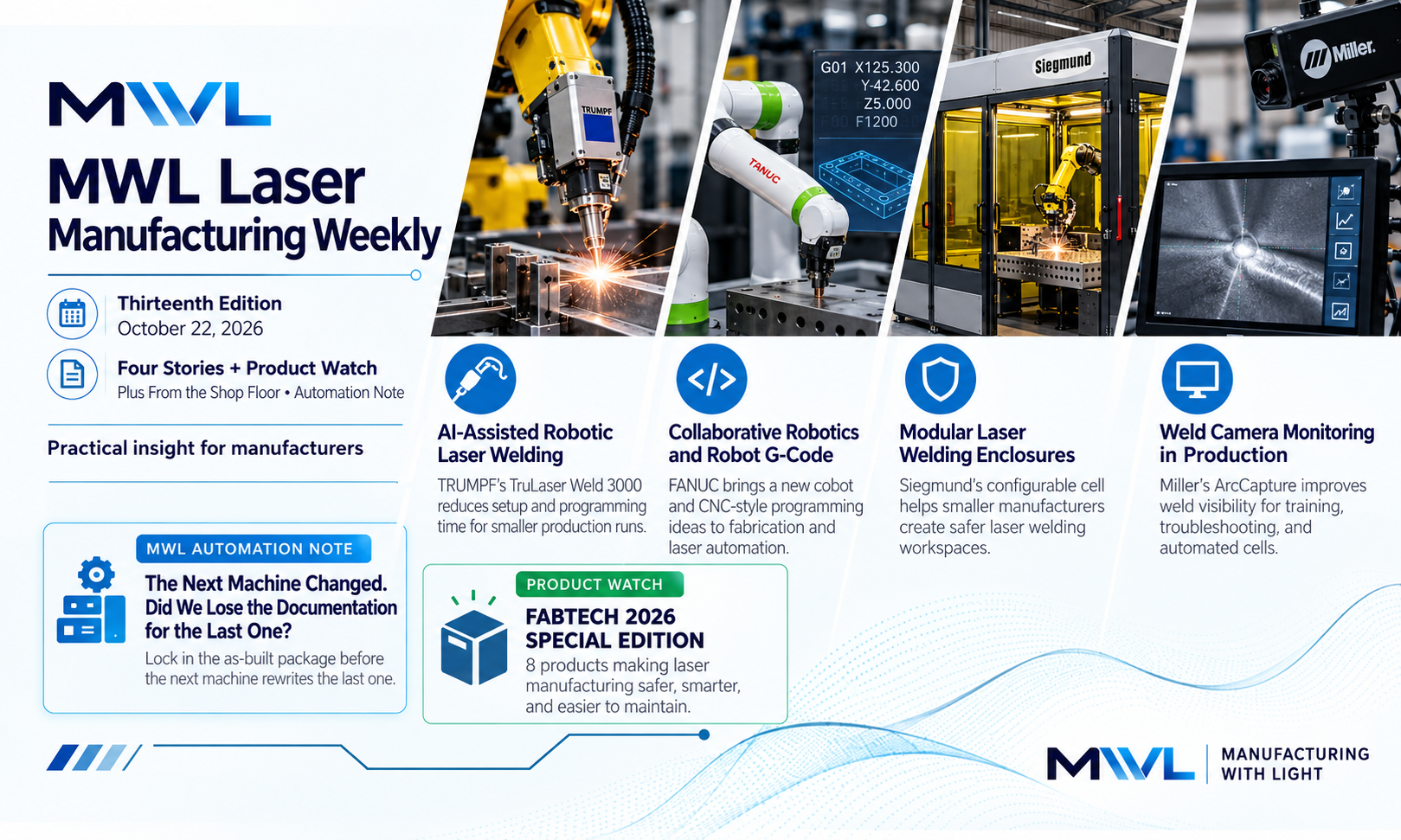
FABTECH 2026: Making Laser Manufacturing More Practical
October 22, 2026 | Manufacturing With Light
Welcome to Edition 13 of Manufacturing With Light Weekly.
FABTECH 2026 is underway in Las Vegas, and there’s plenty of new technology to talk about.
This week’s stories look at robotic laser welding, collaborative automation, laser safety enclosures, and welding cameras. They’re different technologies, but I see a common theme.
Manufacturers are looking for ways to make advanced manufacturing easier to program, safer to operate, and more practical to maintain.
That’s particularly important for smaller manufacturers that don’t necessarily have large engineering departments or dedicated automation teams.
We also have a new MWL Automation Note about something I’ve experienced firsthand: arriving at a customer’s machine only to discover that the drawings no longer describe the machine.
And if you’re interested in new products at FABTECH, we’ve published a separate Product Watch featuring eight practical accessories and technologies worth a closer look.
In This Edition
- TRUMPF Introduces AI-Assisted Robotic Laser Welding
- FANUC Brings Collaborative Robotics and CNC Technology to FABTECH
- Siegmund Introduces a Modular Laser Welding Enclosure
- Miller Brings Weld Cameras Into Automated Production
- MWL Product Watch — FABTECH Special Edition
- MWL Automation Note — The Next Machine Changed. Did We Lose the Documentation for the Last One?
- From the Shop Floor — We Want Your Stories
1. TRUMPF Introduces AI-Assisted Robotic Laser Welding
Making robotic laser welding more practical for smaller production runs
TRUMPF is introducing its new TruLaser Weld 3000 robotic laser welding cell at FABTECH 2026.
The system is designed for manufacturers producing high-quality sheet metal components, especially for applications involving smaller batches and frequent part changes.
One of the more interesting developments is the way TRUMPF is approaching programming.
The TruLaser Weld 3000 supports conventional programming at the machine as well as offline programming using TruTops Weld software.
Its TeachLine Touch function allows operators to correct weld-point locations through the machine interface.
TRUMPF reports that this approach can reduce programming and setup time by up to 50 percent.
An additional TeachLine AI function uses AI-based detection to identify deviations between the intended weld locations and the actual component configuration, allowing the robot path to be corrected.
The company has also introduced a welding optic approximately 40 percent smaller than its previous design, improving access to difficult-to-reach areas of components such as cabinets and enclosures. [1]
Why It Matters
For years, one limitation of robotic welding has been the effort required to program, fixture, and validate a new part.
When a manufacturer is producing thousands of identical assemblies, that programming effort may be relatively easy to justify.
But what about a shop producing 20 or 50 parts before switching to something completely different?
Programming time becomes a much larger part of the total manufacturing cost.
Reducing that effort could make robotic laser welding practical for applications that previously didn’t justify dedicated automation.
I also like TRUMPF’s emphasis on offline programming. Being able to develop the next job while the machine continues producing parts is an important advantage.
Of course, faster programming doesn’t eliminate the need for sound process development, good fixturing, or weld qualification.
But it can remove one barrier to adopting automation.
MWL Perspective: The real opportunity may not be making robots weld faster. It may be making robotic laser welding economical at relatively low production volumes.
Source: TRUMPF — FABTECH 2026: Accelerating Part Production With AI-Powered Laser Welding
2. FANUC Brings Collaborative Robotics and CNC Technology to FABTECH
An interesting connection between conventional CNC programming and robotic manufacturing
FANUC America is demonstrating several robotic welding, cutting, and laser processing applications at FABTECH 2026.
Among the featured technologies is the CRX-3iA collaborative robot, making its FABTECH debut.
Weighing about 11 kg, the CRX-3iA is designed for applications that require a lightweight, easily repositioned robot.
One demonstration uses the robot with a magnetic mounting arrangement for vertical-up welding in applications such as structural fabrication and shipbuilding.
FANUC is also demonstrating coordinated motion using a seventh-axis track and rotating positioner, along with a laser processing cell built around its LR-10iA/10 robot.
That cell combines laser welding and marking operations within a single automated workstation. [2]
The CNC and G-Code Connection
One feature that particularly caught my attention is FANUC’s Robot G-Code capability.
Robot G-Code allows compatible FANUC robots to be controlled through supported FANUC CNC systems using familiar G-code programming concepts.
This technology isn’t new, and FANUC does not identify it as the programming method used in its FABTECH laser cell. However, the company includes Robot G-Code among the CNC technologies highlighted for fabrication applications.
For those of us who have worked with CNC laser machines, that raises some interesting possibilities.
Traditional CNC systems are well suited to applications involving programmed toolpaths, interpolation, feed rates, and coordinated machine motion.
Robots offer flexibility in positioning and reaching around complicated components.
Bringing those two programming environments closer together could simplify certain robotic manufacturing applications.
Why It Matters
I have worked extensively with motion controllers and CNC-style programming for laser processing.
One recurring challenge is deciding how to program the machine.
For a conventional CNC laser cutter, G-code is a natural choice.
For a robotic welding application, teach-pendant programming may be more appropriate.
But when a robot is performing path-intensive manufacturing operations such as laser cutting, welding, or machining, the distinction becomes less obvious.
There are still important technical questions.
Robot accuracy, interpolation behavior, tool orientation, singularities, external-axis coordination, and synchronization with the laser process all need consideration.
Simply allowing a robot to execute G-code doesn’t automatically give it the performance characteristics of a precision CNC machine.
Nevertheless, I think this is an interesting area for machine builders to explore.
MWL Perspective: The important question isn’t whether a robot can execute G-code. It’s whether the complete control system can provide the motion quality, process synchronization, and programming flexibility the application requires.
Sources: FANUC — FABTECH 2026 Technology Preview and FANUC — FABTECH Automation Announcement
3. Siegmund Introduces a Modular Laser Welding Enclosure
Making laser safety infrastructure more accessible to smaller manufacturers
One challenge for manufacturers considering handheld laser welding is the equipment required around the laser.
The welding system itself is only part of the installation.
Depending on the application, manufacturers may also need a laser-rated enclosure, interlocked access points, ventilation, viewing windows, and appropriate safety controls.
Siegmund’s new Modular Laser Welding Cell, presented through Quantum Machinery Group at FABTECH, is designed to simplify part of that installation.
The enclosure uses preassembled walls and modular aluminum profiles.
According to the published specifications, the enclosure is intended for specified laser applications up to 4 kW over 940–1090 nm.
Additional features include:
- Modular protective wall construction.
- Wide double-door access.
- Laser-protective viewing window.
- Optional enclosed roof.
- Provision for connection to an extraction system.
- Configurable enclosure arrangements.
Quantum Machinery Group identifies the product as a CE-compliant safety component and lists DIN EN 60825-4 and DIN EN 207 among its applicable certification claims. [3]
Why It Matters
Handheld laser welding has attracted considerable interest from smaller manufacturers.
But buying a laser welder isn’t the same as establishing a safe laser welding operation.
A properly engineered work area can require significant planning, and manufacturers unfamiliar with industrial laser safety may underestimate what’s involved.
Modular enclosures could make that process more manageable.
Instead of starting from a completely custom design, a manufacturer can work with a defined enclosure system and adapt it to the application.
However, I would emphasize one important point.
A laser-rated enclosure component does not automatically make the completed welding installation safe.
The actual installation still needs an appropriate hazard assessment, properly designed safety functions, consideration of direct and reflected laser radiation, fume extraction, and suitable operating procedures.
The manufacturer’s ratings must also match the laser and operating conditions.
The MWL Perspective
I think making laser safety equipment easier to specify and install is an important part of bringing laser technology to smaller manufacturers.
The challenge is ensuring that convenience doesn’t lead to assumptions about safety.
A modular enclosure can be a valuable part of the solution.
But the complete system still needs to be engineered.
Source: FABTECH — The New Siegmund Modular Laser Welding Cell
4. Miller Brings Weld Camera Monitoring Into Production Applications
Better visibility into what is actually happening at the weld
Miller Electric is featuring its ArcCapture weld camera system at FABTECH 2026.
Originally introduced in January 2026, ArcCapture is designed to provide high-definition images of welding operations.
The system offers 1920 × 1080 imaging and comes in standard and Wi-Fi configurations.
The Wi-Fi version supports streaming to computers, tablets, and smartphones.
Miller initially emphasized the camera’s value for welding training and education, where instructors can observe welding operations and demonstrate techniques without requiring everyone to gather around the work area.
But the company also identifies applications in automated and robotic welding, where the camera can provide visibility into operations that may be difficult to observe directly. [4, 5]
Why It Matters
As manufacturing becomes more automated, direct observation of the process can become more difficult.
Robotic welding cells may operate behind protective barriers, and components or fixtures can obstruct the operator’s view.
A camera can provide useful information for process development, operator monitoring, troubleshooting, and production review.
It can also help engineers identify changes in a welding process’s visible behavior.
However, an important distinction exists between observing a weld and verifying its quality.
A clear camera image does not necessarily reveal incomplete fusion, internal porosity, or other defects that require additional inspection methods.
ArcCapture is primarily an arc-welding product, and you shouldn’t assume its suitability for specific laser welding applications without evaluation.
The MWL Perspective
I’ve always thought that one of the most useful things we can give a machine operator or maintenance technician is better information about what’s happening inside the machine.
A camera doesn’t necessarily need sophisticated AI or automatic defect detection to be useful.
Sometimes simply being able to see the process clearly can help identify a problem that would otherwise be difficult to diagnose.
The next step is deciding what information is worth recording and how to connect it to the production process.
Source: Miller — Built for What’s Next: FABTECH 2026
MWL Product Watch — FABTECH 2026 Special Edition
This week, we’ve already published a special Product Watch featuring eight products that caught our attention at FABTECH.
Rather than concentrating on complete laser cutting and welding machines, we selected smaller products and technologies that may help manufacturers improve safety, monitoring, automation, and maintenance.
The special edition includes laser safety products, welding cameras, CNC control solutions, laser cutting accessories, and maintenance technologies.
Our goal with Product Watch is to identify products that solve practical manufacturing problems and introduce readers to companies developing useful technology.
We also welcome submissions from manufacturers and suppliers developing products related to laser materials processing, automation, motion control, process monitoring, and laser safety.
Product Watch is an independent editorial feature. Inclusion does not imply MWL endorsement.
MWL Automation Note
The Next Machine Changed. Did We Lose the Documentation for the Last One?
Why every machine builder needs to preserve an as-built documentation package before starting the next machine.
I’ve spent much of my career working with system integrators and smaller machine builders.
One problem I’ve encountered more than once is arriving at a customer’s facility for a service call and discovering that the electrical drawings don’t match the machine.
I remember one visit when, after some investigation, we discovered that the original drawings had been modified for another machine built later.
Unfortunately, nobody had preserved a complete copy of the as-built drawings for the machine I was standing in front of.
Now we had a problem.
The documentation described a different machine, and I was supposed to troubleshoot the one in front of me.
I’ve Also Been the One Who Created the Problem
I have to admit, I’ve been on the other side of this too.
Years ago, I assigned a new engineer to prepare electrical drawings for a new machine order.
The system was very similar to one we’d already built, so I told him to use the drawings from the earlier machine.
And that’s exactly what he did.
Unfortunately, he didn’t make a separate copy before modifying them.
We now had drawings for the new machine, but no longer had the original drawings for the machine we’d already shipped.
The engineer hadn’t done anything unreasonable. He followed my instructions.
I just hadn’t made it clear that the original drawings needed to be preserved.
I had told him which drawings to use, but not which drawings he wasn’t allowed to change.
That is an important distinction.
The Facts: Every Machine Has Its Own Configuration
For system integrators and smaller OEMs, reusing an existing design makes perfect sense.
Why start from scratch when you already have working electrical drawings, PLC programs, HMI screens, and mechanical designs?
But every new machine may introduce changes.
Different components. Revised wiring. New software features. Updated safety systems. Customer-specific options.
Those changes mean that two machines built from the same original design may no longer have identical configurations.
An established engineering discipline manages this problem: configuration management.
ISO 10007:2017 provides guidance for controlling product configurations throughout their life cycles, including configuration identification, change control, and maintaining configuration records [6].
The Problem: The Documentation Changes, but the Earlier Machines Are Still Out There
Imagine a small OEM building several similar laser welding systems.
Machine 101 ships with one PLC configuration and a particular laser interface.
Machine 102 uses a different drive and an additional sensor.
Machine 103 has a revised safety circuit and updated HMI screens.
These may all be reasonable engineering improvements.
But what happens when the drawings and programs are continually revised without preserving the versions that belong to each machine?
Five years later, a technician may be working with documentation that describes an entirely different configuration.
That can result in incorrect parts being ordered, wasted troubleshooting time, or software being loaded into a machine it wasn’t intended for.
And when safety circuits have changed, the consequences of using incorrect documentation can be particularly serious.
The latest documentation is not necessarily the correct documentation for the machine being serviced.
The Solution: Freeze the As-Builts Before the Machine Ships
This doesn’t have to be complicated.
Before a machine leaves the factory, create a complete, approved, read-only documentation package identified by the machine’s serial number.
That package should include the applicable electrical drawings, mechanical drawings, bills of materials, and software revisions.
It should also preserve configuration information for PLCs, HMIs, CNC or motion controllers, drives, networks, instruments, and applicable safety systems.
Incorporate commissioning changes before releasing the package.
Give the documentation a clear identification, such as:
Machine 101 — Serial 101 — AS-BUILT — Rev A — October 2026
Store it in a protected location, separate from the working engineering files.
And when the next machine order comes along, start with a separate working copy.
Do not modify the only released record of the previous machine.
If you later modify the earlier machine, retain its original as-shipped package and create a controlled record of the changes so you can reconstruct its current as-maintained configuration.
The important distinction is between:
- As-designed: What engineering intended to build.
- As-built/as-shipped: What was actually delivered.
- As-maintained: What exists after subsequent field modifications.
For a small OEM, a well-organized directory, a simple release checklist, protected archives, and clear responsibilities may be enough to establish an effective starting process.
You don’t necessarily need an expensive document-management system.
You need a process that prevents the original records from disappearing.
The MWL Perspective
I understand how this happens.
The machine ships. The next order is waiting. Everyone is busy, and the engineering team is already improving the design.
Making an archive copy of the documentation doesn’t seem particularly urgent.
Until someone gets a service call.
And that someone may be the engineer who originally built the machine, standing in front of a control cabinet with drawings that describe three generations of improvements the customer never received.
The best time to preserve the documentation is before the machine leaves the factory—not when somebody needs it five years later.
A machine’s documentation should have a history.
It shouldn’t be rewritten every time we build another one.
Reference: ISO 10007:2017 — Quality Management: Guidelines for Configuration Management
From the Shop Floor — We Still Want Your Stories
One of our goals at Manufacturing With Light is to include more perspectives from the people who actually build, operate, program, and maintain manufacturing equipment.
We’re interested in real experiences.
A manufacturing problem you solved.
A process improvement that made a difference.
Something you learned during commissioning or troubleshooting.
Or perhaps a mistake that taught you something worth sharing.
You don’t need to be a professional writer.
If you’ve worked on an interesting laser manufacturing, automation, or additive manufacturing application, we’d like to hear about it.
We also welcome contributions from independent consultants, manufacturing engineers, and technical specialists.
As submissions develop, we’ll feature selected contributions in From the Shop Floor and Consultants Corner.
The goal is to share useful knowledge and give contributors recognition for their experience.
Closing Thought
This week’s developments span robotic laser welding, collaborative automation, laser safety, process monitoring, and software documentation.
At first glance, they may not seem closely related.
But I think they share an important principle.
Making a manufacturing process work is one achievement. Making it dependable, supportable, and practical over its lifetime is another.
That’s where good engineering makes the difference.
Thanks for reading Edition 13 of Manufacturing With Light Weekly.
If you find these discussions useful, please subscribe and share the newsletter with others working in laser manufacturing and automation.
Manufacturing With Light
Precision. Performance. Possibilities.
References
[1] TRUMPF — FABTECH 2026: Accelerating Part Production with TRUMPF’s AI-Powered Laser Welding Cell
https://www.trumpf.com/en_US/newsroom/local-press-releases/press-release-detail-page/release/fabtech-2026-accelerating-part-production-with-trumpfs-ai-powered-laser-welding-cell-10332/
[2] FANUC America — FABTECH 2026: Robotic Welding, Laser Processing and CNC Technologies
https://www.fanucamerica.com/events/fabtech-2026
[3] FABTECH — The New Siegmund Modular Laser Welding Cell
https://cdn.fabtechexpo.com/products/28558/the-new-siegmund-modular-laser-welding-cell
[4] Miller Electric — Built for What’s Next: Miller Brings New Welding Solutions to FABTECH 2026
https://www.millerwelds.com/en-US/about/news-releases/miller-brings-new-welding-solutions-to-fabtech-2026
[5] Miller Electric — Miller Launches ArcCapture Weld Camera Systems, January 2026
https://prod.millerwelds.com/en-us/about/news-releases/miller-launches-arccapture-weld-camera-systems
[6] ISO — ISO 10007:2017, Quality Management: Guidelines for Configuration Management
https://www.iso.org/standard/70400.html
MWL reports on technologies, manufacturing applications, and engineering practices relevant to laser materials processing and advanced manufacturing. Product specifications and performance claims attributed to manufacturers have not been independently tested by MWL.
#ManufacturingWithLight #LaserManufacturing #FABTECH2026 #LaserWelding #ManufacturingAutomation #MotionControl #LaserSafety #AdvancedManufacturing #IndustrialAutomation