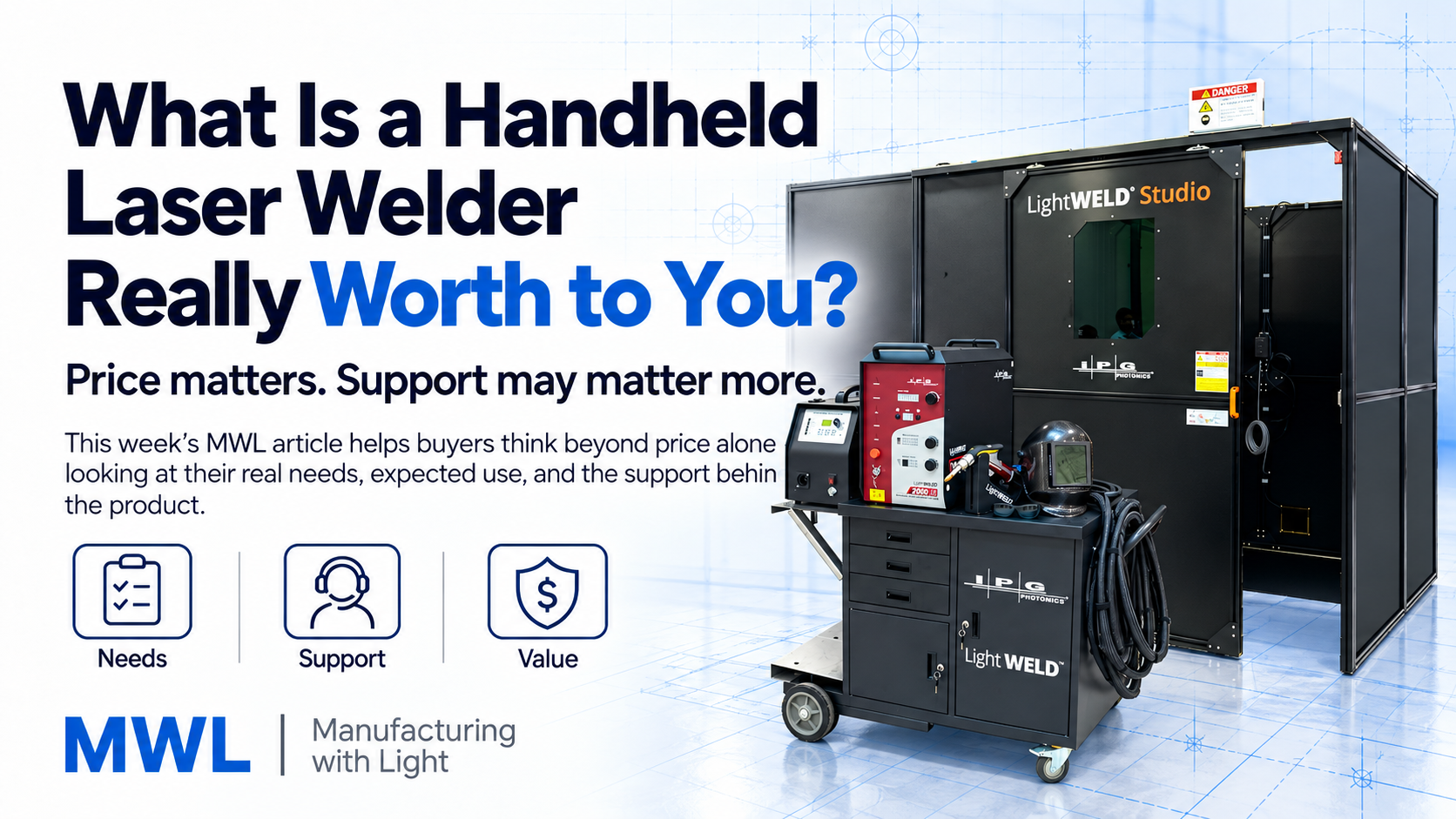
Handheld laser welders are becoming easier to find, and the price range can be surprising.
You can see systems that appear similar on paper selling for dramatically different amounts.
That raises an obvious question for a buyer:
What am I actually getting for the extra money?
I think the answer starts with a question that applies to almost any tool or piece of equipment we buy for our businesses:
What do you actually need it to do?
Start With Your Own Requirements
Like many other pieces of manufacturing equipment, there probably isn’t one handheld laser welder that works for everyone.
Before worrying about brands, features, or price, I would start with a few basic questions:
Why are you buying it?
What materials and thicknesses do you expect to weld?
How frequently will it be used?
Who will operate it?
How important is uptime?
What happens if the machine is down for several days?
Do you already have laser-safety knowledge in-house?
Do you need help developing the welding process?
Those questions change the value equation considerably.
For some buyers, the lowest purchase price may genuinely be the most important factor.
Maybe the machine will only be used occasionally. Maybe the company already has strong internal laser, welding, and maintenance capabilities. Maybe downtime isn’t particularly expensive.
In that situation, paying substantially more for services you don’t need may not make sense.
And that’s OK.
A premium product only exists because less-expensive alternatives also exist.
A Good Machine Still Has to Be the Starting Point
Before talking about premium features or support, I think we need to establish something more basic.
The product itself needs to be good.
It needs to perform the welding work you purchased it for.
It should be reliable.
It should be reasonably easy to operate and maintain.
And with industrial laser equipment in particular, safety, documentation, and regulatory compliance should not be treated as premium options.
Those things are part of delivering a professional industrial product.
Only after those fundamentals are satisfied does it make sense to ask whether paying more creates additional value for your operation.
More Features Don’t Automatically Mean More Value
One temptation when comparing equipment is to make a checklist.
Machine A has eight features.
Machine B has twelve.
Therefore, Machine B must be better.
I’m not convinced that’s a particularly useful way to buy production equipment.
A feature only has value if it solves a problem you actually have.
Advanced controls, additional process modes, data collection, recipe management, automation interfaces, wire feeding, or other capabilities may be extremely valuable for one customer and unnecessary for another.
I’d rather see manufacturers offer some of those capabilities as options instead of making every customer pay for technology they may never use.
The better question isn’t:
“Which machine has the most features?”
It’s:
“Which machine has the capabilities my process actually requires?”
Sometimes You’re Paying for What Happens After the Sale
This is where I think handheld laser welding gets particularly interesting.
You aren’t simply buying a power tool.
You’re introducing a laser manufacturing process into your operation.
That can involve process development, operator training, safety, consumables, replacement optics, maintenance, troubleshooting, and eventually repairs.
And that’s where two machines with similar specifications can become very different purchases.
Imagine that you’re struggling with a weld.
Who do you call?
Can the supplier help determine whether the problem is the machine, the parameters, the material, the fit-up, or the way you’re applying the process?
If an optic is damaged, is a replacement readily available?
If the machine stops working, can someone help diagnose it?
Do your maintenance people have documentation they can actually use?
Can your operators get meaningful training?
If your application changes six months from now, can someone help you evaluate it?
Those things don’t necessarily show up on the specification sheet.
But they may determine whether the machine becomes a useful production tool or an expensive piece of equipment sitting in the corner.
Support May Be Worth More Than the Difference in Purchase Price
This is the part I think buyers sometimes underestimate.
Suppose one machine costs considerably less than another.
At purchase time, the cheaper machine obviously looks attractive.
But what happens when production depends on it?
If a machine saves $10,000 at purchase but a production problem leaves it unusable for several days because nobody can help you, how much did you really save?
That answer will be different for every company.
For a small shop using the welder occasionally, the lower initial cost might still be the right decision.
For a manufacturer using the equipment every day on production parts, technical support, spare parts, training, application assistance, and service response may be worth considerably more.
That’s why I don’t think you should evaluate equipment only by purchase price.
Sometimes what you’re really buying is confidence that someone will help you keep the process running.
The People Behind the Product Matter
The older I get, the more I value this.
When I buy equipment for a manufacturing process, I want to know something about the people standing behind it.
Do they understand the application?
Can I talk to someone technical when I have a real problem?
Do they have experience with the type of work I’m trying to do?
Will they still support the product in several years?
That doesn’t necessarily mean the largest company always wins.
A smaller supplier with knowledgeable people and excellent support may provide tremendous value.
But I would consider the supplier itself part of the product.
Because once the equipment is installed, you’re not dealing with a brochure anymore.
You’re dealing with real production problems.
Think About the Total Purchase, Not Just the Machine
If I were buying a handheld laser welder today, I’d separate the decision into three areas.
The machine
Can it reliably and safely perform the work I need?
The capabilities
Am I paying for features that actually improve my application?
The company behind it
What happens when I need training, process help, parts, service, or troubleshooting?
Different buyers will weight those three categories differently.
And they should.
Sometimes Price Really Is All That Matters
I don’t think we should pretend every buyer needs a premium product. Sometimes a lower-cost machine is exactly the right answer.
If you understand the process, understand the risks, have the internal expertise to support the equipment, and can tolerate the consequences if something goes wrong, buying primarily on price may be perfectly reasonable.
But that should be a deliberate decision.
Not simply:
“These two machines both say 2,000 watts, so why would I pay more?”
Because you’re probably buying much more than watts.
You’re buying the machine, its capabilities, its documentation, its safety and compliance foundation, the availability of replacement parts, and potentially years of technical support.
For some businesses, those things may not justify a higher price. For others, they may be the most valuable part of the purchase.
My Take
Handheld laser welders will become more widely available, and I expect prices to keep varying significantly.
I don’t think the goal should be to convince everyone to buy the most expensive machine.
The goal should be to understand what your operation actually needs and buy accordingly.
Sometimes the right answer will be the lowest price.
Sometimes it will be additional capability.
Sometimes the biggest reason to spend more has very little to do with the laser itself.
It will be the people who answer the phone when you need help.
If you’re using a handheld laser welder in production, what mattered more than you expected after you bought it?