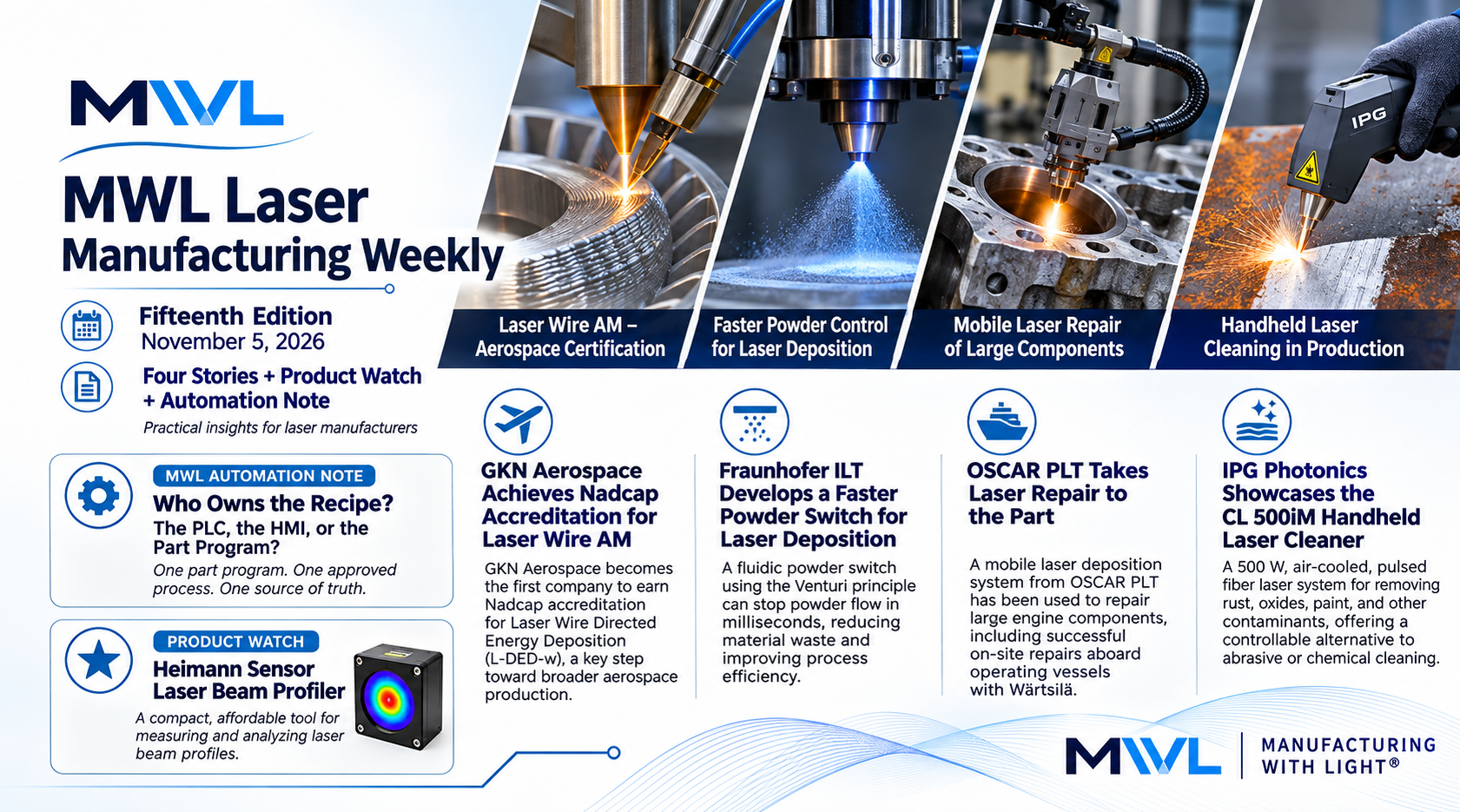
Thursday, November 5, 2026
From Aerospace Additive Manufacturing to Portable Laser Repair: Making Laser Processes Work in Production
Welcome to Edition 15 of Manufacturing With Light Weekly.
This week’s stories cover a wide range of laser manufacturing applications, but they have something important in common.
The challenge isn’t simply making a laser process work. It’s making that process practical, repeatable, and dependable in a real manufacturing environment.
We look at GKN Aerospace’s achievement in laser wire additive manufacturing, a clever new powder-switching technology from Fraunhofer ILT, mobile laser repair equipment from OSCAR PLT, and IPG Photonics’ handheld laser cleaning system.
Our Product Watch features a compact laser beam profiler from Heimann Sensor that could make beam characterization more accessible.
And in this week’s MWL Automation Note, we’re revisiting a subject we’ve discussed before: where manufacturing process parameters should be stored, and why I believe more machines should adopt CNC-style part programs.
Let’s get started.
In This Edition
Industry News
- GKN Aerospace — Nadcap Accreditation for Laser Wire Additive Manufacturing
- Fraunhofer ILT — Faster Powder Switching for Laser Deposition
- OSCAR PLT — Taking Laser Repair to the Part
- IPG Photonics — CL 500iM Handheld Laser Cleaning System
MWL Features
- Product Watch — Heimann Sensor Laser Beam Profiler
- MWL Automation Note — Who Owns the Recipe? The PLC, the HMI, or the Part Program?
- Coming Next — What’s New with Handheld Laser Welding
- From the Shop Floor — Reader Contributions
- References and Further Reading
1. GKN Aerospace Reaches a New Milestone in Laser Wire Additive Manufacturing
* Aerospace | Additive Manufacturing | Process Qualification *
GKN Aerospace announced on October 29 that it has become the first company in the world to achieve Nadcap accreditation for Laser Wire Directed Energy Deposition (L-DED-w). [1]
That’s an important milestone for additive manufacturing, particularly in an industry where process qualification and traceability are essential.
L-DED-w uses a laser to melt metal wire as it deposits material to build up a component. The technology offers opportunities to manufacture complex, large-scale structures while reducing material waste compared with some conventional manufacturing methods.
GKN Aerospace reports that it has already delivered certified additively manufactured components that are flying today.
The new accreditation supports expanding these processes into additional aerospace and defense applications.
Nadcap accreditation involves an independent assessment of specialized manufacturing processes. GKN’s audit covered process controls, operating procedures, personnel qualifications, equipment, material management, and traceability.
Why It Matters
I’ve always believed there is a big difference between demonstrating a successful manufacturing process and turning that process into dependable production.
We see impressive additive manufacturing demonstrations all the time.
But when a manufacturer needs to produce a critical component repeatedly, the requirements change.
The process must be documented. Equipment must be maintained and calibrated. Operators need appropriate qualifications. Material must be controlled. The manufacturer also needs evidence that the process remains within its approved operating conditions.
The interesting part of this announcement isn’t just that GKN can manufacture aerospace components using laser deposition. It’s that the company has demonstrated the process controls needed to support broader production use.
That is a significant step toward moving additive manufacturing from specialized applications into established manufacturing operations.
Source: [1] GKN Aerospace — First in the World to Achieve Nadcap Accreditation for L-DED-w
2. Fraunhofer ILT Develops a Faster Way to Control Powder Flow in Laser Deposition
Laser Cladding | Directed Energy Deposition | Process Efficiency
Fraunhofer Institute for Laser Technology ILT recently introduced an interesting development for laser material deposition: a fluidic powder switch that can interrupt powder flow directly at the deposition nozzle in milliseconds. [2]
It’s a relatively simple idea that addresses a surprisingly important problem.
In laser powder deposition systems, the laser can be turned on and off very quickly.
The powder delivery system, however, may not respond nearly as fast.
During complex toolpaths, pauses, repositioning moves, or processing interruptions, powder may continue flowing even when it isn’t needed.
That wastes material, increases contamination, and can complicate the process.
Traditional mechanical powder-switching methods can introduce delays and wear.
Fraunhofer’s approach uses the Venturi principle.
A controlled gas flow creates suction that diverts powder into a collection container rather than allowing it to continue into the processing area.
The powder path has no mechanically moving parts.
According to Fraunhofer ILT, the system can also switch between materials and adjust powder flow in stages.
The institute reports that early customers are already using the technology in production applications.
Why It Matters
I like developments like this because they remind us that improving laser manufacturing isn’t always about the laser.
Sometimes the best improvement comes from making a supporting process work better.
In a deposition system, powder delivery is just as important as controlling the laser beam and motion.
If the powder continues flowing after the laser shuts off, we’re wasting material and potentially creating other problems.
And for some metal powders, that waste can become expensive.
A faster powder switch may not sound as exciting as a new high-power laser, but it could meaningfully improve process efficiency.
It also demonstrates something important about industrial automation: the complete system has to operate as a coordinated process.
A fast laser and a precise motion system can’t compensate for peripheral equipment that doesn’t respond when needed.
Source: [2] Fraunhofer ILT — Faster, More Porous, Smarter: Innovations for Additive Manufacturing
3. OSCAR PLT Takes Laser Repair to the Part Instead of Bringing the Part to the Machine
Laser Metal Deposition | Industrial Maintenance | Mobile Repair
One of the more interesting developments I came across involves a different approach to industrial laser repair.
Instead of bringing a damaged component to a laser processing machine, OSCAR PLT is developing equipment that brings the laser repair process directly to the component.
The company’s mobile ProFocus system uses wire-fed Laser Metal Deposition to repair large industrial parts, including components that would be difficult or expensive to remove and transport. [3]
OSCAR PLT has been working with Wärtsilä, a manufacturer of marine and energy systems, to demonstrate the technology.
According to OSCAR PLT, the collaboration has included successful repairs of two test engine blocks and two actual on-site repairs aboard operating vessels.
The mobile system is based on the company’s ProFocus technology, which is designed to deposit material with low penetration and low dilution.
These characteristics can help minimize the impact on the original material, particularly when repairing large cast components.
The equipment is compact enough for restricted spaces such as engine rooms and can be used with relatively small robotic systems.
Why It Matters
I’ve worked with enough large equipment to appreciate how difficult it can be to remove a major component for repair.
Sometimes the repair itself is relatively straightforward.
Getting the component out of the machine, transporting it to a repair facility, and reinstalling it can become a much larger project.
And while all that is happening, the equipment may be out of production.
Mobile laser deposition offers an interesting alternative.
Of course, working outside a controlled manufacturing cell introduces challenges.
The repair system must accommodate the component’s actual position and geometry. Shielding gas coverage must remain effective. Access may be limited. The resulting repair must still meet the required quality standards.
That means the machine design, controls, fixturing, and process qualification are particularly important.
What I find interesting is the potential to make laser repair practical where conventional shop-based processes may not be economical.
This could become a valuable application for industrial maintenance, marine equipment, power generation, and other industries working with large, expensive components.
For readers interested in the actual technology, OSCAR PLT’s article includes useful information about the equipment and its repair applications.
Source: [3] OSCAR PLT — ProFocus Goes Mobile: On-Site Repair of Large Components
4. IPG Photonics Brings Handheld Laser Cleaning to Industrial Surface Preparation
Laser Cleaning | Surface Preparation | Manufacturing Applications
We’ve spent quite a bit of time discussing handheld laser welding, but handheld laser cleaning is another application worth watching.
IPG Photonics’ CL 500iM is a portable laser cleaning system designed to remove rust, oxides, paint, oils, and other surface contaminants. [4]
The system uses a 500 W nanosecond-pulsed fiber laser rather than the continuous-wave laser technology commonly associated with high-power welding.
It features air-cooled operation, digital touchscreen controls, adjustable cleaning parameters, and integrated fume extraction.
Laser cleaning works by directing short laser pulses at the surface. Depending on the material, coating, and selected parameters, the laser can remove unwanted surface material while limiting its effect on the underlying substrate.
IPG positions the CL 500iM as an alternative to conventional processes such as abrasive blasting and chemical cleaning.
Why It Matters
Surface preparation doesn’t always receive the attention it deserves in manufacturing.
But whether we’re welding, bonding, coating, or repairing a component, surface condition can greatly affect the result.
Contamination, corrosion, coatings, and oxides can interfere with downstream manufacturing processes.
Laser cleaning can remove selected materials without abrasive media or chemical baths.
It may also be useful for localized cleaning when treating an entire component is unnecessary or impractical.
However, manufacturers still need to evaluate cleaning effectiveness, processing speed, substrate compatibility, and the cost of implementation.
And safety remains essential.
The CL 500iM is a Class 4 laser system. IPG’s safety information identifies the need for a laser-safe work area, suitable protective equipment, fume extraction, and appropriate laser safety oversight. [5]
The real question for a manufacturer isn’t simply whether the laser can remove contamination. It’s whether laser cleaning provides a more consistent, economical, and manageable process for the particular application.
That makes this an interesting technology for fabricators, maintenance departments, and manufacturers looking to improve their surface preparation processes.
Sources: [4] IPG Photonics — CL 500iM Handheld Laser Cleaning System; [5] IPG Photonics — CL 500iM Frequently Asked Questions
MWL Product Watch
Heimann Sensor — A Compact Laser Beam Profiler
Laser Diagnostics | Process Development | Measurement Technology
In this week’s Product Watch, we’re looking at something considerably smaller than a complete laser manufacturing system.
Heimann Sensor offers a compact laser beam profiler based on infrared thermopile array technology. [6, 7]
A beam profiler measures and visualizes how laser energy is distributed across a beam.
That’s an important measurement because laser power alone doesn’t tell us everything about the beam.
Two laser systems may produce the same total power but have different spatial intensity distributions.
Those differences can influence how energy is delivered to the workpiece and may affect cutting, welding, marking, and other laser processes.
Heimann offers two main sensor-array configurations:
- 80 × 64 pixels, with 90 µm pixel pitch and an Ethernet/UDP interface.
- 160 × 120 pixels, with 45 µm pixel pitch and a USB interface.
Different optical filter configurations are available for various wavelengths.
Beam-analysis software is available, allowing users to visualize and analyze measured beam profiles. Heimann’s technical datasheet lists the software as a separate purchase.
Why It Caught Our Attention
One of our objectives with Product Watch is to identify practical equipment that can help manufacturers improve their existing laser processes.
We don’t want to feature only expensive, fully integrated manufacturing systems.
Measurement tools, sensors, accessories, and software can sometimes provide more immediate value.
A beam profiler can help engineers characterize a laser source, investigate changes in beam distribution, or evaluate an optical setup.
But there is an important limitation.
This device cannot be placed directly in the beam of a kilowatt-class industrial laser.
Heimann’s published specifications describe supported optical power levels in the microwatt-to-milliwatt range.
Measuring high-power industrial laser systems would therefore require an appropriate, manufacturer-approved optical arrangement to reduce the energy reaching the sensor.
The customer also needs to confirm that the selected sensor, filters, and analysis software are suitable for the intended application.
This may be particularly interesting for laser laboratories, process developers, and manufacturers who need a relatively compact beam-characterization solution.
It isn’t necessarily a turnkey production-laser diagnostic system, but it is a technology worth examining.
Sources: [6] Heimann Sensor — New Laser Beam Profiler; [7] Heimann Sensor — Beam Profiler Technical Datasheet
Have a Product MWL Should Look At?
We’re especially interested in practical products that can help manufacturers improve laser processes.
That includes measurement instruments, sensors, welding and cutting accessories, process-monitoring equipment, safety products, and useful software.
If your company has developed something interesting, send Manufacturing With Light a product link and a brief description.
Product Watch is intended to identify useful technology, not provide paid endorsements. We attribute product claims to their manufacturers unless we independently verify them.
MWL Automation Note
Who Owns the Recipe? The PLC, the HMI, or the Part Program?
One part program. One approved process. One source of truth.
We’ve Discussed This Before. But It Deserves Another Look.
A few weeks ago, I wrote an MWL Automation Note titled Program the Machine Once. Program the Process Separately. [8]
The basic idea was to separate the machine’s capabilities from the instructions that tell it how to manufacture a particular part.
It’s an approach CNC programmers have used for decades, and one I believe deserves more attention in other types of automated manufacturing equipment.
But there’s another part of this discussion that’s just as important.
Where should we store the actual process parameters, and how do we make sure we’re running the correct ones?
Before we move on to our new newsletter feature, What’s New with Handheld Laser Welding, I thought this topic deserved another look.
One Part Program, One Set of Process Parameters
I’ve worked with both CNC-style systems and conventional PLC-controlled machines, and I have come to prefer keeping the complete product-specific manufacturing process in a text-based part program.
Something similar to a CNC G-code file.
For a laser welding application, that file might contain:
- Part number and revision
- Motion coordinates and travel speeds
- Laser power and operating mode
- Pulse or modulation settings
- Wobble parameters
- Process gas settings
- Welding sequence and timing
- Calls to validated machine functions
The machine controller is responsible for knowing how to execute those instructions safely and reliably.
The part program tells the controller what to manufacture.
This is essentially the CNC programming model, where an interpreter executes instructions from a part program while the underlying control system manages the machine. [9]
What I particularly like is that the manufacturing process becomes a separate, identifiable file rather than a collection of settings scattered across multiple systems.
The Problem with HMI Recipes
There’s nothing inherently wrong with an HMI recipe system.
For a relatively simple machine, a table containing temperatures, pressures, speeds, and timing values may be all that’s needed.
But consider a laser welding system where:
- The controller contains the motion program and welding sequence.
- The HMI contains the laser power and travel-speed recipe.
- The laser source maintains another set of parameters.
- An additional configuration file contains other process settings.
Now suppose a process engineer makes a small change to improve a weld.
Which file changed?
Was the change saved in the HMI? Was the laser preset updated? Did someone modify the controller program?
And if we manufacture the same part six months from now, how do we know we’re using exactly the same process?
Everything may work perfectly today.
The problem appears when someone has to reproduce the process later.
I’ve seen enough custom machine software to know that once parameters and sequences are distributed among several systems, keeping everything synchronized can become a significant maintenance problem.
NIST’s configuration-management guidance emphasizes maintaining controlled baselines and managing changes to those configurations. Although the guidance is broader than manufacturing recipes, the underlying principle applies directly to this problem. [10]
What About Parts That Are Supposed to Be Locked Down?
For many manufacturing applications, once a process has been developed, tested, and approved, production personnel should not be able to change it without authorization.
That’s particularly important in industries where manufacturing processes require documented control and traceability.
Imagine an approved laser welding program named:
PART_1042_REV_C.PROC
The file contains the complete product-specific welding sequence and its approved process parameters.
Once released for production, the operator can select and run it, but cannot edit it.
If an engineer needs to change the laser power, travel speed, or weld sequence, the change goes through an approval process and becomes a new controlled revision.
And there’s an important distinction here.
Making an HMI field read-only is not the same as protecting the complete manufacturing process.
A controlled program-management system should verify that the correct approved file has been loaded, prevent unauthorized modifications, and record which program revision was actually executed.
The system can also use file-integrity checks, such as cryptographic hashes, to detect changes.
In other words, the goal isn’t simply to prevent someone from changing a number on the screen.
It’s to know exactly what instructions and parameters were used to manufacture the part.
Backups Shouldn’t Be an Afterthought
This is one of the biggest advantages I see in text-based part programs.
If every product has its own process file, maintaining a library of approved programs becomes relatively straightforward.
Programs can be stored by customer, part number, and revision.
They can be copied, compared, archived, and backed up using ordinary file-management and version-control tools.
A manufacturer might have hundreds or thousands of part programs, with the current approved versions stored locally and master copies maintained on a secure company server.
When a controller or industrial PC fails, those files can be restored without having to reconstruct process settings from HMI screens, recipe databases, or handwritten notes.
Of course, the part programs aren’t the only things that need backing up.
The underlying controller application, machine configuration, calibration data, HMI project, and other critical files still need their own backup and recovery procedures.
In fact, NIST published its OT Backup Quick Start Guide in June 2026. The guide specifically emphasizes identifying the files and configurations required for recovery, integrating backups with change management, maintaining protected copies, and testing the recovery process. [11]
That last point matters.
I’ve told customers more than once that they need to maintain software backups, while privately suspecting that nobody would actually do it.
And sometimes I was the contractor who should have made it easier for them.
A well-organized library of part programs doesn’t solve every backup problem, but it certainly makes one important part of the job easier.
A backup strategy should be part of the machine design, not something we discuss after a controller fails.
Local Storage or a Secure Server?
I don’t see why a modern manufacturing system shouldn’t be capable of storing a substantial library of approved part programs.
A machine could maintain frequently used files locally while a secure server holds the master library.
When the operator selects a part, the appropriate approved program can be transferred to the machine, verified, and loaded for execution.
Once loaded, the machine should execute a validated local copy rather than depend on a continuously available network connection.
If the network becomes unavailable, previously authorized local programs could remain available, subject to the company’s production-control requirements.
This also connects with another recent MWL discussion: Does Your Machine Controller Really Need the Plant Network?
In many cases, I think a separate industrial PC or controlled interface is a better place to manage communications with company systems.
The real-time machine controller doesn’t necessarily need direct access to the corporate network or file server.
NIST’s Guide to Operational Technology Security provides a broader discussion of protecting industrial control systems, including network architecture, access control, system integrity, and availability. [12]
The important point is that centralized program management doesn’t have to mean exposing the machine controller unnecessarily or making production dependent on the network.
Text Files Aren’t Just for CNC Machines
I don’t believe every automated manufacturing system needs a full CNC interpreter.
But many could benefit from the same programming philosophy.
Imagine a laser welding machine that understands a small set of validated commands.
A part program might look something like this:
PART = 1042
REVISION = C

CLAMP_PART
VERIFY_PART

SET_LASER_POWER 1200
SET_TRAVEL_SPEED 35
SET_PROCESS_GAS ARGON

MOVE X=100 Y=50
LASER_ON
MOVE X=150 Y=50
LASER_OFF

UNCLAMP_PART
Illustrative pseudocode only. Actual implementations must define units, command validation, sequencing, interlocks, and safe execution behavior.
The controller understands how to clamp the part, check its interlocks, position the axes, control the laser, and handle errors.
The part program simply calls those capabilities in the required order.
A different product uses a different file.
The underlying machine software doesn’t necessarily have to change.
This becomes especially attractive when a machine manufactures many different products or when process engineers frequently develop new applications.
There’s Still a Place for the HMI
I’m not suggesting we eliminate HMIs or recipe-management interfaces.
Quite the opposite.
A good HMI can make selecting, viewing, developing, and managing part programs easier.
It can display the approved process settings, show the current program revision, and provide authorized users with tools to develop or adjust a process.
But the HMI should not quietly become a second, independent source of process parameters.
If an engineer changes a parameter through the HMI, that change should be managed as part of a controlled process definition.
For an approved production program, temporary adjustments should either be prohibited or managed through a documented, authorized deviation procedure.
The important distinction is that the HMI is an interface to the process definition, not an independently maintained copy of it.
There is also an important qualification.
Not every value belongs in the part program.
Machine-specific information such as servo tuning, calibration values, tool offsets, safety limits, and hardware configuration may legitimately remain in the machine controller or its associated configuration files.
A part program should not be allowed to override essential safety functions or machine-protection limits.
There may also be applications where adaptive process control needs to adjust parameters while the machine is running.
Those cases require additional thought.
But I would still want a clear record of the approved program, the permitted adjustments, and the actual conditions used during production.
The objective isn’t to put every variable in one file.
It’s to ensure that the manufacturing process has one authoritative definition and that its dependencies are controlled.
A Better Foundation for Tomorrow’s Machines
As manufacturers begin exploring AI-assisted programming, diagnostics, and maintenance, I believe structured process files will become even more valuable.
An AI tool could potentially compare two revisions, identify process changes, check programmed values against approved limits, or help determine which program was used to manufacture a particular part.
But that’s only possible if we can reliably identify the process definition and its associated configuration.
If the manufacturing instructions are scattered across several proprietary databases, undocumented PLC variables, and HMI screens, even an AI tool is going to struggle to reconstruct what actually happened.
Good organization makes things easier for technicians today and potentially much easier for software tools tomorrow.
A Final Thought
I’ve spent a lot of years working with both PLC-controlled machines and CNC-style systems.
The more I compare them, the more I believe some of the best ideas from CNC programming deserve wider use in industrial automation.
Keep the machine functions standardized. Keep the manufacturing instructions separate. Keep the approved process parameters together. And make the entire process easy to back up, restore, review, and reproduce.
Not every machine needs a full CNC interpreter. But many machines could benefit from the same philosophy.
Could This Approach Work on Your Machines?
At Manufacturing With Light, we’re interested in helping manufacturers and machine builders explore practical approaches to part-program management, reusable machine functions, and maintainable control software.
If you’re designing a new machine or struggling with recipes scattered across multiple systems, MWL would be happy to discuss ideas for getting started.
Visit www.manufacturingwithlight.com.
Coming Next: What’s New with Handheld Laser Welding
After spending several editions discussing practical automation issues, we’re planning to introduce a new recurring feature:
What’s New with Handheld Laser Welding
We’ll be looking at new equipment, applications, accessories, safety, production techniques, and the practical challenges of bringing handheld laser welding into manufacturing.
Automation will remain an important part of MWL, and we’ll return to it when there’s a worthwhile topic to explore.
But for now, it’s time to broaden the conversation.
From the Shop Floor — We’d Like to Hear From You
We would still like to make From the Shop Floor a regular part of Manufacturing With Light Weekly.
But that depends on contributions from readers.
Have you solved an interesting manufacturing problem, improved a laser process, developed a useful tool, or learned something the hard way?
We’d like to hear about it.
We’re interested in practical stories from technicians, machine builders, process engineers, maintenance personnel, and manufacturing professionals.
You don’t need to write a formal technical article. A brief description of the problem and how you approached it is a good place to start.
We’re also interested in hearing from independent consultants who would like to contribute practical technical articles to a future Consultants Corner feature.
Contact MWL through our LinkedIn page or website.
Closing Thought
This week’s stories cover accredited aerospace manufacturing, efficient powder delivery, mobile repair, surface cleaning, beam measurement, and control software.
Different technologies, but a familiar lesson.
A successful laser process depends on much more than the laser itself.
It depends on the engineering, automation, measurement, documentation, and people needed to make that process reliable in production.
That’s what Manufacturing With Light is all about.
If you’re finding these articles useful, please subscribe to MWL Laser Manufacturing Weekly and share it with someone working in manufacturing.
Thank you for reading.
Manufacturing With Light
www.manufacturingwithlight.com
References and Further Reading
[1] GKN Aerospace. (October 29, 2026). GKN Aerospace Becomes First in the World to Achieve Nadcap Accreditation for L-DED-w.
Read the GKN Aerospace announcement
[2] Fraunhofer Institute for Laser Technology ILT. (October 7, 2026). Faster, More Porous, Smarter: Fraunhofer ILT Innovations for Additive Manufacturing.
Read the Fraunhofer ILT announcement
[3] OSCAR PLT. (September 10, 2026). ProFocus Goes Mobile: On-Site Repair of Large Components.
Read the OSCAR PLT technical article
[4] IPG Photonics. CL 500iM Handheld Laser Cleaning System. Official product information.
IPG CL 500iM product information
[5] IPG Photonics. CL 500iM Frequently Asked Questions. Product safety and operating guidance.
IPG CL 500iM FAQ
[6] Heimann Sensor. (July 20, 2025). New Laser Beam Profiler.
Heimann Sensor product announcement
[7] Heimann Sensor. (December 17, 2025). Beam Profiler: Infrared Thermopile Array Sensors for Laser Beam Profiling. Technical datasheet, Revision 9.
Heimann Sensor technical datasheet (PDF)
[8] Kane, W. (September 3, 2026). Program the Machine Once. Program the Process Separately. Manufacturing With Light.
Read the previous MWL Automation Note
[9] LinuxCNC Project. G-code Overview. Official technical documentation.
LinuxCNC G-code documentation
[10] National Institute of Standards and Technology. (2020). Security and Privacy Controls for Information Systems and Organizations. NIST Special Publication 800-53, Revision 5. See Configuration Management controls CM-2 and CM-3.
NIST SP 800-53 Revision 5
[11] Maysey, T., Powell, M., Steel, J., and Sarvia, S. (June 2026). OT Backup Quick Start Guide. NIST Special Publication 1339.
NIST SP 1339 — OT Backup Quick Start Guide
[12] Stouffer, K., et al. (September 2023). Guide to Operational Technology (OT) Security. NIST Special Publication 800-82, Revision 3.
NIST SP 800-82 Revision 3
Manufacturing With Light Weekly provides independent editorial coverage of industrial laser technologies and manufacturing applications. Product information and performance claims are attributed to their respective manufacturers unless otherwise indicated.
#ManufacturingWithLight #LaserManufacturing #LaserWelding #LaserCleaning #AdditiveManufacturing #IndustrialAutomation #ManufacturingEngineering