MWL Automation Note
Who Owns the Recipe? The PLC, the HMI, or the Part Program?
One part program. One approved process. One source of truth.
We’ve Discussed This Before. But It Deserves Another Look.
A few weeks ago, I wrote an MWL Automation Note titled Program the Machine Once. Program the Process Separately. [8]
The basic idea was to separate the machine’s capabilities from the instructions that tell it how to manufacture a particular part.
CNC programmers have used this approach for decades, and I believe it deserves more attention in other types of automated manufacturing equipment.
But there’s another part of this discussion that’s just as important.
Where should we store the actual process parameters, and how do we make sure we’re running the correct ones?
Before we move on to our new newsletter feature, What’s New with Handheld Laser Welding, I thought this topic deserved another look.
One Part Program, One Set of Process Parameters
I’ve worked with both CNC-style systems and conventional PLC-controlled machines, and I have come to prefer keeping the complete product-specific manufacturing process in a text-based part program.
Something similar to a CNC G-code file.
For a laser welding application, that file might contain:
- Part number and revision
- Motion coordinates and travel speeds
- Laser power and operating mode
- Pulse or modulation settings
- Wobble parameters
- Process gas settings
- Welding sequence and timing
- Calls to validated machine functions
The machine controller must know how to execute those instructions safely and reliably.
The part program tells the controller what to manufacture.
This is essentially the CNC programming model, where an interpreter executes instructions from a part program while the underlying control system manages the machine. [9]
What I particularly like is that the manufacturing process becomes a separate, identifiable file rather than a collection of settings scattered across multiple systems.
The Problem with HMI Recipes
There’s nothing inherently wrong with an HMI recipe system.
For a relatively simple machine, a table containing temperatures, pressures, speeds, and timing values may be all that’s needed.
But consider a laser welding system where:
- The controller contains the motion program and welding sequence.
- The HMI contains the laser power and travel-speed recipe.
- The laser source maintains another set of parameters.
- An additional configuration file contains other process settings.
Now suppose a process engineer makes a small change to improve a weld.
Which file changed?
Was the change saved in the HMI? Was the laser preset updated? Did someone modify the controller program?
And if we manufacture the same part six months from now, how do we know we’re using exactly the same process?
Everything may work perfectly today.
The problem appears when someone has to reproduce the process later.
I’ve seen enough custom machine software to know that once parameters and sequences are distributed among several systems, keeping everything synchronized can become a significant maintenance problem.
NIST’s configuration-management guidance emphasizes maintaining controlled baselines and managing changes to those configurations. Although the guidance is broader than manufacturing recipes, the underlying principle applies directly to this problem. [10]
What About Parts That Are Supposed to Be Locked Down?
For many manufacturing applications, once a process has been developed, tested, and approved, production personnel should not be able to change it without authorization.
This is especially important in industries where manufacturing processes require documented control and traceability.
Imagine an approved laser welding program named:
PART_1042_REV_C.PROC
The file contains the complete product-specific welding sequence and its approved process parameters.
Once released for production, the operator can select and run it, but cannot edit it.
If an engineer needs to change the laser power, travel speed, or weld sequence, the change goes through an approval process and becomes a new controlled revision.
And there’s an important distinction here.
Making an HMI field read-only is not the same as protecting the complete manufacturing process.
A controlled program-management system should verify that the correct approved file has been loaded, prevent unauthorized modifications, and record which program revision was actually executed.
The system can also use file-integrity checks, such as cryptographic hashes, to detect changes.
In other words, the goal isn’t simply to prevent someone from changing a number on the screen.
It’s to know exactly what instructions and parameters were used to manufacture the part.
Backups Shouldn’t Be an Afterthought
This is one of the biggest advantages I see in text-based part programs.
If every product has its own process file, maintaining a library of approved programs becomes relatively straightforward.
You can store programs by customer, part number, and revision.
They can be copied, compared, archived, and backed up using ordinary file-management and version-control tools.
A manufacturer might have hundreds or thousands of part programs, with the current approved versions stored locally and master copies maintained on a secure company server.
When a controller or industrial PC fails, you can restore those files without reconstructing process settings from HMI screens, recipe databases, or handwritten notes.
Of course, the part programs aren’t the only things that need backing up.
The underlying controller application, machine configuration, calibration data, HMI project, and other critical files still need their own backup and recovery procedures.
In fact, NIST published its OT Backup Quick Start Guide in June 2026. The guide specifically emphasizes identifying the files and configurations required for recovery, integrating backups with change management, maintaining protected copies, and testing the recovery process. [11]
That last point matters.
I’ve told customers more than once that they need to maintain software backups, while privately suspecting that nobody would actually do it.
And sometimes I was the contractor who should have made it easier for them.
A well-organized library of part programs doesn’t solve every backup problem, but it certainly makes one important part of the job easier.
A backup strategy should be part of the machine design, not something we discuss after a controller fails.
Local Storage or a Secure Server?
I don’t see why a modern manufacturing system shouldn’t be able to store a substantial library of approved part programs.
A machine could maintain frequently used files locally while a secure server holds the master library.
When the operator selects a part, the appropriate approved program can be transferred to the machine, verified, and loaded for execution.
Once loaded, the machine should execute a validated local copy rather than depend on a continuously available network connection.
If the network becomes unavailable, previously authorized local programs could remain available, subject to the company’s production-control requirements.
This also connects with another recent MWL discussion: Does Your Machine Controller Really Need the Plant Network?
In many cases, I think a separate industrial PC or controlled interface is a better place to manage communications with company systems.
The real-time machine controller doesn’t necessarily need direct access to the corporate network or file server.
NIST’s Guide to Operational Technology Security provides a broader discussion of protecting industrial control systems, including network architecture, access control, system integrity, and availability. [12]
The important point is that centralized program management doesn’t have to mean exposing the machine controller unnecessarily or making production dependent on the network.
Text Files Aren’t Just for CNC Machines
I don’t believe every automated manufacturing system needs a full CNC interpreter.
But many could benefit from the same programming philosophy.
Imagine a laser welding machine that understands a small set of validated commands.
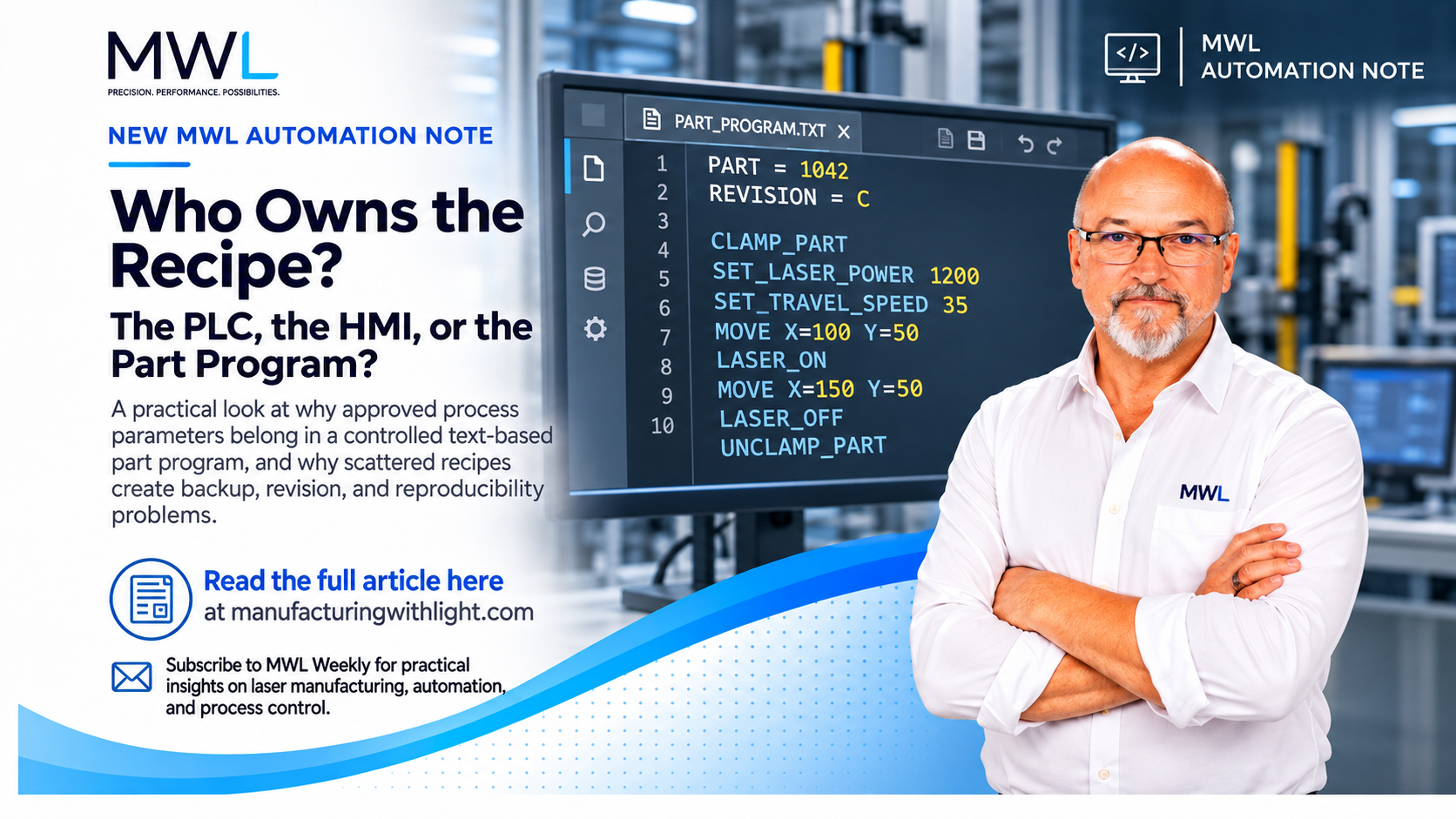
A part program might look something like this:
PART = 1042
REVISION = C

CLAMP_PART
VERIFY_PART

SET_LASER_POWER 1200
SET_TRAVEL_SPEED 35
SET_PROCESS_GAS ARGON

MOVE X=100 Y=50
LASER_ON
MOVE X=150 Y=50
LASER_OFF

UNCLAMP_PART
Illustrative pseudocode only. Actual implementations must define units, command validation, sequencing, interlocks, and safe execution behavior.
The controller understands how to clamp the part, check its interlocks, position the axes, control the laser, and handle errors.
The part program simply calls those capabilities in the required order.
A different product uses a different file.
The underlying machine software doesn’t necessarily have to change.
This becomes especially attractive when a machine manufactures many different products or when process engineers frequently develop new applications.
There’s Still a Place for the HMI
I’m not suggesting we eliminate HMIs or recipe-management interfaces.
Quite the opposite.
A good HMI can make selecting, viewing, developing, and managing part programs easier.
It can display approved process settings, show the current program revision, and give authorized users tools to develop or adjust a process.
But the HMI should not quietly become a second, independent source of process parameters.
If an engineer changes a parameter through the HMI, that change should be managed as part of a controlled process definition.
For an approved production program, temporary adjustments should either be prohibited or managed through a documented, authorized deviation procedure.
The important distinction is that the HMI is an interface to the process definition, not an independently maintained copy of it.
There is also an important qualification.
Not every value belongs in the part program.
Machine-specific information such as servo tuning, calibration values, tool offsets, safety limits, and hardware configuration may legitimately remain in the machine controller or its associated configuration files.
A part program should not be allowed to override essential safety functions or machine-protection limits.
Some applications also require adaptive process control to adjust parameters while the machine is running.
Those cases require additional thought.
But I would still want a clear record of the approved program, the permitted adjustments, and the actual conditions used during production.
The objective isn’t to put every variable in one file.
It’s to ensure that the manufacturing process has one authoritative definition and that its dependencies are controlled.
A Better Foundation for Tomorrow’s Machines
As manufacturers begin exploring AI-assisted programming, diagnostics, and maintenance, I believe structured process files will become even more valuable.
An AI tool could potentially compare two revisions, identify process changes, check programmed values against approved limits, or help determine which program was used to manufacture a particular part.
But that’s only possible if we can reliably identify the process definition and its associated configuration.
If manufacturing instructions are scattered across several proprietary databases, undocumented PLC variables, and HMI screens, even an AI tool will struggle to reconstruct what actually happened.
Good organization makes things easier for technicians today and potentially much easier for software tools tomorrow.
A Final Thought
I’ve spent many years working with both PLC-controlled machines and CNC-style systems.
The more I compare them, the more I believe some of the best ideas from CNC programming deserve wider use in industrial automation.
Keep the machine functions standardized. Keep the manufacturing instructions separate. Keep the approved process parameters together. And make the entire process easy to back up, restore, review, and reproduce.
Not every machine needs a full CNC interpreter. But many machines could benefit from the same philosophy.
Could This Approach Work on Your Machines?
At Manufacturing With Light, we’re interested in helping manufacturers and machine builders explore practical approaches to part-program management, reusable machine functions, and maintainable control software.
If you’re designing a new machine or struggling with recipes scattered across multiple systems, MWL would be happy to discuss how to get started.