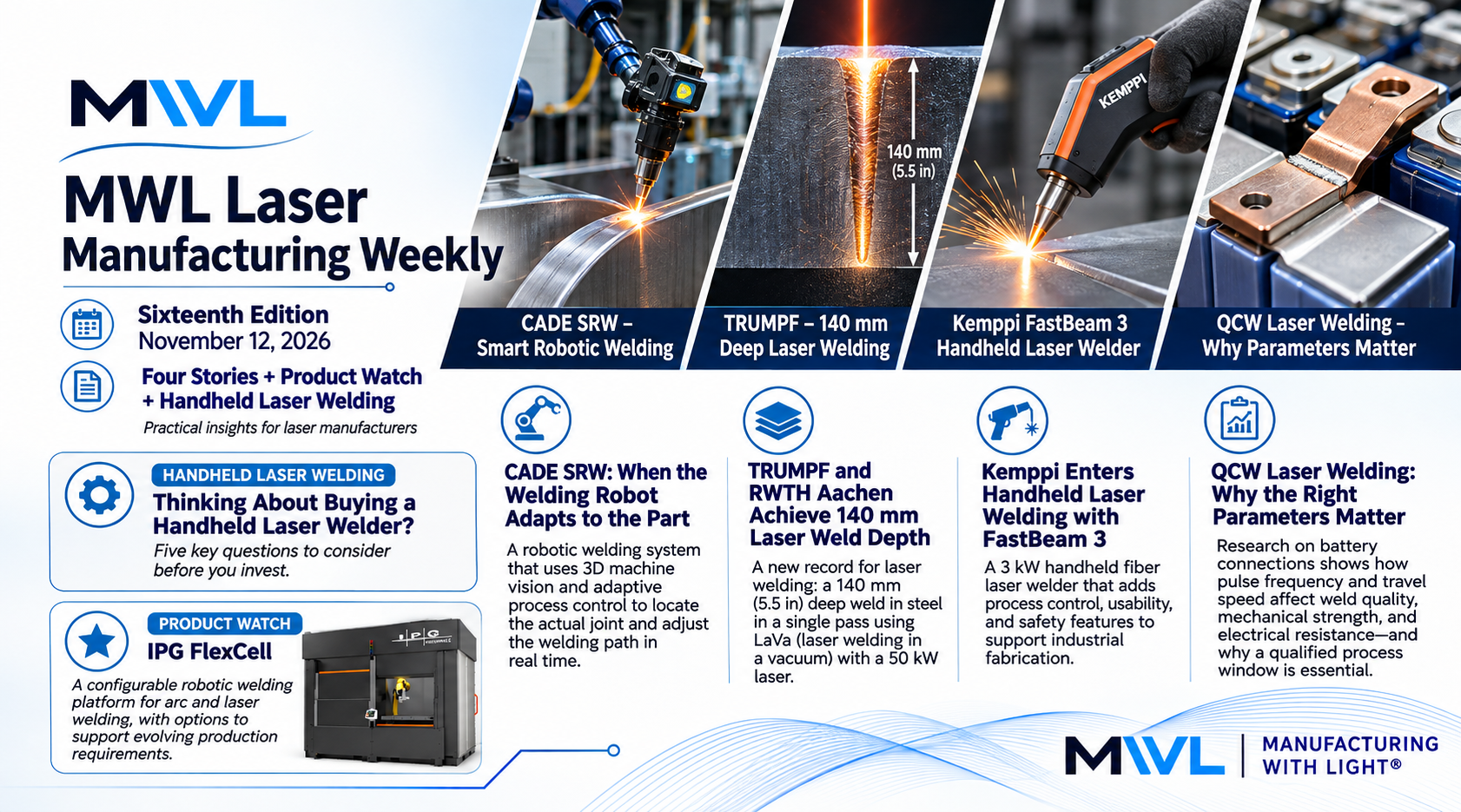
Smart Robotic Welding, Record-Depth Laser Welds, and Why Welding Parameters Matter
November 12, 2026
Welcome to another edition of Manufacturing With Light Weekly!
This week, we’re looking at several interesting developments in welding technology, from robots that can adapt to the actual part instead of following a fixed programmed path, to researchers achieving an impressive 140 mm laser weld depth in steel.
We’re also examining new handheld laser welding equipment and research that demonstrates why selecting the right laser parameters—and verifying the resulting weld—is so important.
In Product Watch, we feature IPG Photonics’ FlexCell robotic welding platform.
And we’re making a change to the newsletter.
For the next several editions, we’ll put the MWL Automation Note on hold and introduce a new recurring section dedicated to Handheld Laser Welding.
Our goal is to help manufacturers understand the technology, evaluate where it makes sense, and address the practical issues involved in introducing it into production.
As always, the emphasis is on the engineering and manufacturing considerations behind the technology.
In This Edition
1. CADE SRW — When the Welding Robot Adapts to the Part
Robotic welding using 3D vision and adaptive process control.
2. TRUMPF — A 140 mm Deep Laser Weld in a Single Pass
Expanding laser welding into heavy-section fabrication.
3. Kemppi — FastBeam 3 Handheld Laser Welder
An established welding manufacturer enters the handheld laser market.
4. QCW Laser Welding — Why Process Parameters Matter
Research connects welding settings to mechanical and electrical performance.
5. MWL Product Watch — IPG FlexCell
A configurable robotic platform for arc and laser welding.
6. Handheld Laser Welding — Where Do You Start?
Five important questions to consider before purchasing a system.
7. From the Shop Floor & Consultants Corner
An invitation to share practical manufacturing knowledge.
1. CADE SRW: When the Welding Robot Adapts to the Part
One of the fundamental challenges in robotic welding is that robots are very good at doing exactly what we tell them to do.
Unfortunately, the parts don’t always cooperate.
Anyone who has worked with fabricated assemblies knows that the actual part doesn’t necessarily match the drawing. Cutting tolerances, forming operations, fixture variation, assembly fit-up, and thermal distortion can all affect the location and geometry of a weld joint.
A robot may repeat its programmed path with excellent precision, but if the weld joint has moved, that precision doesn’t necessarily produce a good weld.
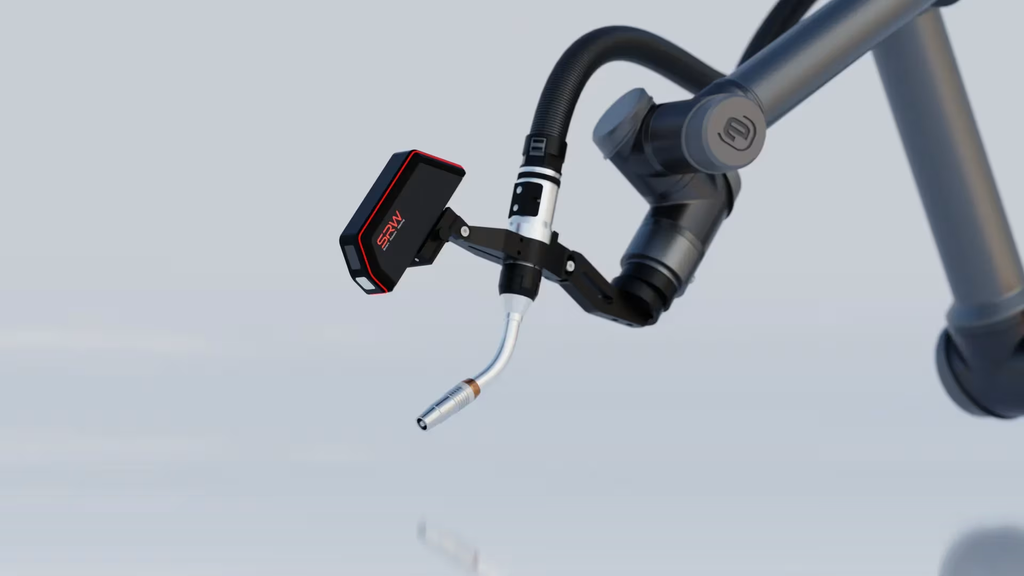
CADE, an engineering company based in Spain, has developed an approach called SRW—Smart Robotic Welding.
The system combines robotic motion, 3D machine vision, and adaptive welding control to identify and follow the actual weld joint.
Rather than relying entirely on a fixed, pre-taught path, SRW can locate the joint, determine its geometry, and make corrections during welding.
According to CADE, the system can:
- Detect and locate weld joints using 3D machine vision.
- Generate welding paths based on the actual part geometry.
- Correct the robot’s path during welding.
- Adjust torch position, orientation, and stand-off distance.
- Adapt welding parameters to changes in joint geometry.
- Record process information for traceability.
CADE describes applications involving pressure vessels, tanks, piping, and structural fabrication.
The company demonstrated SRW at MetalMadrid 2026, held November 4–5 in Spain.
A Practical Application
One particularly interesting application involves automated tank welding.
CADE’s associated Agile Smart Factories organization describes a system that integrates a Universal Robots collaborative robot, an EWM ForceTig welding system, and SRW vision-based joint tracking with an existing tank-welding tower.
Rather than replacing the customer’s complete installation, the system adds robotic welding and intelligent joint tracking to equipment already in place.
For manufacturers with substantial investments in existing equipment, that’s an interesting approach.
Why It Matters
I find this technology particularly interesting because it highlights an important difference between positioning accuracy and process accuracy.
You can have an extremely accurate motion system and still produce a poor result if the process doesn’t account for part variations.
Traditional robotic welding often addresses this problem through tighter tolerances, sophisticated fixtures, seam-finding routines, or dedicated seam-tracking sensors.
Those approaches can work very well, but they also add cost and complexity.
CADE’s approach brings joint detection, path correction, and process adjustment together in a more integrated solution.
That could be especially valuable for large fabricated assemblies, low-volume production, or applications where perfect part-to-part consistency is difficult to achieve.
Although CADE identifies laser welding as a compatible process, the publicly documented tank-welding application uses arc welding. Laser-specific performance would need to be evaluated separately.
For laser welding, joint-position accuracy, fit-up, beam alignment, and process stability can be especially critical.
MWL Takeaway: Sometimes improving robotic welding isn’t about making the robot more accurate. It’s about giving the robot better information about the actual part.
Sources:
- CADE Engineering — CADE SRW: Intelligent Robotic Welding
- Agile Smart Factories — Automated Tank Welding with SRW
2. TRUMPF and RWTH Aachen Achieve 140 mm Laser Welding Depth
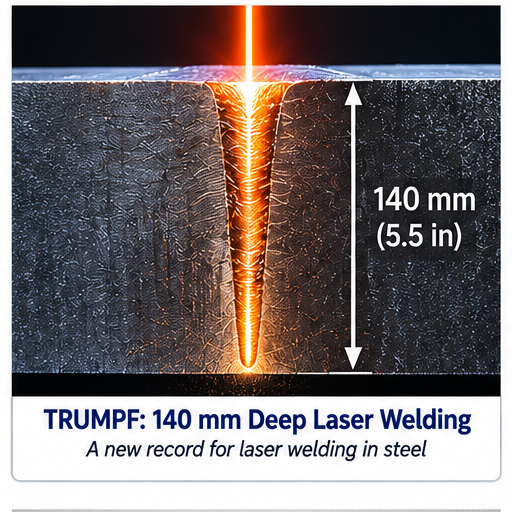
TRUMPF and researchers at RWTH Aachen University have reported an impressive achievement in high-power laser welding.
Using laser welding in a vacuum (LaVa), the research team produced a weld reaching 140 mm—approximately 5.5 inches—deep in steel in a single pass.
TRUMPF announced the achievement on November 9, 2026, describing it as a new record for laser-based deep welding.
The experiments used a 50 kW high-power laser operating at a reduced ambient pressure of approximately 50 mbar.
TRUMPF also employed its BrightLine Weld beam-shaping technology to help stabilize the welding process.
According to the company, comparable laser-based processes had previously achieved welding depths of approximately 60 mm.
Potential applications include shipbuilding, offshore wind energy, pipelines, and heavy industrial fabrication.
Why It Matters
When we think about laser welding, many of us think of relatively thin materials, precision components, and applications where low heat input and reduced distortion are important.
Welding steel more than five inches deep takes the discussion into a different category.
Heavy-section welding commonly requires substantial joint preparation, filler material, multiple welding passes, and considerable processing time.
A process that can produce deep welds with fewer passes could offer significant productivity benefits.
Of course, penetration depth alone doesn’t establish that a welding process is ready for production.
Important questions remain about joint preparation, weld quality, mechanical properties, inspection, equipment costs, and process qualification.
And a 50 kW laser operating with vacuum equipment isn’t something most fabrication shops will be purchasing next week.
But this achievement is an interesting indication of how laser welding continues to expand into applications traditionally dominated by conventional welding processes.
The Bigger Picture
Much of the discussion around industrial laser welding focuses on replacing an existing process with something faster.
This research suggests a somewhat different opportunity.
In certain applications, laser welding may eventually change how large structures are designed and manufactured.
If manufacturers can reduce the number of welding passes, they may also reduce handling, repositioning, distortion correction, and other manufacturing operations surrounding the weld.
Those potential benefits will need to be demonstrated in production, but they make this development worth watching.
MWL Takeaway: Advances in laser technology aren’t just making existing processes faster. They’re opening possibilities for applications that previously weren’t practical for laser welding.
Source: TRUMPF — World Record with a High-Power Laser, November 9, 2026
3. Kemppi Enters Handheld Laser Welding with FastBeam 3
Another established welding-equipment manufacturer is entering the handheld laser welding market.
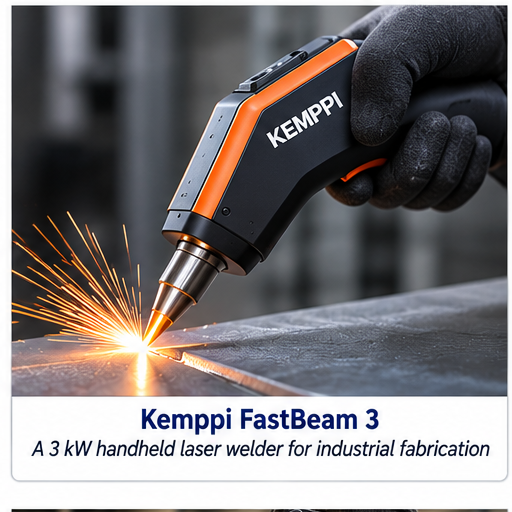
Finland-based Kemppi introduced its FastBeam 3, a 3 kW handheld fiber laser welding system, in October 2026.
The water-cooled system is designed for industrial fabrication involving steel, stainless steel, and aluminum.
While the laser’s output power is certainly significant, several other features caught our attention.
Kemppi’s Penetration Shape Control allows operators to adjust beam shape, power distribution, oscillation, and other parameters to influence the weld profile.
The system also includes Weld Assist, designed to guide operators toward suitable starting parameters for different welding applications.
Kemppi emphasizes equipment usability, integrated safety functions, and process control.
The company reports welding speeds exceeding ten times those of TIG in certain applications, although actual productivity gains will depend on materials, joint design, preparation, and production requirements.
Why It Matters
The handheld laser welding market has been changing rapidly.
Early discussions about these systems often focused on welding speed, penetration, and whether a handheld laser could replace TIG or MIG welding for particular applications.
Those questions remain important.
But I think we’re reaching a point where manufacturers need to consider much more than the laser’s power rating.
How easy is it to establish and repeat a welding procedure?
What happens when the operator changes?
Can the system consistently produce the required weld quality?
What training, replacement parts, technical support, and service are available?
Kemppi’s entry is interesting because the company brings an established background in industrial welding equipment and process development.
It’s another indication that handheld laser welding is becoming part of the broader industrial welding market rather than remaining a specialized technology.
Beyond the Price Tag
The handheld laser welding market includes equipment at widely varying price points.
For some applications, a relatively simple system may be entirely adequate.
For others, usability, process development assistance, training, and long-term support can be just as important as the hardware.
That doesn’t automatically make a more expensive machine the better choice.
It means manufacturers need to evaluate the complete package against their actual production requirements.
MWL Takeaway: A good handheld laser welding system needs more than laser power. Process control, usability, safety, and supplier support are increasingly important parts of the purchasing decision.
Sources:
4. QCW Laser Welding: Why the Right Parameters Matter
Here’s a research story that I think deserves attention from anyone developing or supporting a laser welding process.
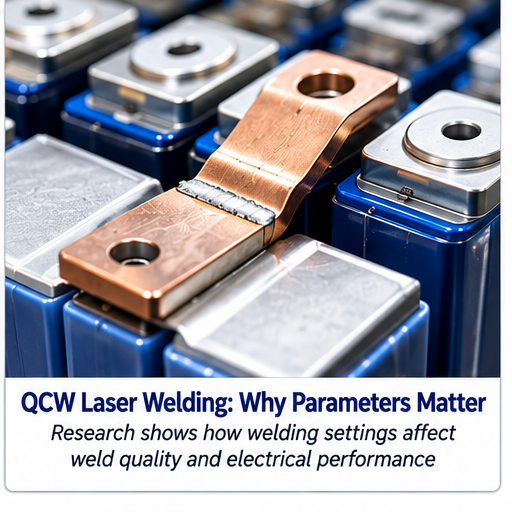
A paper published in Manufacturing Letters, titled “Investigation of Quality and Integrity in QCW Fiber Laser Welding of Tab to Busbar for EV Battery Interconnects,” examines how laser welding parameters affect the quality and performance of electrical connections used in battery manufacturing.
The researchers studied quasi-continuous-wave (QCW) fiber laser welding of nickel-plated copper busbars to multilayer stainless steel–copper–stainless steel battery tabs.
They investigated how laser pulse frequency and travel speed affected:
- Weld geometry and morphology.
- Mechanical bond strength.
- Electrical contact resistance.
- Material hardness.
One important finding was that pulse overlap and linear energy density strongly influenced the resulting weld.
Within the experimental conditions studied, the researchers identified a favorable pulse-overlap range of approximately 20–60%, combined with linear energy density between 20 and 40 J/mm.
Those conditions produced bond failure loads greater than 500 N and contact resistance below 160 micro-ohms.
The researchers also reported a 43.6% reduction in electrical contact resistance when increasing pulse frequency from 25 Hz to 75 Hz at a travel speed of 7 mm/s.
These results are specific to the tested materials, joint configuration, and experimental conditions. They should not be interpreted as general-purpose welding recommendations.
Why It Matters
This is one of those research papers that illustrates something I’ve encountered repeatedly in laser manufacturing.
Getting the laser to make a weld is usually much easier than understanding what makes that weld acceptable.
We can adjust power, pulse frequency, pulse duration, travel speed, focus, beam oscillation, and other settings until we produce something that looks like a good weld.
But what does that really tell us?
In this battery application, the weld has two important jobs.
It must provide a mechanically reliable connection, and it must conduct electrical current with sufficiently low resistance.
A weld that looks acceptable may not necessarily satisfy both requirements.
The researchers used mechanical testing, electrical measurements, and weld morphology analysis to understand how process changes affected performance.
That’s the part I find most valuable.
Too often, process development becomes an exercise in changing settings until the result looks acceptable.
A more disciplined approach is to establish a qualified process window based on measurable results.
That means identifying the important parameters, understanding how they interact, and testing whether the resulting weld actually meets the application’s requirements.
It’s also worth remembering that more energy isn’t always better.
Increasing heat input can improve penetration or bonding under some conditions, but excessive energy can introduce distortion, undesirable changes in weld geometry, and other problems.
Process Monitoring Is Not the Same as Weld Inspection
There is another important distinction.
Recording that a laser operated at the correct power, frequency, and travel speed doesn’t prove that every resulting weld is acceptable.
Process monitoring can tell us whether the machine operated within established conditions.
Inspection and testing help determine whether the finished weld meets its requirements.
Both can be valuable, but they answer different questions.
Before deciding which production data to monitor, we first need to understand which parameters actually influence weld quality.
That’s one reason research like this is useful.
The Bigger Picture
This study focuses on electrical battery connections, but the lessons extend to many laser manufacturing applications.
Whether we’re welding medical devices, automotive parts, aerospace assemblies, or everyday fabricated products, we need to understand the relationship between the laser parameters and the finished result.
And we need appropriate methods to verify that result.
MWL Takeaway: A successful laser welding process isn’t simply a set of settings that produces a good-looking weld. It’s a process with defined parameters, known limits, and measurable evidence that the finished weld meets its requirements.
Research Reference:
R. Gorai and R. Singh, “Investigation of Quality and Integrity in QCW Fiber Laser Welding of Tab to Busbar for EV Battery Interconnects,” Manufacturing Letters, Volume 49, Supplement, October 2026, pp. 377–386.
Read the original research paper — DOI: 10.1016/j.mfglet.2026.07.048
5. MWL Product Watch
IPG FlexCell: Robotic Welding with Room to Grow
This week’s Product Watch features the IPG Photonics FlexCell robotic welding platform.
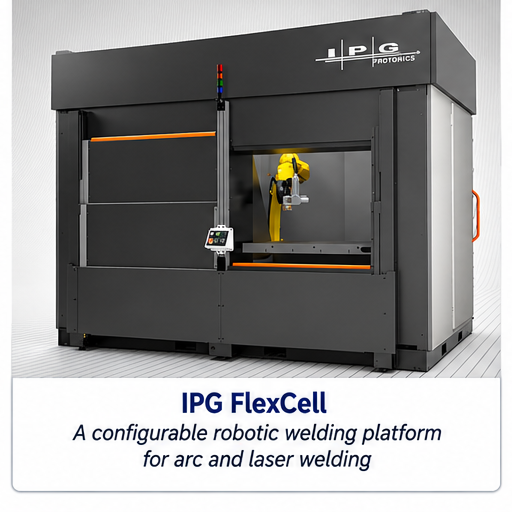
FlexCell is a configurable, pre-engineered robotic welding system offered in both conventional arc and laser welding configurations.
Rather than requiring every application to start with a completely custom robotic cell, IPG offers standard platform arrangements that can be configured to meet different manufacturing requirements.
Options include fixed-table workstations, trunnion positioners, dual-station systems, and other part-handling configurations.
Laser versions can incorporate IPG fiber laser sources, laser welding heads, and machine vision for weld placement.
Arc welding configurations are available with equipment from established welding manufacturers.
IPG also presents a future upgrade path from an arc welding system to a laser welding configuration, subject to application requirements and the necessary system changes.
Why It Caught Our Attention
For manufacturers considering robotic welding, selecting the welding process is only one part of the decision.
There are many other questions.
How will the parts be loaded and positioned?
What fixturing will be required?
How difficult will programming and changeovers become?
What safety systems are needed?
Who will support the equipment when something goes wrong?
And what happens when production requirements change?
A pre-engineered platform can provide a more structured starting point than designing an entire welding system from scratch.
I also like the idea of a supplier that can discuss both conventional arc welding and laser welding rather than assuming one process is always the correct solution.
Laser welding offers some attractive advantages, but joint tolerances, material conditions, production volume, and application economics still determine whether it makes sense.
For many manufacturers, the flexibility to choose the appropriate process may be more valuable than committing to one technology.
MWL Product Watch Takeaway: The value of a robotic welding system isn’t simply how fast it can make a weld. It’s how effectively the complete system supports reliable production.
Source: IPG Photonics — FlexCell Robotic Welding Systems
MWL Product Watch highlights products and technologies we believe may interest manufacturers. Inclusion does not constitute an MWL endorsement or an independent product evaluation.
6. Handheld Laser Welding
Thinking About Buying a Handheld Laser Welder? Where Do You Start?
Welcome to our new recurring section on handheld laser welding.
Over the next several editions, we’ll look at the technology from the perspective of manufacturers considering a purchase or beginning to introduce handheld laser welding into production.
The emphasis will be on practical applications, equipment selection, safety, training, process development, and the problems that often get little attention during product demonstrations.
Before You Buy
Handheld laser welding has attracted a lot of attention over the past several years, and for good reasons.
The equipment can offer impressive welding speeds, relatively low heat input, reduced distortion, and some very attractive results compared with conventional welding processes.
If you’ve watched a good demonstration, it’s easy to understand the appeal.
But watching someone make an impressive weld at a trade show and introducing a new welding process into your own manufacturing operation are two very different things.
Before you start comparing machines and prices, I think there are five questions worth answering.
1. What Are You Actually Planning to Weld?
This sounds obvious, but it’s probably the best place to begin.
What materials are you welding? How thick are they? What joint configurations are involved? What tolerances can you maintain?
Are you making repetitive production welds or repairing and fabricating different parts every day?
Handheld laser welding can be an excellent process for certain applications, but it’s not the best choice for everything.
Joint fit-up can be especially important, and some applications may require additional process development, filler wire, or changes to part preparation.
Before purchasing a machine, I would want the supplier to demonstrate the process using my actual parts or representative samples, not just a collection of perfectly prepared demonstration coupons.
2. Who Is Going to Operate It?
One attraction of handheld laser welding is that the basic welding process can be relatively easy to learn.
That doesn’t mean good welding knowledge is no longer important.
Operators still need to understand joint preparation, fit-up, travel speed, shielding gas, filler material where appropriate, and how to recognize an unacceptable weld.
They also need training on the laser system and its operating procedures.
The equipment may simplify the physical act of welding, but it doesn’t eliminate the need to understand the process.
And it’s important to distinguish learning how to operate the machine from becoming qualified to produce welds for a particular application.
Those are not necessarily the same thing.
3. Is Your Facility Ready for a High-Power Laser?
This is probably the most important question, and it needs to be addressed before the equipment is put into service.
Handheld laser welding equipment typically contains a high-power Class 4 laser.
Direct and reflected laser radiation can cause severe eye and skin injuries.
A suitable installation requires much more than purchasing a pair of laser safety glasses.
The American Welding Society’s handheld laser welding safety guidance identifies the need for a Laser Safety Officer, a documented laser safety program, appropriate controlled areas, protective equipment, operator training, and other safeguards.
Depending on the installation, this can include a laser-safe enclosure or controlled workspace, access interlocks, warning systems, appropriate ventilation, and procedures to prevent unintended exposure.
Unlike some conventional welding operations, we cannot assume the surrounding shop is safe from hazardous laser reflections.
The laser safety eyewear and welding helmet must provide protection appropriate to the laser wavelength and the hazard assessment. Ordinary welding helmets are not substitutes for laser-rated protection.
These are not reasons to avoid handheld laser welding.
They are reasons to plan the installation properly and involve a qualified Laser Safety Officer before the equipment is put into operation.
Safety isn’t an accessory you purchase after the welder arrives. It’s part of the installation.
4. How Will You Know the Weld Is Good?
Making a weld that looks good isn’t necessarily the same as making a weld that meets the application requirements.
This week’s QCW laser welding research is a perfect example.
For some parts, visual inspection may be an appropriate part of the acceptance process.
For others, the application may require mechanical testing, cross sections, penetration measurements, leak testing, or other qualification and inspection methods.
The question is what the finished weld needs to accomplish.
Is it a structural joint?
Does it need to be leak-tight?
Is appearance the primary requirement?
Are there applicable welding codes or customer specifications?
And can you consistently reproduce the required result?
Not every production weld needs destructive testing, but every application needs an appropriate method to establish and verify acceptable quality.
5. Who Is Going to Support You After the Sale?
This is a subject I’ve been thinking about quite a bit recently.
Handheld laser welding equipment is available at a wide range of prices.
Sometimes a lower-priced machine may be perfectly adequate for an application.
But the purchase price is only one part of the investment.
What happens when you need help developing a new welding procedure?
Who trains your operators?
Can you get replacement parts?
Who provides service when the machine stops working?
Will the supplier help you understand why a particular weld isn’t producing the results you expected?
For some manufacturers, that application knowledge and support may be more valuable than additional laser power or another feature on the control screen.
I’m not suggesting everyone needs to purchase the most expensive machine.
I’m suggesting that the right machine is the one that meets your manufacturing requirements, including the support required to keep it productive.
Where Do We Go from Here?
In the coming weeks, we’ll take a closer look at handheld laser welding from the perspective of manufacturers considering the technology or beginning to use it.
We’ll discuss the applications where it makes sense, safety and training requirements, equipment selection, process development, weld quality, and the practical issues involved in day-to-day production.
The goal is not to promote one manufacturer over another.
It’s to provide useful information that helps manufacturers make informed decisions.
MWL Takeaway: Buying a handheld laser welder may be relatively straightforward. Successfully introducing handheld laser welding into production takes a little more planning.
Safety and Technical References:
- American Welding Society — Handheld Laser Welding Safety, January 2025
- American Welding Society — Providing a Safe Environment for Handheld Laser Welding, May 2025
- OSHA — Laser Hazards: Standards
- FDA — Laser Products and Instruments
7. From the Shop Floor — We Want to Hear From You
Some of the most useful manufacturing knowledge comes from the people who work with these processes every day.
We’re continuing to invite readers to contribute their experiences to our From the Shop Floor section.
Have you solved a difficult laser welding problem? Found a better way to manufacture a part? Encountered something unexpected during commissioning or production?
We’d be interested in hearing about it.
Your contribution doesn’t need to be a formal technical article.
A short description of the problem, what you tried, and what you learned can be valuable to other manufacturers.
And if you have an interesting manufacturing application or process improvement you’d like to share, we’d like to hear about that too.
Consultants Corner — Share Your Expertise
MWL also welcomes contributions from independent consultants, engineers, and industry specialists.
Our goal is to share practical technical knowledge while giving contributors an opportunity to introduce their experience and expertise to readers.
Topics can include laser materials processing, additive manufacturing, motion control, automation, process development, safety, or other areas of advanced manufacturing.
You don’t need to be a professional writer.
If you have something interesting to share, we can work together to turn it into an article.
Contact Manufacturing With Light through LinkedIn if you’d like to contribute.
Closing Thought
This week’s stories cover several very different welding technologies.
CADE is using machine vision to help robots adapt to real parts.
TRUMPF is pushing the boundaries of deep laser welding.
Kemppi is bringing its industrial welding experience into the handheld laser market.
And the QCW battery welding research reminds us how much the process parameters influence the finished result.
The technology is impressive.
But I think the bigger lesson is that successful manufacturing requires understanding the entire process—not just the machine.
The best technology is the technology we can make work reliably, consistently, and economically in production.
Thanks for reading Manufacturing With Light Weekly.
If you find the newsletter useful, please subscribe, share it with a colleague, and join the discussion.
Manufacturing With Light (MWL)
www.manufacturingwithlight.com
#ManufacturingWithLight #LaserManufacturing #LaserWelding #HandheldLaserWelding #RoboticWelding #AdvancedManufacturing #WeldingTechnology #ManufacturingEngineering