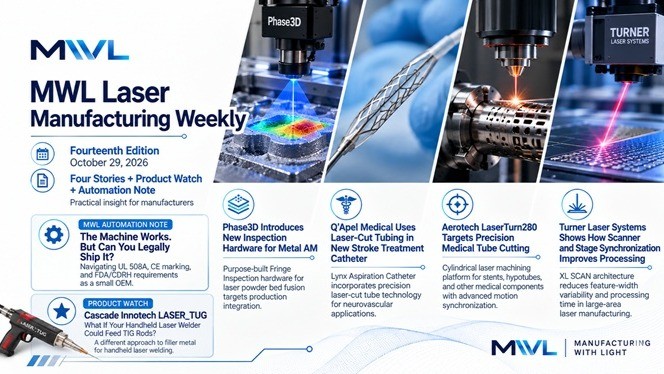
Precision, Production, and the Challenges of Building Better Laser Machines
Welcome to Edition 14 of Manufacturing With Light Weekly.
This week, we’re looking at several different developments in laser manufacturing, but I think they have something important in common.
Whether we’re talking about inspecting a metal additive manufacturing process, laser-cutting intricate medical components, or improving the performance of a precision motion system, the challenge is moving beyond simply demonstrating that a technology works.
The real value comes when that technology becomes part of a reliable, repeatable, and economically practical manufacturing process.
We have four industry stories this week, with a particular emphasis on U.S. manufacturers and technology developers.
Our Product Watch looks at an unusual accessory for handheld laser welding that uses standard TIG filler rods instead of wire spools.
And this week’s Automation Note is a little different. It may leave you with more questions than answers as we discuss the compliance challenges small machine builders face.
In This Edition
- Phase3D: New Inspection Hardware for Metal Additive Manufacturing
- Q’Apel Medical: How Laser-Cut Tubing Supports a New Stroke Treatment Catheter
- Aerotech: LaserTurn280 Brings Precision Motion to Medical Tube Cutting
- Turner Laser Systems: Better Scanner and Stage Synchronization Improves Laser Processing
- MWL Product Watch: LASER_TUG — What If Your Laser Welder Could Feed TIG Rods?
- MWL Automation Note: The Machine Works. But Can You Legally Ship It?
- From the Shop Floor: We’d Like Your Input
1. Phase3D Introduces New Inspection Hardware for Metal Additive Manufacturing
Chicago, Illinois | October 27, 2026
Chicago-based Phase3D has introduced a new generation of its Fringe Inspection technology designed specifically for laser powder bed fusion (LPBF).
The new hardware is the result of a multi-year development effort to make layer-by-layer inspection easier to integrate into production additive manufacturing systems.
Unlike traditional monitoring approaches that rely primarily on process images, Fringe Inspection uses structured light to measure the build surface and produce quantitative height data. Those measurements allow engineers to identify and characterize variations in the powder bed and the processed surface.
The new hardware architecture is the key change.
Phase3D has moved beyond an inspection system assembled from commercially available components to a purpose-built platform designed for OEM integration and larger-scale deployment.
The new design includes a custom projector, integrated computing and storage, passive cooling, industrial connectors, and multiple triggering options. These changes are intended to make the technology easier to incorporate into existing and future LPBF machines.
Why It Matters
One ongoing challenge in metal additive manufacturing is knowing what’s happening inside the machine while a part is being built.
A problem early in a build can waste hours of machine time and expensive material.
Inspection systems can identify potential problems, but they also need to be reliable, repeatable, and maintainable. That becomes particularly important when a manufacturer moves from operating one or two additive machines to managing an entire production fleet.
The MWL Perspective
What caught my attention wasn’t simply that Phase3D developed another inspection system.
It’s that the company is working to turn an inspection technology into a standardized machine subsystem.
That distinction matters.
Manufacturing equipment needs reliable interfaces, predictable operation, accessible diagnostics, and hardware that can be consistently reproduced and supported.
Better measurement technology is valuable.
Making that measurement technology practical for everyday manufacturing may be even more valuable.
Source: TCT Magazine — Phase3D Launches Purpose-Built Inspection Hardware for Laser Powder Bed Fusion
2. Q’Apel Medical Demonstrates the Value of Precision Laser-Cut Tubing
Fremont, California | September 9, 2026
Q’Apel Medical launched its Lynx Aspiration Catheter System in the United States in September, expanding the company’s product line for neurovascular procedures.
The catheter is designed for use in mechanical thrombectomy, a procedure used to remove blood clots during treatment of certain ischemic strokes.
What makes this development particularly interesting to MWL is the use of Q’Apel’s proprietary Laser Cut Tube technology, or QLCT.
This is the second Q’Apel product incorporating that technology.
The design combines laser-cut metallic tubing with other catheter materials to achieve specific mechanical characteristics.
According to Q’Apel, the Lynx system uses stainless steel and nitinol laser-cut tube structures to provide proximal support, distal flexibility, and kink resistance.
These characteristics are especially important when a catheter must navigate narrow, curved blood vessels while maintaining adequate control.
Why It Matters
Medical-device manufacturing offers some excellent examples of what precision laser processing can accomplish.
Laser cutting allows engineers to create intricate patterns in extremely small metal tubes.
By changing the geometry of those patterns, manufacturers can influence how the finished component bends, twists, and responds to mechanical loading.
The laser isn’t simply cutting the material to a particular length.
It’s helping create the mechanical characteristics of the finished medical device.
The MWL Perspective
I’ve worked with precision laser tube-cutting equipment, and one thing that has always interested me is the relationship between the cutting process and the finished component’s performance.
These are demanding applications.
The system must coordinate rotary and linear motion, maintain a consistent relationship between the laser and the tube, and repeatedly produce very small features.
Once those features are cut, the manufacturer still needs to address material condition, dimensional inspection, finishing, cleaning, and other requirements associated with medical-device production.
In applications like this, the laser-cut pattern isn’t just a manufacturing detail. It’s part of the product design.
Sources: Q’Apel Medical — News and Announcements | Q’Apel — Lynx Product Information | Q’Apel Laser Cut Tube Technology
3. Aerotech LaserTurn280 Targets Precision Medical Tube Cutting
Pittsburgh, Pennsylvania | September 2026
Aerotech’s LaserTurn280 is a precision motion platform developed for cylindrical laser machining applications, including medical stents, hypotubes, and other small-diameter components.
The system combines a linear motor stage with three rotary-stage configurations. Depending on the selected configuration, it accommodates tube diameters from 0.3 to 30 mm.
Aerotech has also incorporated workholding and material-handling features intended to simplify integration into complete laser machining systems.
The platform can be configured for wet or dry cutting, and it supports different collet arrangements depending on the application.
When used with Aerotech’s Automation1 control platform, the system can leverage Position-Synchronized Output (PSO) and Enhanced Tracking Control (ETC).
These capabilities are particularly relevant when coordinating laser pulses with high-speed motion.
Why It Matters
Medical tube cutting is an application where the motion system can make a substantial difference in both productivity and part quality.
The challenge isn’t simply positioning the tube accurately.
It’s coordinating linear and rotary movement while keeping the laser synchronized with the programmed cutting path.
For complex patterns, small contour errors can become significant relative to the size of the features being produced.
The machine also needs to handle material efficiently, avoid unwanted tube movement during regripping, and produce consistent results from one component to the next.
The MWL Perspective
One thing I’ve learned working with precision laser cutting equipment is that controller specifications don’t always tell you how a machine will perform in a real application.
The motion trajectory, available interpolation methods, acceleration limits, tube support, and laser synchronization all matter.
And some of these limitations don’t become obvious until you’re actually cutting a part.
That’s why I like seeing motion platforms developed around a particular manufacturing application rather than simply assembling a collection of precision stages.
The goal isn’t just accurate motion. It’s making the correct part, repeatedly, at a useful production rate.
Sources: Aerotech — LaserTurn280 Product Information | Medical Design & Outsourcing — Aerotech’s Cylindrical Laser Machining Platform
4. Turner Laser Systems Shows Why Scanner and Stage Synchronization Matters
Fremont, California | ICALEO 2026
Turner Laser Systems presented research at ICALEO 2026 demonstrating how coordinating galvanometer scanners with precision linear stages can improve laser processing across large working areas.
SCANLAB, ACS Motion Control, and Physik Instrumente developed the work using the XL SCAN architecture.
Conventional galvanometer scanners are very effective at moving a laser beam rapidly within a limited field.
But as processing areas grow, manufacturers often need to move the part or the scanner to reach adjacent regions.
That introduces the possibility of stitching errors, geometric differences between scan fields, and additional processing time.
The approach demonstrated by Turner coordinates the scanner and linear stages so that both contribute to the laser trajectory.
According to the company’s reported results, the system reduced feature-width variability from 1.53 µm to 0.52 µm over substrates exceeding 200 mm, eliminated visible stitching lines in the demonstrated process, and reduced processing time by 22%.
Those results are specific to the reported application and should not be interpreted as universal performance improvements.
Why It Matters
Precision laser processing requires more than a laser beam that can be positioned accurately.
The beam must follow the intended path at the appropriate velocity, and the process must remain consistent over the entire working area.
As manufacturing areas become larger, maintaining that performance becomes increasingly difficult.
Synchronizing the scanner with the machine stages offers another approach to solving the problem.
Rather than treating the galvo and mechanical axes as separate systems, the control architecture coordinates them as part of one manufacturing process.
The MWL Perspective
This story particularly interests me because it connects directly with something we’ve discussed at MWL before.
A faster laser doesn’t necessarily produce more parts per hour.
Sometimes the limiting factor is the motion system, the path, or the way different axes are coordinated.
Turner also reported separate research on through-glass-via manufacturing that increased processing throughput from four to nine holes per second using the same laser source.
That is a useful reminder that improving the control and motion system may sometimes provide more value than upgrading the laser itself.
I’d like to see more practical studies like this, where the improvements are measured against actual manufacturing results rather than simply comparing individual component specifications.
Source: Turner Laser Systems — ICALEO 2026 Technical Announcement
MWL Product Watch
What If Your Handheld Laser Welder Could Feed TIG Rods?
Featured Product: LASER_TUG — Cascade Innotech
One advantage of handheld laser welding is its versatility. But filler-wire feeding can create challenges, particularly for shops producing small batches, changing materials frequently, or working with joints that require additional filler metal.
Cascade Innotech has developed an interesting alternative called LASER_TUG.
Rather than relying on a conventional spool-fed wire feeder, LASER_TUG mounts directly to the handheld laser welding gun and uses straight TIG filler rods.
According to the manufacturer’s published specifications, the system accommodates rods up to 1/8-inch diameter, with adjustable feed rates from 0 to 150 inches per minute.
The supplier promotes easier changes between filler alloys and diameters, reduced dependence on wire spools, and the potential for increased filler-metal deposition.
Why It Caught My Attention
I like products that solve practical manufacturing problems without requiring a purchase of an entirely new machine.
For a small fabrication shop, purchasing a separate spool of wire for every material and diameter may not make economic sense.
Conventional TIG filler rods can offer greater flexibility, especially for short production runs or occasional specialty alloys.
There are trade-offs, of course.
Mounting the feeder directly on the welding gun adds equipment the operator must handle. Rod length limits continuous feeding time, and larger filler diameters don’t automatically produce better welds.
I’d be particularly interested in how the added weight affects ergonomics and how consistently the system feeds filler material during production.
The MWL Perspective
Handheld laser welding technology continues to evolve, but not every useful improvement needs to come from the laser source itself.
Sometimes a relatively simple accessory can make an existing system more practical.
LASER_TUG is worth a closer look, especially for shops that frequently change filler materials or need more flexibility than a conventional spool-fed system provides.
I’d be interested in hearing from anyone who has used one in production.
Product availability: At the time of this review, Serra Laser lists LASER_TUG for $3,500 as a preorder item. The listing also indicates that the product is sold out. Interested buyers should confirm compatibility, availability, and expected delivery directly with the supplier.
Manufacturer: Cascade Innotech Distributor: Serra Laser Product information: LASER_TUG at Serra Laser
MWL Product Watch highlights technology that may interest manufacturers. Inclusion does not constitute an MWL endorsement. Product performance claims should be evaluated for the intended application.
MWL Automation Note
The Machine Works. But Can You Legally Ship It?
This week’s Automation Note may leave you with more questions than answers. And that’s intentional.
Normally, I use these notes to share practical ideas about machine automation, programming, and the problems we encounter building and maintaining industrial equipment. But this week, I’d like to raise a problem that I believe deserves more discussion, particularly among smaller machine builders.
How do small OEMs navigate the complex and potentially expensive requirements for machine safety and regulatory compliance?
Consider a small company that has just finished building a specialized laser welding system. The motion control works, the laser process is reliable, the safety systems have been designed, and the customer is pleased with the results. Now it’s time to ship the machine.
Then someone asks: “Is the electrical panel UL 508A Listed?”
Or perhaps the customer is in Europe and wants CE marking. And if the machine is headed for the U.S. market, another question comes up: “Have you addressed the FDA/CDRH requirements for the finished laser product?”
Suddenly, making the machine work may have been the easy part.
For large equipment manufacturers with dedicated compliance departments, established certification processes, and standardized product lines, these requirements are part of everyday business. But what about the small OEM building three or four specialized machines a year?
They may have excellent controls engineers, mechanical designers, and laser-processing expertise. What they probably don’t have is a full-time regulatory compliance department.
And that’s where I’d like to start the discussion.
The Facts: What Does Compliance Actually Require?
Laser-machine manufacturers may need to address several requirements, depending on the machine, its intended use, and where it will be installed.
UL 508A — Industrial Control Panels
UL 508A covers industrial electrical control panels, not the complete machine they control. [A1]
One challenge for smaller OEMs is finding components with appropriate certifications and documentation. Not every component must be UL Listed. UL Recognized components can also be acceptable when used according to the applicable requirements and their conditions of acceptability.
But specialized automation equipment doesn’t always fit neatly into those categories. You might select an excellent industrial computer, motion controller, laser interface, or power supply, only to discover that its certification status creates a problem for the panel builder.
Now what? Do you substitute another component? Arrange an additional evaluation? Redesign the electrical system? None of those options is particularly attractive when the machine has already been engineered.
And there’s an important distinction worth remembering: A UL 508A Listed control panel does not mean the complete laser machine has been certified.
In the United States, electrical equipment acceptance also involves applicable OSHA requirements, electrical codes, and the authority having jurisdiction. UL is not the only nationally recognized testing laboratory, and a UL 508A Listed panel is not a universal legal requirement for every machine installation. [A2]
However, electrical approval requirements are real, and customer specifications may be more demanding than the applicable minimum legal requirements.
CE Marking — European Markets
CE marking is another area where I think there’s considerable misunderstanding. For many categories of machinery, the manufacturer can perform the conformity assessment and issue its own Declaration of Conformity. An independent notified body is not automatically required. [A3]
That sounds relatively straightforward. But the manufacturer still has to demonstrate compliance with the applicable European requirements.
For laser-processing equipment, that may involve machinery safety, electrical safety, electromagnetic compatibility, laser radiation hazards, risk assessment, safety-function validation, technical documentation, and testing.
So although you don’t purchase the CE mark itself from a certification organization, demonstrating conformity can be expensive. Especially if you’re building only a handful of machines.
A regulatory change is also approaching. The EU Machinery Regulation (EU) 2023/1230 becomes generally applicable on January 20, 2027, replacing the existing Machinery Directive for machinery placed on the market under the new regime. [A4]
For small OEMs developing equipment for Europe, that’s one more reason to establish the requirements early.
FDA/CDRH — Laser Product Compliance
For manufacturers selling laser products in the United States, the FDA’s laser-product regulations add another set of responsibilities. [A5]
Purchasing a commercial laser source doesn’t automatically establish compliance of the completed machine. Depending on the product and applicable provisions, the machine builder may be responsible for classification, protective housings, interlocks, labeling, testing, certification, recordkeeping, and reporting.
An enclosed laser machine may qualify as a Class 1 laser product during normal operation, even though it contains a Class 4 laser. But the finished product must actually satisfy the requirements supporting that classification.
And none of these compliance programs automatically covers the others.
A listed electrical panel doesn’t establish laser radiation safety. FDA laser compliance doesn’t establish complete machinery electrical safety. And CE marking requires its own assessment of applicable European legislation.
The Problem for Smaller OEMs
Imagine a small company specializing in custom laser welding or cutting systems. They understand the process. They know how to integrate motion, controls, and lasers. They build machines that perform extremely well.
But they may not have an electrical compliance specialist, a functional safety engineer, or someone experienced in preparing CE technical documentation and FDA reports. And they may not build enough machines to justify having those specialists on staff.
A few problems stand out.
1. Finding Components That Meet the Requirements
Specialized laser systems often require specialized hardware. The component that best meets the application’s technical requirements may not have the certification or documentation needed for the intended installation.
Finding an alternative may be difficult, and redesigning around another component may affect performance, cost, or delivery.
2. The Cost of Outside Expertise
Testing laboratories, safety consultants, panel certification providers, and regulatory specialists provide essential services. But those services cost money.
A company building hundreds of similar machines can distribute much of the initial compliance engineering cost across production. A company building two custom machines has far fewer opportunities to recover that investment.
3. Understanding Which Requirements Apply
One difficulty is determining what is actually required. Is a UL 508A Listed panel necessary for this installation? Would a different evaluation approach be acceptable? Does this machine require third-party CE conformity assessment? What FDA reporting applies to this particular laser product?
The answers depend on the equipment, application, market, and regulatory circumstances. These aren’t necessarily questions that an experienced PLC programmer or mechanical engineer can answer without additional research or assistance.
4. Discovering Problems Too Late
Perhaps the most expensive situation is discovering a compliance problem after the machine is built. An electrical panel requires modification. A component must be replaced. A safety assessment identifies a design problem. Or the documentation needed to demonstrate conformity was never prepared.
Now the machine is finished, except it isn’t. And the engineer who thought the project was complete gets to explain why the customer still can’t put it into production.
So how do smaller OEMs Solve This?
I don’t believe the answer is to make compliance less important. We’re talking about machinery with high-power lasers, hazardous electrical energy, moving axes, and automated processes. Safety requirements exist for good reasons.
The real question is whether small manufacturers can meet those requirements in better ways without turning every machine into a major compliance project.
I can think of several possibilities worth discussing.
Could We Standardize More of the Machine?
Instead of developing a completely new electrical and safety architecture for every project, perhaps smaller OEMs could use common control platforms, approved component lists, standard safety circuits, and reusable documentation.
Each application would still need appropriate evaluation and validation, but some of the engineering could be reused.
This also fits with something we’ve discussed in previous Automation Notes. Standardization isn’t just about making machines easier to program and maintain. It may also make them easier to document, evaluate, and support.
Could Outside Specialists Provide More Practical Services for Small OEMs?
A company building three machines a year may not need a full-time compliance engineer. But it might benefit tremendously from a few hours of expert review before finalizing the design.
Would a preliminary component review, electrical architecture assessment, or compliance planning session prevent expensive problems later?
For one-off equipment, field evaluations or limited-production certification may also be worth discussing with qualified providers and the relevant authorities. These are established approaches, although neither is a universal substitute for all machine-level requirements. [A6]
Could Component Manufacturers Do More?
This is one area that particularly interests me.
Industrial automation manufacturers want to design their products into equipment. But when a component lacks appropriate certification or the necessary documentation is difficult to obtain, it can become a significant obstacle for a small OEM.
Could suppliers provide clearer information about certification status, conditions of use, and documentation for different markets?
Perhaps making products easier to incorporate into compliant machinery should receive as much attention as adding features.
Could Industry Organizations Help?
Organizations involved in industrial automation, machine building, and laser manufacturing might provide practical compliance education, document templates, or access to experienced specialists.
Not a replacement for proper engineering, testing, or legal requirements. Just a way to help smaller companies understand what they’re facing before they invest substantial resources in a design.
More Questions Than Answers
I said at the beginning that this week’s Automation Note might leave you with more questions than answers. I suspect it has.
But I think this discussion matters, especially as we encourage smaller companies to develop innovative laser-processing and advanced manufacturing equipment.
How do we make regulatory compliance more manageable and affordable for small OEMs without compromising safety?
Is greater standardization the answer? Better access to compliance expertise? More support from component manufacturers? Or perhaps some combination of all three?
I don’t have a complete answer. And I’d be interested in hearing from people who deal with these problems every day.
From the Shop Floor — We’d Like Your Input
If you’re a small machine builder, electrical panel manufacturer, controls engineer, or compliance specialist, how are you handling these challenges?
Are you managing UL 508A, CE marking, and laser-product compliance internally, outsourcing the work, or using some combination of both?
What approaches have worked, and what would make the process easier for smaller OEMs?
I’d particularly welcome comments from companies that have found practical and affordable solutions. Perhaps we can collect some of those experiences and share them in a future MWL article.
After all, building a machine that works is hard enough.
Getting it out the door shouldn’t be a complete mystery.
Automation Note References
[A1] UL Solutions — What UL 508A Control Panel Certification Covers
[A2] OSHA — Nationally Recognized Testing Laboratory Program
[A3] European Commission — CE Marking Requirements
[A4] European Union — Machinery Regulation (EU) 2023/1230
[A5] FDA — Laser Products and Instruments
[A6] UL Solutions — Field Evaluations
Closing Thought
This week’s stories illustrate some of the different ways lasers are becoming part of modern manufacturing.
Phase3D is working to make additive manufacturing inspection easier to integrate. Q’Apel Medical demonstrates how precisely cut metal tubing can contribute to the mechanical performance of a medical device. Aerotech and Turner Laser Systems show how motion-control technology can improve the accuracy and productivity of laser-processing equipment.
And our Automation Note reminds us that building a machine that works is only part of bringing it to market.
The real challenge is turning good technology into reliable, safe, maintainable, and economically practical manufacturing equipment.
That’s where much of the engineering takes place.
Contribute to Manufacturing With Light
We’re always interested in hearing from manufacturing engineers, technicians, machine builders, and industry consultants.
Have you solved an interesting production problem, developed a useful process, or learned something others might benefit from?
Consider sharing your experience through our From the Shop Floor or Consultants Corner sections. Contributors can gain exposure to readers interested in laser materials processing, automation, motion control, and advanced manufacturing.
Contact Manufacturing With Light through our LinkedIn company page or visit manufacturingwithlight.com.
If you find these weekly updates useful, please subscribe to MWL Laser Manufacturing Weekly and share it with colleagues working in laser manufacturing.
Manufacturing With Light
Laser Materials Processing • Automation • Motion Control • Advanced Manufacturing
#ManufacturingWithLight #LaserManufacturing #LaserWelding #MedicalDevices #AdditiveManufacturing #MotionControl #MachineSafety #IndustrialAutomation