A Manufacturing With Light Perspective
September 23, 2026
I only began paying close attention to handheld laser welding a few months ago, when I started Manufacturing With Light.
Now it’s clear that a lot had been happening while I wasn’t paying attention.
I feel a little like I walked into a movie during the second act. The basic plot was easy to understand: put a fiber laser into a compact system and let an operator guide the welding head, but many key developments had already occurred.
And the pace has not slowed.
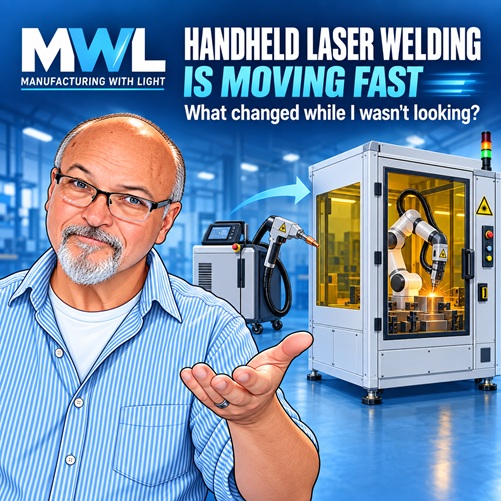
Handheld laser welding is moving from an interesting new tool toward a broader manufacturing platform. Power has increased. Air-cooled systems have become more capable. Wobble control, cleaning modes, wire feeding, stored recipes, safety functions, and digital interfaces are becoming normal. Major welding companies have entered the market. The same technology is now being placed on collaborative robots.
Even the safety and welding-qualification conversations are beginning to catch up.
In This Article
- This Did Not Happen Overnight
- More Power Without Giving Up Portability
- The Torch Is Becoming a Process Tool
- The Welding Industry Has Moved In
- Handheld Is Becoming a Path to Automation
- Safety and Qualification Are Catching Up
- What Has Not Changed
- A Controls Person’s View
This Did Not Happen Overnight
IPG Photonics introduced the original LightWELD in November 2020 as a compact, air-cooled 1,500 W handheld laser welding system.[1]
Even that first system already included several features that helped make handheld laser welding practical: stored process parameters, wobble welding, provisions for wire feeding, and safety interlocks.
Since then, the product category has developed quickly.
IPG added welding and cleaning models and eventually increased output to 2 kW. Other suppliers introduced water-cooled and air-cooled systems at several power levels. Welding companies began adding their own process knowledge, consumables, wire feeders, service networks, and training.
So the real story is not that handheld laser welding suddenly appeared this year.
The story is that several years of product development are now becoming visible at once.
More Power Without Giving Up Portability
One obvious change is power.
IPG’s current LightWELD family ranges from 1 kW to 2 kW, with air cooling across the range. The company lists substantially greater material capability for the 2 kW model than for its 1 kW system, including thicker steel, aluminum, nickel alloys, titanium, and copper.[2]
Miller now offers 1 kW and 2 kW OptX systems, while Lincoln Electric’s Flex Lase and the new ESAB Dueler bring handheld laser welding into product families already familiar to traditional welding customers.[3][4][5]
More power is useful, but portability may be the more important advance.
A compact air-cooled system removes the external chiller and some of the plumbing and maintenance that previously made industrial laser equipment feel less approachable to a fabrication shop.
That does not turn a Class 4 laser into a conventional portable welder. The controlled area, interlocks, beam hazards, fumes, and personal protective equipment still must be addressed.
But the laser source itself is no longer the large, intimidating part of the installation that it once was.
The Torch Is Becoming a Process Tool
The earliest impression many people had of handheld laser welding was simple:
Point the laser at the joint and move quickly.
The current systems are more sophisticated than that.
Wobble control moves the beam across the joint to widen the effective weld and make the process more tolerant of fit-up variation. Stored recipes help match power, wobble, travel speed, material, and thickness. Pre-weld and post-weld cleaning modes give the same platform additional uses. Digital interfaces allow manufacturers to store and adjust custom parameters.
Wire feeding is also becoming more important.
Autogenous welding can be fast and clean when the joint fit-up is good, but filler wire gives the process more options for gaps, joint geometry, metallurgy, and bead size. Lincoln Electric is even offering its twin-wire HyperFill approach as an accessory for Flex Lase, while its controls provide external interfaces for cobot, PLC, safety, and I/O integration.[4]
This is starting to look less like a single-purpose tool and more like a configurable welding process.
The Welding Industry Has Moved In
To me, one of the strongest signs of change is not a specification.
It is the names on the machines.
Miller has the OptX family. Lincoln Electric has Flex Lase. In September, ESAB introduced the Dueler EHL 1500, its first handheld laser welder.
The Dueler combines a 1,500 W air-cooled laser, touchscreen controls, and ESAB’s PreciDrive wire feeder in one system. ESAB is positioning it as a complement to MIG and TIG rather than a replacement.[5]
That may be more significant than another increase in power.
Traditional welding companies bring welding distributors, filler-metal knowledge, applications support, safety equipment, service, and relationships with fabrication shops.
Handheld laser welding originally entered many shops through laser companies and importers. It is now being incorporated into the established welding industry.
Handheld Is Becoming a Path to Automation
Another rapid development is the move from a person holding the torch to a collaborative robot holding essentially the same process.
IPG now offers a LightWELD Cobot System. Lincoln Electric offers a Flex Lase Cobot System with integrated programming, wire control, fume extraction, and a cart-mounted Class 1 enclosure. FANUC recently demonstrated a CRX system that combines a manual laser welding machine with a cobot for pipe welding and automated discoloration removal.[6][7][8]
This creates an interesting adoption path for smaller manufacturers:
- Prove the process manually.
- Learn which parts benefit from laser welding.
- Move repetitive work onto a cobot.
It is not as simple as attaching any handheld torch to any robot. Automation changes the safeguarding, fixturing, motion, process development, and control requirements.
A collaborative robot also does not make the laser beam collaborative.
Still, the handheld platform may become the entry point that introduces many fabrication shops to automated laser welding.
Safety and Qualification Are Catching Up
The technology moved into the market faster than the supporting safety and welding ecosystem.
That gap is beginning to narrow.
ISO published ISO 11553-2:2026, a revised machine-safety standard specifically addressing hand-held and hand-operated laser processing machines. It covers the significant hazards associated with the complete machine, including the source, beam-guiding and beam-shaping equipment, and controls.[9]
The American Welding Society’s current B2.1/B2.1M:2026 specification includes laser beam welding among the processes covered for welding-procedure and personnel qualification.[10]
That does not mean every question about handheld laser welding has been settled. It does mean the conversation is moving beyond productivity claims toward machine design, operator protection, procedure qualification, testing, and repeatability.
That is necessary to become a mainstream industrial process.
What Has Not Changed
The machines have advanced quickly.
The basic responsibilities have not.
A preset is not a qualified welding procedure.
An easy-to-use torch does not make every operator a welder.
A good-looking bead does not prove penetration, fusion, strength, or freedom from porosity.
What makes a good weld still depends on what that weld has to do.
Manufacturers still need to understand the material, joint design, fit-up, shielding gas, filler metal, travel speed, heat input, inspection requirements, and applicable code. They need to test the process and train the operator.
And because these are high-power Class 4 lasers, they need a real laser-safety program—not only a pair of glasses included with the machine.
A Controls Person’s View
I am not a welder. My background is controls, software, and laser-machine integration.
That probably affects what I notice.
I see the handheld laser welder becoming a connected manufacturing system. It has process recipes, user permissions, safety inputs, wire-feed control, cleaning modes, communication interfaces, and increasingly a path into robotic automation.
My expectation is that the next layer of competition will not be based only on laser power.
It will include better recipe management, process databases, traceability, operator guidance, parameter protection, weld monitoring, and easier movement between manual and automated operation.
That is an inference, but it follows the same pattern I have seen in other manufacturing technologies: once the core process works, the value moves toward making it repeatable, documentable, and easier to integrate.
Closing Thought
I started looking closely at handheld laser welding only a few months ago.
What I found was not a brand-new technology waiting to be invented. I found a fast-moving process that had already been developing for several years and is now entering another phase.
The machines are becoming more capable.
The welding industry is becoming more involved.
Automation is becoming more accessible.
Standards and qualification are beginning to catch up.
The next challenge is making sure adoption advances as quickly as the equipment—without leaving process
knowledge, documentation, and safety behind.
Manufacturing With Light
Practical reporting and commentary on laser manufacturing, automation, and advanced production.
References
- IPG Photonics — Launch of the original LightWELD handheld laser welding system, November 5, 2020
- IPG Photonics — Current LightWELD welding and cleaning product family
- Miller Electric — OptX handheld laser welders
- Lincoln Electric — Flex Lase handheld and cobotic laser welding systems
- ESAB — Introduction of the Dueler EHL 1500 handheld laser welder
- IPG Photonics — LightWELD Cobot System
- Lincoln Electric — Flex Lase Cobot System
- FANUC — CRX laser welding system integrating a manual laser welder with a collaborative robot
- ISO — ISO 11553-2:2026, safety requirements for hand-held or hand-operated laser processing machines
- American Welding Society — AWS B2.1/B2.1M:2026
#ManufacturingWithLight #HandheldLaserWelding #LaserWelding #WeldingAutomation #IndustrialSafety #AdvancedManufacturing