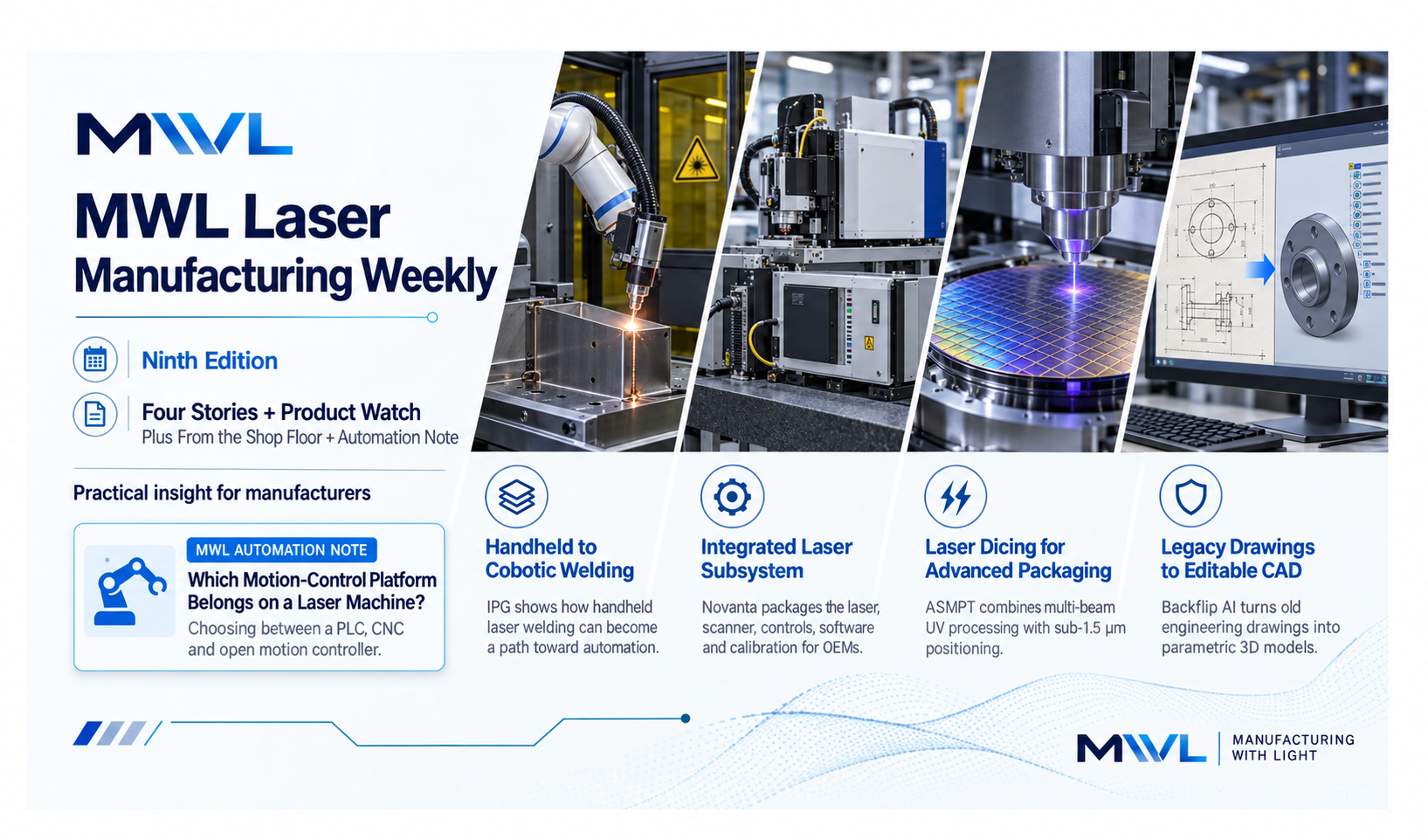
MWL Laser Manufacturing Weekly — Edition 9
September 24, 2026
This week’s stories have a common theme: laser technology is becoming easier to turn into a production platform.
IPG is showing handheld-laser users a path toward cobotic welding. Novanta is packaging the laser, scanner, controls, software, and calibration into one OEM subsystem. ASMPT is combining laser processing, precision motion, wafer handling, coating, and cleaning for advanced semiconductor packaging. And an AI tool is trying to unlock the engineering knowledge trapped in old 2D drawings.
In MWL Product Watch, BOLD Laser Automation introduces a modular femtosecond micromachining platform aimed at production rather than laboratory experimentation.
The Automation Note asks a question that affects all of these systems:
Which motion-control platform belongs on a laser machine?
In This Edition
- IPG Moves Handheld-Laser Custo#ipg_moves_handheldmers Toward Cobotic Welding
- Novanta Packages the Laser, Scanner, Controls, Software, and Calibration for OEMs
- ASMPT Brings Laser Dicing and Grooving to Advanced Chip Packaging
- AI Converts Legacy Engineering Drawings Into Editable CAD
- MWL Product Watch — BOLD LPC0808FS Femtosecond Micromachining Platform
- MWL Automation Note — Which Motion-Control Platform Belongs on a Laser Machine?
- From the Shop Floor — MWL Wants Your Stories
- Consultants’ Corner — Share Your Expertise With MWL Readers
1. IPG Moves Handheld-Laser Customers Toward Cobotic Welding
Handheld laser welding has given many fabricators their first practical experience with laser processing.
Now IPG Photonics is showing those customers what may come next.
At a LightWELD Open House in Marlborough, Massachusetts, on September 30, IPG will demonstrate handheld welding, cobotic welding, and laser cutting. The event includes hands-on work with the 2 kW LightWELD 2000 XR and live demonstrations of collaborative-robot welding systems built around LightWELD technology.
IPG is inviting visitors to bring their own parts for evaluation and test welding. That is important because the question is no longer simply whether a handheld laser can make a weld. The next question is whether the process can be repeated automatically on real production parts.
Why It Matters
Handheld laser welding lowered the first barrier to laser welding: it packaged the source, delivery system, controls, and process settings into something a fabrication shop could understand and use.
Cobotic welding could lower the next barrier.
A shop may be able to prove a process manually, learn where laser welding fits, and then automate repetitive parts without jumping immediately to a large custom robotic cell.
That does not mean a handheld laser can simply be fastened to a cobot and called an automated system. The risk assessment, laser enclosure, interlocks, fixturing, controls, path programming, and process development still matter. A collaborative robot does not make a Class 4 laser beam collaborative.
But the progression makes sense:
Prove the welding process by hand. Automate the parts that justify it.
If IPG can make that transition feel practical to LightWELD users, handheld laser welding may become an entry point into automation rather than the final destination.
Source: IPG Photonics — LightWELD Open House, Marlborough, Massachusetts
2. Novanta Packages the Laser, Scanner, Controls, Software, and Calibration for OEMs
Building a laser machine often means making products from several suppliers behave like one system.
The laser source comes from one company. The scanner comes from another. Then there are optics, controls, software, cables, beam delivery, mounting, calibration, and the question of who takes the first support call when the process does not work as expected.
Novanta’s new 3-Axis Integrator Package is intended to remove some of that integration work for OEM machine builders.
The factory-aligned subsystem combines a pre-aligned CO₂ laser, Novanta’s Vectria dynamic-focus scan head, an SMC controller, software, beam delivery, mounting hardware, and factory calibration. Laser options range from 30 W to more than 400 W of average power, and Novanta says the system can support processing fields exceeding one meter.
The third optical axis provides dynamic focus, allowing processing across larger areas and complex three-dimensional surfaces. Novanta is targeting applications including flexible packaging, automotive and e-mobility production, medical devices, large-area marking, digital converting, and precision material processing.
Why It Matters
None of the individual pieces is surprising.
The important part is that they arrive as a validated subsystem from one supplier.
For an OEM, integration time is product-development time. Every hour spent aligning optics, tuning scanner behavior, connecting software, and determining which vendor owns a problem is an hour not spent developing the part of the machine that makes it different.
A package like this also creates clearer responsibility. Novanta includes one warranty, integrated technical support, and application support around the subsystem.
There is still plenty for the OEM to engineer: material handling, guarding, safety controls, fume extraction, part presentation, process recipes, and the overall machine experience.
But if the laser-processing core already behaves like a subsystem instead of a collection of components, the machine builder can spend more time on the machine.
Source: Novanta — 3-Axis Integrator Package for OEM Machine Builders
3. ASMPT Brings Laser Dicing and Grooving to Advanced Chip Packaging
Laser manufacturing is not limited to large sheets, weld seams, or metal additive parts.
At the other end of the scale, laser processing is becoming an important part of advanced semiconductor packaging.
ASMPT will highlight its ALSI LASER1206 at SEMICON West in October. The fully automated platform is designed for high-precision wafer dicing and grooving in advanced memory, logic, AI, and power-device applications.
The system uses ASMPT’s patented multi-beam UV laser technology to limit local heat input, reduce burr formation, and preserve die strength. It handles both film-frame and bare wafers and integrates wafer coating and cleaning.
ASMPT states that the planar motion system achieves positioning accuracy of less than 1.5 micrometers. The platform processes wafers from 60 to 800 micrometers thick for grooving and from 20 to 200 micrometers for dicing.
Why It Matters
Advanced packaging is becoming critical to AI and high-performance computing because future performance depends on how multiple dies, memory, interconnects, and photonic components are assembled—not only on the transistor geometry inside one chip.
That creates a manufacturing problem at microscopic scale.
The laser process must remove material accurately without putting too much heat into the wafer. Motion must remain precise. Handling must protect delicate wafers. Cleaning and coating must fit into the same controlled workflow. Throughput still has to be high enough for production.
The LASER1206 is interesting because it treats those requirements as one manufacturing system rather than as a laser process operating by itself.
Who Supplies the Motion Controller?
I looked for this because motion is central to the application.
ASMPT’s public material identifies a planar motion system and publishes the positioning accuracy, but it does not identify the motion controller or stage supplier used in the LASER1206.
Public references to motion components used elsewhere in ASMPT equipment exist, but none I found tie a particular third-party controller to this machine. Without confirmation from ASMPT, I would not assign a supplier based on those other systems.
Sources: ASMPT — Accelerating AI Through Advanced Packaging and ASMPT ALSI — LASER1206 Product Information
4. AI Converts Legacy Engineering Drawings Into Editable CAD
This is not one of our usual laser-manufacturing stories.
But it connects directly to last week’s Automation Note about what happens when the machine changes and the documentation does not.
Backflip AI has introduced Drawing to CAD, a tool that interprets the views, dimensions, and geometry in an engineering drawing and reconstructs the part as a parametric 3D model with an editable feature tree.
The tool is available through an Autodesk Fusion add-in and a web application. The goal is to turn drawing archives into usable CAD without requiring an engineer to rebuild every model manually.
For manufacturers supporting older equipment, that could be valuable. Many replacement parts still begin with a PDF, scanned print, or drawing pulled from a cabinet. An editable model makes it easier to manufacture a replacement, update the design, or create a digital spare-parts library.
Why It Matters
This is a good example of what AI can do with documentation—and what it cannot do.
If the old drawing accurately describes the part, converting it into editable CAD may save a considerable amount of reconstruction work.
But if the machine was modified in the field and the drawing was never updated, the AI can create a very clean model of the wrong part.
It cannot recover a change that nobody recorded.
That is the connection to last week’s Automation Note. Better tools can help manufacturers use old engineering information, but they do not remove the need for revision control, change records, and verification against the machine that actually exists.
Before releasing a part reconstructed from a legacy drawing, someone still needs to ask:
Is this the latest drawing—and does it still match the machine?
Sources: Backflip AI — Drawing to CAD and TCT Magazine — Backflip AI Launches Drawing to CAD Tool
MWL Product Watch
BOLD LPC0808FS Femtosecond Micromachining Platform
BOLD Laser Automation has introduced the LPC0808FS, a modular femtosecond laser platform for production micromachining.
The system is aimed at microvia drilling, wafer processing, selective coating removal, thin-film structuring, and other fine-feature applications involving materials such as semiconductors, glass, ceramics, polymers, and composites.
The announced configuration uses an MKS Spirit HE-30-SHG femtosecond laser with 1040 nm infrared and 520 nm green output. It combines high-speed galvanometer beam steering with precision XY motion, automated Z-axis focus control, and triangulation for changing substrate thickness.
Production options include cassette loading, robotic pick-and-place handling, automated wafer flipping, debris extraction, and a Class 1 enclosure. BOLD’s OptixOS software provides recipe management, pattern generation, and diagnostics, with support for formats including DXF, Gerber, and GDSII.
Why It Caught My Attention
Femtosecond processing is often discussed in terms of pulse duration, wavelength, and extremely small features.
This platform is being presented in manufacturing terms: loading parts, managing recipes, controlling focus, removing debris, reducing operator dependency, and keeping the equipment useful as applications change.
The modularity is especially important.
A precision laser system can be a major investment. If the handling, vision, software, and process modules can evolve without replacing the entire machine, the platform has a better chance of remaining useful after the first application changes.
That is the difference between demonstrating an impressive laser process and delivering a production tool.
Sources: BOLD Laser Automation — LPC0808FS Product Information and Laser Focus World — Modular Femtosecond Laser Platform Advances Precision Micromachining
MWL Product Watch highlights products and technologies that may be interesting to manufacturers. Inclusion is not an endorsement, and companies do not pay to be included.
MWL Automation Note
Which Motion-Control Platform Belongs on a Laser Machine?
There is no single correct control platform for every laser machine.
A machine that moves to one position, fires the laser, and returns home does not need the same architecture as a high-speed cutter running large CNC programs.
A robot welding a three-dimensional assembly does not have the same requirements as a galvanometer scanner coordinating with precision XY stages.
PLC motion, CNC controls, robot controllers, and open motion-control platforms can all be the right answer.
The problem starts when we choose the familiar controller first and try to make the process fit it later.
A PLC Can Be Enough
For many laser applications, a modern PLC with motion capability is a perfectly reasonable choice.
If the machine clamps a part, moves one or two axes through a short sequence, turns the laser on at defined positions, and returns home, a PLC can handle the machine logic, safety interface, HMI, I/O, and motion in one familiar environment.
That can be a major advantage for the customer’s maintenance team.
The PLC becomes less comfortable when the machine begins to behave like a CNC system.
The G-Code Interpreter Worked—Until the Programs Got Large
I ran into this on a laser-processing machine that used a G-code interpreter built into the PLC program.
The idea made sense. The PLC already controlled the machine, and adding a parser allowed it to read a CNC-style program without adding another controller.
It worked with smaller programs.
Then the CNC files got larger, and the PLC did not have enough usable memory to hold them.
That is the kind of limitation that can be easy to miss during the original architecture discussion. A controller may have memory available for the application, removable storage, or file-handling functions, but that does not necessarily mean it can buffer and execute a very large contour program the way a CNC or motion controller can.
We had solved the parsing problem but created a program-handling problem.
A few hundred moves in a commissioning test and a production file containing hundreds of thousands of motion blocks are very different workloads.
Laser Synchronization May Be the Deciding Factor
Memory is not the only issue.
One of the hardest parts of laser-machine control is synchronizing the laser process with motion.
The laser may need to turn on at an exact position, pulse at a fixed distance interval, change power with velocity, shut off through a corner, coordinate with an external scanner, or respond to position feedback with very little delay.
If the motion controller executes the path while a PLC or industrial PC sends separate laser commands, communication delays and scan times can move the process event away from the intended location.
At low speed, that error may not matter.
At high speed, a few milliseconds can become a visible mark, an incomplete weld, excess heat at a corner, or a feature placed in the wrong location.
That is why I look closely at functions such as position-synchronized outputs, hardware compare triggers, high-speed registration, velocity-based power control, buffered motion, and deterministic coordination between stages, scanners, and the laser.
Sometimes the best controller is simply the one that can keep the process event tied to the motion path.
Where CNC Controls Fit
A CNC controller is often the natural choice when G-code is the center of the machine.
It already knows how to manage large part programs, coordinate multiple axes, plan contours, apply offsets, control feed rate, look ahead through the path, and provide an operator workflow that machinists understand.
For cutting, drilling, trimming, and other toolpath-driven processes, that is hard to ignore.
The tradeoff is that a CNC platform may be less flexible when the OEM wants unusual process logic, several kinds of beam delivery, extensive external instrumentation, or a software architecture shared with machines that do not look like conventional machine tools.
Where Robot Controllers Fit
Robots are attractive when the process needs reach and orientation in three dimensions.
They make sense for welding large fabrications, cladding complex surfaces, trimming molded components, or processing parts that would be difficult to manipulate with Cartesian stages.
Robots also provide an established ecosystem for safety, offline programming, positioners, vision, and production support.
But a robot controller should not automatically be treated like a high-performance CNC or precision motion controller. Path accuracy, velocity stability, corner behavior, program size, process synchronization, and access to real-time motion data need to be evaluated for the actual laser process.
Repeatability alone does not tell the whole story.
Why an Open Motion Controller Deserves Consideration
For an OEM developing one machine, the simplest platform that meets the process requirements is usually the right choice.
For an OEM developing a family of laser machines, I think an open motion-control platform deserves serious consideration.
The OEM may want to use one software architecture across cutting, welding, cladding, additive manufacturing, cold spray, scanner applications, and special-purpose systems.
An open motion controller can provide coordinated motion, large-program handling, deterministic process synchronization, custom kinematics, scanner and stage control, machine-language functions, fieldbus connectivity, and APIs for a custom HMI or supervisory PC.
More importantly, it can let the OEM separate reusable machine functions from application-specific process modules.
The same homing, limits, coordinate systems, program management, diagnostics, recipe handling, and service tools can be reused while the process layer changes from cutting to welding or from stages to a scanner.
That requires more engineering at the beginning.
The OEM owns more of the architecture, software standards, libraries, testing, and long-term support. “Open” does not mean “free of complexity.”
But if the goal is a modular product family rather than one custom machine, that initial investment can begin paying back on the second and third application.
Questions to Ask Before Choosing
Before settling on a control platform, I would ask:
- How large can the production programs become?
- Is the process synchronized to position, velocity, time, or an external encoder?
- Does the machine need precise contouring or mainly point-to-point moves?
- Will it coordinate stages, rotary axes, robots, galvanometer scanners, or all of them?
- Who owns the G-code interpreter and the laser-process logic?
- How are programs transferred, buffered, resumed, and versioned?
- Is this a single-purpose machine or the beginning of an OEM product family?
- Can the customer support the platform ten years from now?
I have worked on applications where a PLC with motion was the simplest and most maintainable answer.
I have also seen what happens when a PLC is pushed into becoming a CNC controller, file server, motion planner, and laser synchronizer all at once.
It may work.
The better question is whether it will still work when the programs get larger, the path gets faster, the process gets more demanding, and the OEM wants to reuse the software on the next machine.
Closing Thought
The best motion-control platform is not the one with the longest feature list.
It is the one that fits the path, the program size, the synchronization requirements, the machine architecture, and the way the equipment will be supported and expanded.
Choose a controller for the machine you are building.
But if you are an OEM, make sure it also leaves room for the machines you have not built yet.
From the Shop Floor
MWL Still Wants Your Stories
Some of the best manufacturing lessons never appear in a press release.
They happen during startup, troubleshooting, process development, and production.
Maybe you solved a strange laser-processing problem. Maybe a fixture behaved differently than expected. Maybe a small automation change prevented hours of downtime. Maybe something failed spectacularly and taught you more than the successful jobs did.
That is what From the Shop Floor is meant to capture.
If you work around laser cutting, welding, additive manufacturing, automation, optics, motion control, maintenance, or advanced manufacturing and have a lesson worth sharing, send it to MWL.
It does not have to be a polished article. Tell us what happened, what you learned, and what someone else might find useful.
Consultants’ Corner
Are you an independent consultant working in laser materials processing, welding, optics, beam delivery, additive manufacturing, controls, automation, motion, safety, or another area related to advanced manufacturing?
MWL is looking for knowledgeable people willing to contribute practical articles.
The goal of Consultants’ Corner is simple: give readers useful information while giving experienced independent specialists an opportunity to show what they know.
Articles can include a link to the contributor’s website or professional profile.
If you have an idea, send MWL a message.
Closing Thought
This week’s stories are all about moving from a component or isolated task toward a production platform.
A handheld welding process becomes a path to cobotic automation.
A laser, scanner, controller, and software arrive as one aligned subsystem.
Wafer dicing becomes a coordinated process involving precision motion, handling, coating, cleaning, and environmental control.
An old drawing becomes editable CAD—but only if the source information can still be trusted.
And a femtosecond process becomes more useful when it is surrounded by the handling, focus control, recipes, diagnostics, and safety systems needed for production.
The laser is important.
But increasingly, the competitive advantage is in everything required to turn that laser into a machine people can operate, support, and build upon.
Manufacturing With Light
Practical reporting and commentary on laser manufacturing, automation, and advanced production.
#ManufacturingWithLight #LaserManufacturing #LaserWelding #MotionControl #SemiconductorManufacturing #IndustrialAutomation