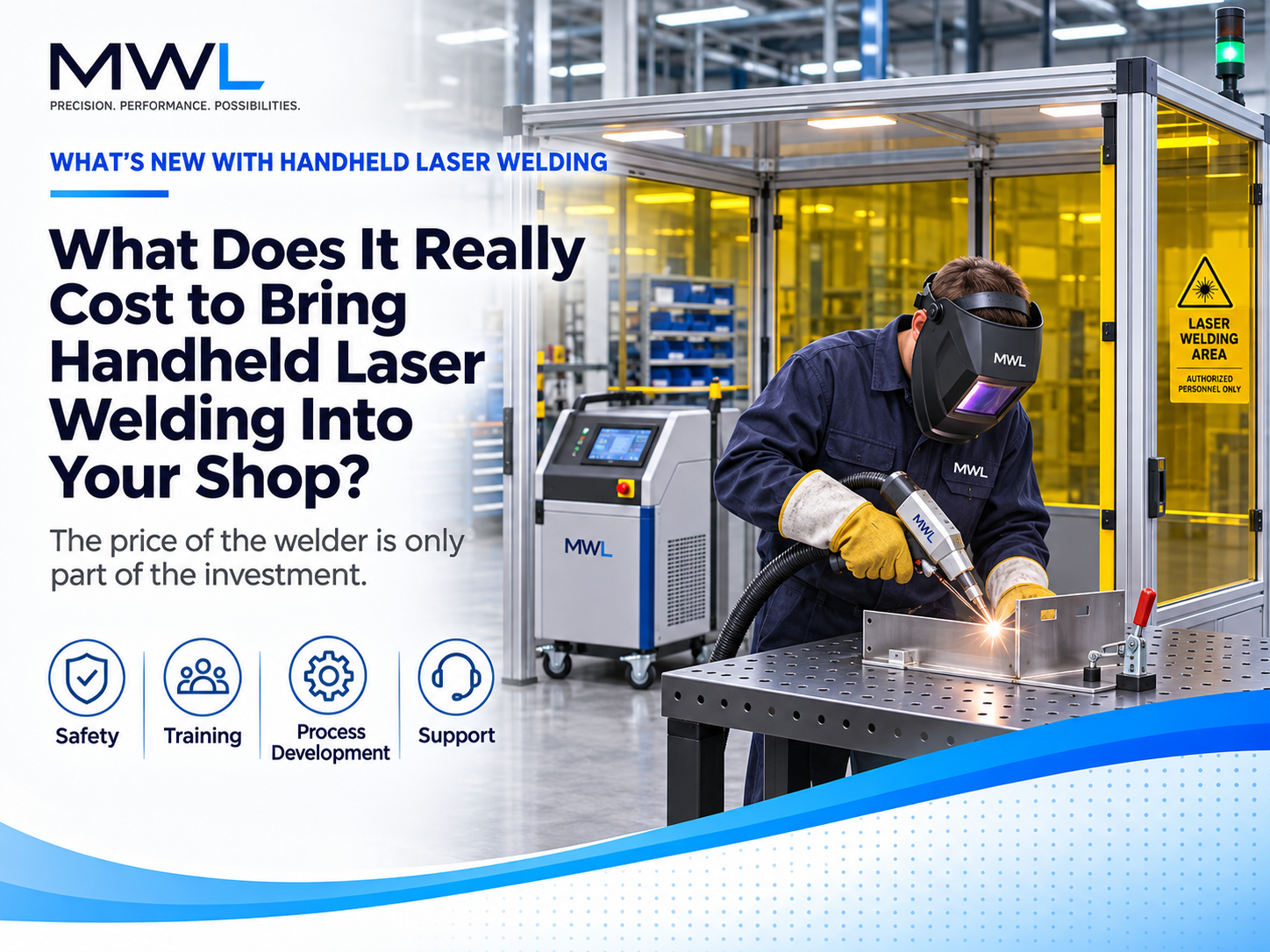
The price of the welder is only part of the investment.
Handheld laser welding is attracting considerable attention, and for good reason. Modern systems can produce impressive welds, often with relatively little distortion and less post-weld finishing than some conventional processes.
Manufacturers are also promoting faster welding speeds and shorter operator learning curves. For smaller fabrication shops, that sounds attractive.
But suppose you’re considering buying your first handheld laser welder. You’ve watched the demonstrations. You’ve seen the videos. Maybe you’ve even tried one yourself.
Now comes the important question.
What will it actually take to put that machine into production in your shop?
I don’t mean just the purchase price. I mean everything necessary to use it safely, train the people operating it, produce acceptable welds, and keep it running.
That’s where I think the conversation needs to begin.
First, What Are You Planning to Weld?
Before looking at equipment, I would start with the parts.
What materials are you welding? What thicknesses? How are the joints prepared? Are you making the same parts every day, or is every job different? Do you have repeatable fixturing? How will you determine whether the finished weld is acceptable?
Those questions should influence the equipment you select. A shop producing repetitive stainless steel sheet-metal assemblies may have very different requirements from one repairing aluminum components or welding heavy structural fabrications.
The best laser welder isn’t necessarily the one with the highest power.
It’s the one that can reliably produce the welds your business needs.
And sometimes, after evaluating the actual applications, a conventional welding process may remain the better choice.
The Welder Is Only the Beginning
A handheld laser welding system is not simply another welding power supply you can place anywhere on the shop floor.
A complete installation may require several additional investments.
Laser safety and the welding area
Handheld laser welding systems are generally Class 4 laser products, presenting potentially serious hazards from direct and reflected laser radiation.
According to the American Welding Society, safe operation requires a properly established laser-controlled area, an appropriate laser safety program, qualified oversight, training, and suitable protective measures. [1]
A properly designed, interlocked laser enclosure or controlled room can be one of the most important parts of the installation. The cost and complexity will depend on the shop layout and the intended application.
Laser safety glasses and a welding curtain are not substitutes for an appropriate engineering assessment.
Ventilation and fume extraction
Laser welding still produces fumes and other process emissions. The ventilation requirements depend on the materials, coatings, filler metals, and production conditions.
A shop may need local exhaust ventilation, filtration, and additional environmental controls.
Shielding gas and accessories
Depending on the process, the system may require shielding gas, regulators, hoses, welding nozzles, replacement protective optics, and other consumables.
If you’re planning to use filler wire, a compatible wire feeder may be another investment.
Electrical and facility requirements
Review the machine’s electrical service, installation space, cooling requirements, and environmental limitations before purchasing.
Air-cooled systems can simplify installation, but that doesn’t eliminate the need to verify the manufacturer’s facility requirements.
These expenses may not be as interesting as the laser itself. But they are part of the real investment.
Training Is More Than Learning to Pull the Trigger
One selling point of handheld laser welding is that operators may be able to learn the basic welding technique relatively quickly. That can be a genuine advantage.
But we need to distinguish between learning how to operate the equipment and becoming qualified to manufacture acceptable welded products.
An operator still needs to understand joint preparation, fit-up, shielding gas, welding parameters, material behavior, inspection requirements, and safe operating procedures.
Someone in the organization also needs to understand how to develop, document, and maintain the welding process.
The American Welding Society has published specific handheld laser welding safety guidance because this technology introduces hazards that conventional welding experience alone may not adequately address. [1, 2]
Easy to operate doesn’t mean the process no longer requires welding knowledge.
Don’t Forget the Cost of Process Development
Let’s say you’ve purchased the equipment and installed a suitable laser-controlled area. Now you need to make production parts.
Are the manufacturer’s standard welding programs sufficient? Will you need to develop parameters for particular materials and joints? Will fixturing need to be improved? Do you need to qualify the welding procedure or perform destructive testing? What about inspection and acceptance requirements?
The answers depend on the application, but they affect both implementation time and cost.
And this is where I think a knowledgeable equipment supplier can make a real difference.
A supplier who understands welding applications and can help you develop a dependable process may provide substantially more value than one whose responsibility ends when the equipment is delivered.
Support Should Be Part of the Purchase Decision
I’ve been looking at handheld laser welding equipment from several different perspectives lately. One thing keeps coming back to me.
When you buy an industrial machine, you’re also depending on the company and people supporting it.
Can the supplier help evaluate your application before the sale? Can they demonstrate the process using your actual parts? Do they understand the installation and safety requirements? Will they provide useful operator training? Can you obtain replacement components and service when something fails? And if you run into a difficult welding application six months later, will someone help?
These questions matter just as much as laser power, welding speed, and the number of preset programs.
Sometimes the cheapest machine will be the right choice. But for a manufacturer depending on that machine to produce saleable parts every day, equipment support can be worth considerably more than the initial price difference.
Calculate the Cost per Good Part
Ultimately, I think manufacturers should evaluate handheld laser welding the same way they evaluate other production equipment.
Not simply by comparing purchase prices, but by estimating what the process will cost to operate.
That means considering:
- Equipment and installation costs
- Safety equipment, enclosure, and training
- Process development and qualification
- Labor and actual production time
- Shielding gas, consumables, and maintenance
- Inspection, scrap, and rework
- Equipment uptime and technical support
There may be significant savings from faster welding, reduced distortion, less finishing, or increased production capacity.
But those benefits need to be demonstrated using the manufacturer’s actual parts.
A welding demonstration on a carefully prepared sample is interesting.
A repeatable process that produces acceptable parts, shift after shift, is what you’re really buying.
My Closing Thought
I believe handheld laser welding has a promising future, particularly for smaller shops looking to improve productivity and take on work that may have been difficult or uneconomical with conventional processes.
But successful adoption requires more than buying a laser. It requires the right applications, a safe installation, capable operators, appropriate process development, and dependable support.
My advice to anyone considering the technology is simple.
Before asking how much the laser welder costs, ask what it will cost to put it to work.
That discussion may lead you to a different equipment choice. It may also help you avoid some expensive surprises.
And that’s exactly the type of practical information we want to explore in this new MWL feature.
We’d Like to Hear from You
Are you already using handheld laser welding? What surprised you about bringing the technology into your shop? Was it the equipment, training, safety requirements, fixturing, process development, or something else?
We’d welcome comments and experiences from manufacturers, welding engineers, technicians, and equipment suppliers.
Real shop-floor experience can be particularly useful to someone considering their first system.
References
[1] American Welding Society. (September 2024). Safety and Health Fact Sheet No. 46 — Handheld Laser Welding Safety.
https://aws-p-001-delivery.sitecorecontenthub.cloud/api/public/content/fact-sheet-no.-46-sep-2024
[2] American Welding Society. (January 2025). Handheld Laser Welding Safety. Welding Digest.
https://www.aws.org/magazines-and-media/welding-digest/2025/january/wd-jan-25-handheld-laser-welding-safety
[3] American Welding Society. (January 2026). Getting a Grip on Handheld Laser Safety. Welding Digest.
https://www.aws.org/magazines-and-media/welding-digest/2026/january/getting-a-grip-on-handheld-laser-safety/
[4] IPG Photonics. Laser Safety — Policies and Standards. Manufacturer safety guidance.
https://www.ipgphotonics.com/company/policies-standards/laser-safety
[5] IPG Photonics. LightWELD Handheld Laser Welding and Cleaning Systems. Product information, capabilities, and options.
https://www.ipgphotonics.com/en-us/products/lightweld/lightweld-handheld-laser-welding-and-cleaning
Manufacturing With Light
Practical perspectives on laser manufacturing, welding, automation, and advanced manufacturing.