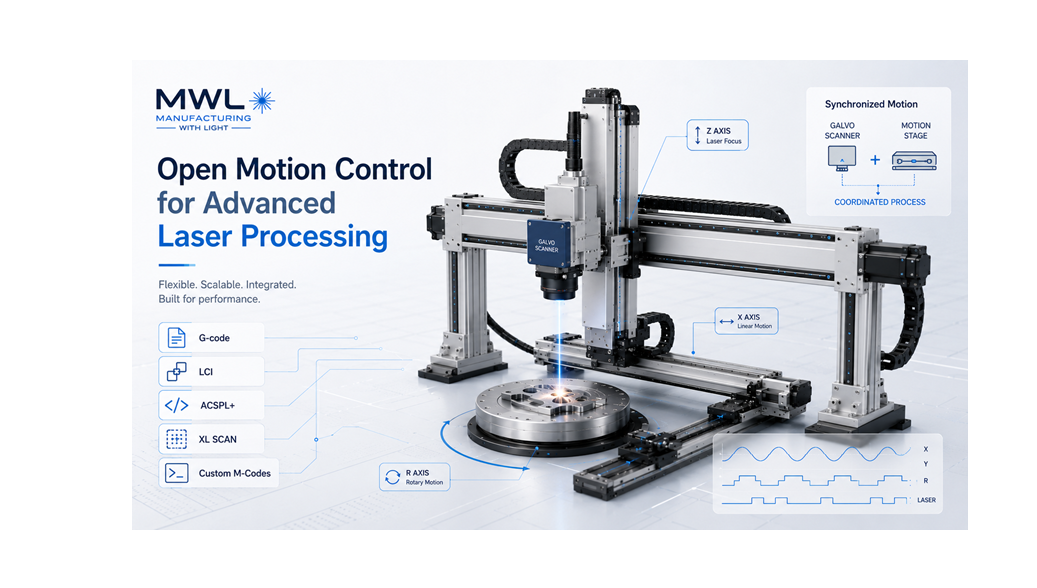
In high-end laser material processing, the motion controller is not just moving axes. It is helping determine how energy is delivered into the material.
That distinction matters. Whether the process is laser cutting, welding, drilling, micromachining, cleaning, cladding, or scanner-based processing, the controller must coordinate motion, laser timing, process I/O, recipes, sensors, and recovery logic. In many applications, the quality of the process depends as much on synchronization as it does on raw laser power.
This is why open motion control platforms deserve serious consideration for advanced laser-processing machinery.
A traditional CNC may be the right choice for a standard sheet cutting machine. But when the machine becomes more specialized — small features, high-speed triggering, multi-axis motion, scanner integration, custom process tools, or unusual machine kinematics — a more open and programmable platform can become a strong contender.
One example is the ACS Motion Control SPiiPlus platform. It combines an EtherCAT-based motion platform, G-code capability, ACSPL+ real-time programming, laser control hardware through the LCI module, XL SCAN for stage-and-galvo coordination, and user-definable G and M codes. That combination makes it worth considering for OEMs building laser machines that do not fit neatly into a standard CNC template [1], [2], [3].
The Case for an Open Platform
Many laser machines start with a simple question:
“Can we run this from G-code?”
That is a reasonable starting point. G-code is familiar, CAM-friendly, and widely understood by machine operators and manufacturing engineers. But advanced laser systems often need more than basic G1, G2, and G3 moves.
They may need to:
- Fire a laser based on position, not just time
- Vary laser power with velocity
- Gate the laser by segment, zone, or coordinate array
- Add special pierce, preheat, gas, powder, or cleaning routines
- Coordinate scanner motion with stage motion
- Use custom M-codes for process devices
- Recover cleanly from interrupted jobs
- Integrate inspection, vision, height sensing, or safety logic
- Protect OEM process know-how while still allowing operator flexibility
This is where a platform like SPiiPlus becomes interesting. ACS describes the SPiiPlus platform as an EtherCAT-based control platform comprising motion controllers, drives, interfaces, and I/O for precision motion systems [1]. Its motion controllers are described as EtherCAT MainDevices supporting high-performance multi-axis control, fast network cycle rates, advanced motion profile generation, real-time multi-threaded programming, and motion-to-process event synchronization [2].
For laser OEMs, that means the platform can be approached as more than a motion controller. It can become the machine’s process-control layer.
G-Code Where It Makes Sense
G-code still matters.
For many laser machines, especially those driven from CAM, the toolpath should remain easy to generate, review, simulate, and support. ACS specifically positions its G-code support for laser processing and CNC machines, including standard G and M codes, multiple coordinate systems, rotations, transformations, user-definable G and M codes, simulator support, and integration with ACSPL+ [3].
That is important because a machine builder need not choose between a CNC-style workflow and a programmable motion platform.
A practical architecture might look like this:
- CAM outputs G-code for the main process path.
- Standard G-code handles the motion path.
- Custom M-codes handle laser enable, gas, powder, shutter, scanner setup, or inspection triggers.
- ACSPL+ functions handle the deeper process logic behind those M-codes.
- The HMI presents recipes and operator choices without exposing unnecessary complexity.
For a production manager, this preserves the familiar CNC workflow. For a machine design engineer, it provides a way to add application-specific behavior without forcing every process detail into CAM output.
LCI: Motion-Synchronized Laser Control
The Laser Control Interface, or LCI, is one of the most important pieces for fixed-beam laser applications.
ACS describes the LCI as an EtherCAT slave module that enables ACS controllers to directly control a laser source and synchronize laser activation and pulsing with 2D, 3D, or 5D motion paths [4]. ACS also states that the LCI is intended for laser-processing OEMs with demanding throughput and accuracy requirements, and that it can synchronize the control of a fixed-beam laser with motion via an SPiiPlus EtherCAT controller [5].
The key point is that the laser is not simply being turned on and off by a slow PLC output.
The LCI supports laser-control modes including time-based modes, digital modulation, fixed frequency, fixed pulse width, fixed duty cycle, tickle mode, velocity-based power control, fixed-distance pulse firing, distance-array pulse mode, segment-based gate and pulse modes, coordinate-based gate and pulse modes, delay compensation, external clock synchronization, pierce mode, and virtual encoder outputs [6].
In real machine terms, that can support applications such as:
- Fixed-distance pulse spacing for micromachining
- Segment-based laser gating from a contour path
- Coordinate-array triggering for precise feature placement
- Velocity-based power control to manage heat input
- Laser on/off delay compensation
- Pierce or first-pulse behavior
- External laser clock synchronization
- Multi-axis position-based triggering
For processes such as laser drilling, stent cutting, precision ablation, medical tube cutting, fine-feature cutting, or electronics processing, position-based laser control can be the difference between a machine that simply moves well and a machine that processes consistently.
ACSPL+: The Layer That Makes the Machine Specific
The open-platform argument becomes strongest when the laser machine needs custom behavior.
ACSPL+ is ACS’s real-time, multi-threaded programming language for SPiiPlus controllers. ACS describes it as a real-time programming environment intended to streamline precision motion application development, with support for motion programming, machine logic, synchronization, diagnostics, and application-specific functions [7].
This matters because advanced laser machines often need logic that is too process-specific for standard CNC functions.
Examples include:
- A custom M-code that verifies the laser is ready before motion begins
- A pierce routine that changes power, gas, and timing by material recipe
- A cleaning pass before welding or cladding
- A powder-feed delay at the start of a laser cladding path
- A recovery routine that backs up, re-establishes standoff, and restarts
- A diagnostic function that confirms a process output actually changed state
- A scanner or inspection handshake during a CNC program
- A user-defined function that calculates power based on velocity, angle, or path region
This is where ACSPL+ can act as the “process glue” between G-code, motion, laser timing, I/O, and the HMI.
For machine builders, that flexibility can reduce dependence on external PLC workarounds or host-PC timing. For production users, it can result in a cleaner operator experience: the operator sees a recipe and a program, while the controller handles the process details in the background.
Custom M-Codes: Turning Process Knowledge into Machine Behavior
Custom M-codes are especially valuable in laser systems because so much of the process happens outside the motion path.
A basic G-code program may describe where to move, but the machine also needs to know when to:
- Turn on shielding gas
- Open a shutter
- Enable laser emission
- Set process power
- Start powder flow
- Verify chiller, fume extraction, or safety status
- Trigger inspection
- Call a scanner routine
- Pause for operator confirmation
- Recover from a fault
ACS’s G-code capability specifically includes user-definable G and M codes for machine-specific functionality, with laser configuration given as an example [3].
That is a strong feature for OEMs because custom M-codes can turn application know-how into reusable machine functions. Instead of embedding process details throughout every CAM post, the post can call clean, machine-specific commands.
For example:
- M70 could prepare the laser and verify safety status.
- M71 could run a pierce routine.
- M72 could enable position-based laser pulsing.
- M73 could start powder flow and wait for stabilization.
- M74 could execute an inspection handshake.
- M75 could shut down the process in a controlled sequence.
The actual numbers and functions would be OEM-specific, but the concept is powerful: custom M-codes make a specialized laser machine easier to program, support, and train.
XL SCAN: When the Machine Uses Both Stages and Galvos
Not all laser machines use a fixed beam.
Many high-end systems use galvo scanners for speed and motion stages for travel. This combination is common in large-area micromachining, laser texturing, high-speed marking, battery processing, scanner welding, electronics manufacturing, and some additive processes.
The challenge is that galvos and stages are very different devices. Galvos are fast but limited in field size. Stages cover large areas but are mechanically slower. If they are not properly coordinated, the machine may experience stitching errors, reduced throughput, or complex calibration issues.
ACS describes XL SCAN as a solution for synchronizing motion stages and galvo scanners. It was jointly developed by ACS Motion Control and SCANLAB to move beyond traditional step-and-scan processing, with stated goals of higher throughput and accuracy, reduced stitching errors, simulation support, support for multiple scan heads, and advanced laser-control options such as Spot Distance Control [8].
For machine builders, this matters because scanner integration should not be an afterthought. If the application requires both large work areas and scanner speed, stage-and-galvo synchronization should be part of the architecture from the beginning.
Scaling the Platform to the Application
One of the most practical arguments for SPiiPlus is scalability.
Not every laser machine needs every feature. A two-axis fixed-beam micromachining system, a multi-axis tube cutter, a 5-axis laser cladding machine, and a large-format scanner system all have different requirements.
A scalable architecture allows the OEM to choose the level of complexity needed for the machine:
Application TypeController CriteriaWhere an Open SPiiPlus Architecture Can HelpPrecision laser cuttingSmooth contouring, G-code, custom M-codes, laser gating, height/focus integrationG-code workflow with ACSPL+ process logic and LCI laser synchronizationLaser drilling and micromachiningPosition-based triggering, pulse spacing, high-speed laser outputsLCI modes such as fixed-distance pulsing, coordinate-array pulsing, and delay compensationMedical tube cuttingRotary/linear coordination, small features, process repeatability, inspection integrationMulti-axis motion, G-code, ACSPL+ functions, custom M-codes, data and diagnostic logicLaser weldingSmooth path motion, power control, gas timing, seam or fixture integrationACSPL+ process sequencing, coordinated motion, real-time I/O, custom weld routinesLaser cladding / DEDCoordinated axes, laser power, powder, gas, standoff, recoveryACSPL+ for process sequencing, custom M-codes for powder/laser/gas, scalable multi-axis motionScanner processingStage/galvo coordination, field stitching, scanner synchronizationXL SCAN for synchronized stage and scanner controlInspection-assisted processingTriggering, position capture, external sensor handshakesMotion-to-process synchronization, MARK/PEG-style event handling, ACSPL+ logic
This does not mean every application should use ACS. It means that when the machine is specialized, the controller should be evaluated on flexibility, synchronization, and process integration — not just axis count and interpolation.
Where This Type of Platform Is Especially Strong
An open motion-control platform is especially attractive when the OEM is building a machine where the process is still evolving.
That includes applications such as:
- Advanced laser micromachining
- Medical device laser processing
- Laser-assisted manufacturing
- Laser cladding and repair
- Hybrid CNC and laser systems
- Scanner/stage laser systems
- Research-to-production equipment
- Specialized cutting or welding machines
- Systems requiring customer-specific process recipes
In these cases, the machine builder may not know all the requirements on day one. A customer may later ask for a new material, sensor, laser source, scan strategy, or process step.
A closed machine architecture can make those changes difficult. An open architecture with G-code, ACSPL+, custom functions, custom M-codes, and specialized laser hardware gives the OEM more room to adapt.
The Tradeoff: Flexibility Requires Engineering Discipline
There is a fair caution here.
An open controller is not automatically easier. It gives the machine builder more power, but also more responsibility.
The OEM still needs good software architecture, naming conventions, simulation practices, fault handling, recipe management, documentation, and operator training. ACS’s own LCI documentation notes that users are responsible for restrictions on maximum speed and frequency in some cases, a reminder that advanced features must be engineered and validated carefully [6].
The flexibility is valuable, but it should be treated like a machine-design asset, not a shortcut.
For production managers, the question should be:
“Does this flexibility make the machine easier to run and support?”
For machine designers, the question should be:
“Can we structure this flexibility into reusable, documented, maintainable machine functions?”
If the answer is yes, then an open motion platform can be a major advantage.
Final Thoughts
High-end laser processing is moving toward tighter integration between motion and process control.
The laser source matters. The optics matter. The mechanics matter. But the controller determines how motion, laser output, timing, I/O, sensors, and recovery logic come together.
That is why an open motion-control platform like ACS Motion Control’s SPiiPlus deserves serious consideration for advanced laser-processing machinery.
G-code keeps the workflow familiar. The LCI module brings laser synchronization closer to the motion path. ACSPL+ provides the real-time programming layer for custom process logic. XL SCAN addresses stage-and-galvo applications. Custom M-codes and functions allow the OEM to package process knowledge into reusable machine behavior.
For standard machines, a standard CNC may be enough.
For specialized laser machines, the better question is not whether the controller can run the axes.
The better question is whether the controller can scale with the process.
References
[1] ACS Motion Control, “SPiiPlus Platform.” (ACS Motion Control)
[2] ACS Motion Control, “Multi-Axis, EtherCAT Motion Controllers.” (ACS Motion Control)
[3] ACS Motion Control, “G-Code Programming.” (ACS Motion Control)
[4] ACS Motion Control, “LCI Installation and Operation Guide,” January 2025.
[5] ACS Motion Control, “LCI — Laser Control Interface.” (ACS Motion Control)
[6] ACS Motion Control, “Laser Control Interface Firmware Support Application Note,” December 2025.
[7] ACS Motion Control, “ACSPL+ Programming.” (ACS Motion Control)
[8] ACS Motion Control, “XL SCAN.” (ACS Motion Control)
[9] ACS Motion Control, “Motion-to-Process Synchronization.” (ACS Motion Control)
[10] ACS Motion Control, “Laser Processing Systems.” (ACS Motion Control)