
Learning Objectives
- Describe conduction-mode and keyhole-mode welding.
- Explain how power, travel speed, focus, and wobble interact.
- Compare handheld laser welding with GTAW and GMAW in practical terms.
- Recognize the strengths and limitations of the process.
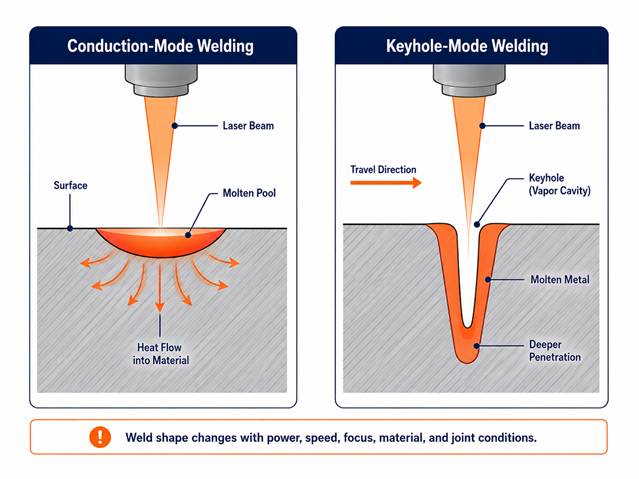
Figure 2-1. Simplified comparison of conduction-mode and keyhole-mode laser welding.
2.1 What the Laser Is Doing
A handheld laser welder directs concentrated optical energy onto the workpiece. The metal absorbs some of that energy and heats rapidly. Depending on the conditions, the process may create a shallow molten pool or a deeper vapor cavity called a keyhole.
In conduction-mode welding, heat flows from the surface into the material. The weld tends to be wider and shallower.
In keyhole-mode welding, the energy density is high enough to vaporize a small amount of metal. Vapor pressure opens a narrow cavity. The laser energy penetrates more deeply into that cavity, producing a deeper weld.
In real shop work, the operating condition may move between these behaviors. The operator should not assume that a smooth face automatically proves full penetration.
2.2 The Main Process Variables
The most important variables include:
- laser power or programmed energy,
- travel speed,
- focal position and working distance,
- beam-wobble width,
- wobble frequency,
- torch angle,
- shielding-gas type and flow,
- filler-wire type and feed,
- joint gap and fit-up,
- material alloy, thickness, and surface condition.
These variables interact. For example, increasing power without changing travel speed can increase penetration, but it can also increase undercut, spatter, burn-through, instability, or the size of the hazardous reflection.
2.3 Beam Wobble in Plain Language
Imagine drawing a straight line with a pencil. Now imagine moving the pencil rapidly side to side while still moving forward. The second path covers more width.
That is the basic idea behind beam wobble. Internal mirrors move the focused beam through a small pattern. The result can:
- widen the fusion zone,
- help bridge limited fit-up variation,
- spread heat across the joint,
- and make hand travel more manageable.
Wobble does not eliminate the need for fit-up. A large gap still reduces support under the molten pool and may require filler wire or a redesigned joint.
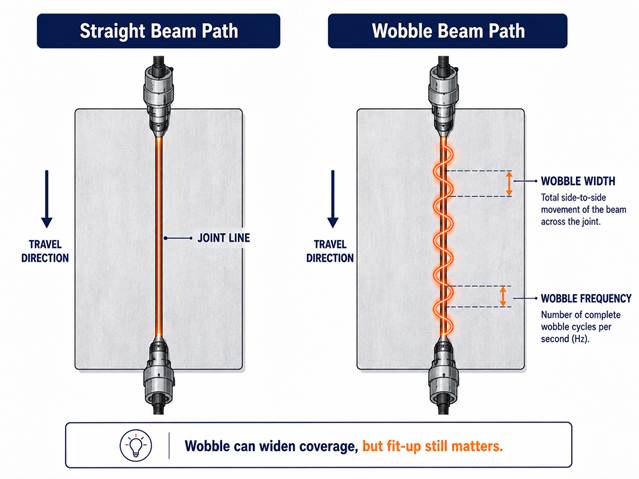
Figure 2-2. Straight and oscillating beam paths. Wobble width and frequency change how the beam covers the joint.
2.4 Comparison with Familiar Welding Processes
Compared with GTAW
Handheld laser welding can be much faster on suitable thin-gauge joints and may produce less overall distortion. GTAW, however, gives the welder direct control of the arc and filler addition and remains highly versatile for many joint conditions.
Compared with GMAW
Laser welding can produce a narrow, clean-looking joint with less spatter and less finishing on suitable parts. GMAW is generally more forgiving of heavy section, open joints, dirty work, and structural fabrication where a larger deposited weld is required.
Compared with Resistance Welding
Laser welding can create continuous seams and reach joints that are not easily clamped between electrodes. Resistance welding may still be simpler and more economical for high-volume sheet-metal spot welds.
2.5 What Handheld Laser Welding Does Well
The process is often attractive when the work has:
- repeatable fit-up,
- clean material,
- accessible seams,
- moderate thickness,
- controlled positioning,
- short finishing requirements,
- and value in reduced distortion.
2.6 Where It Can Struggle
Challenges include:
- large or changing gaps,
- inconsistent joint position,
- unknown coatings,
- contamination,
- highly reflective geometry,
- difficult out-of-position work,
- thick structural joints,
- code work without a qualified procedure,
- and parts that cannot be placed in a safe controlled area.
Shop Tip
A good demonstration weld is not the same as a production process. Test representative parts, including normal gap variation, edge condition, operator position, and the actual inspection requirement.
Key Takeaways
- Laser welds can be shallow conduction welds or deeper keyhole welds.
- Process variables interact; one setting cannot be judged alone.
- Beam wobble improves practical usability but does not replace fit-up.
- Suitability depends on the part, not only on the machine.
Review Questions
- What is the difference between conduction and keyhole welding?
- Why can a visually smooth weld still lack penetration?
- What does wobble width change?
- Name three applications that may not be good handheld-laser candidates.