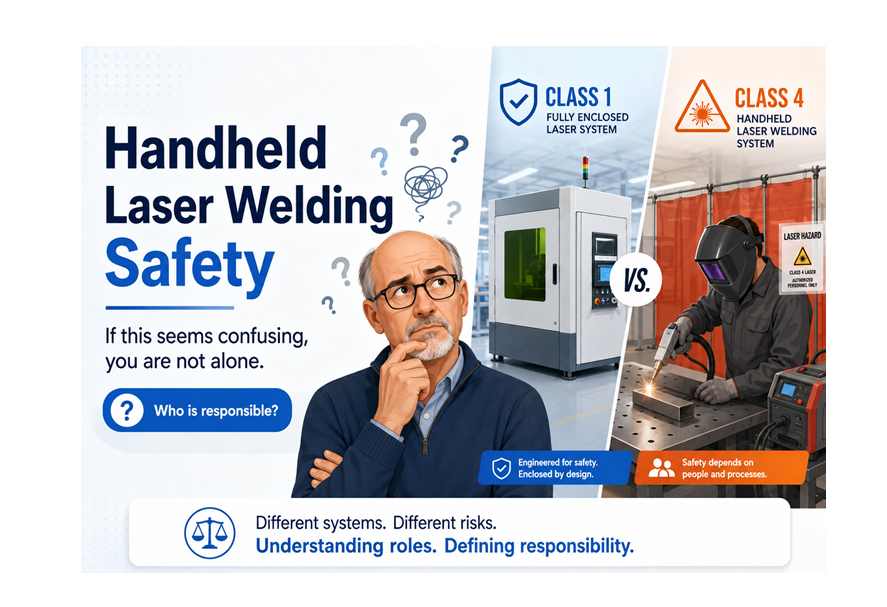
I will admit that I am confused. You probably will be too if you read this article. But it’s an important topic that deserves to be discussed. Please read the full article. And please chime in.
I have helped build industrial laser systems containing Class 4 lasers. To make the completed machines Class I, or Class 1 under IEC terminology, we used light-tight protective enclosures, interlocked access doors, dual-channel monitored safety controls, warning indicators, documented operating modes, and controlled maintenance procedures.
The goal was straightforward: during normal production, the operator should not have access to hazardous laser radiation.
During validated Class 1 operation, laser-specific eye protection normally should not be needed to protect someone standing outside the machine from the processing beam. Other PPE may still be required for mechanical, thermal, chemical, or process-related hazards.
That safety model has always made sense to me.
Then handheld laser welding and cleaning systems began appearing in manufacturing facilities.
Now an operator may stand only a few feet from an open Class 4 process while manually aiming a laser with an output of 1,500, 2,000, or more watts at a workpiece.
The operator may be protected by some combination of:
- Laser protective eyewear
- A laser-protective helmet or face shield
- Protective clothing
- Restricted access
- Portable barriers
- Training
- Administrative procedures
- Workpiece-detection features built into the equipment
I understand why manufacturers want this flexibility. Handheld lasers can provide high processing speeds, relatively low heat input, access to joints that are difficult to automate, and an alternative to building a complete automated machine.
What I do not completely understand is whether everyone buying these systems realizes how much safety responsibility comes with them.
My concern is not that handheld laser processing should be prohibited.
My concern is whether the division of responsibility among the equipment manufacturer, importer, distributor, integrator, employer, Laser Safety Officer, and operator is being communicated clearly enough.
There is an enormous difference between:
This laser product may legally be introduced into U.S. commerce.
and:
This laser can be operated safely in this particular building, on these materials, by these employees, using this barrier arrangement and these procedures.
Those are not the same conclusion.
First, what does Class 1 actually mean?
Under the traditional FDA classification system, the safest classification is written Class I, using a Roman numeral. Under IEC 60825-1, it is written Class 1.
FDA currently allows manufacturers to use specified portions of IEC 60825-1 Edition 3 as an alternative compliance approach under FDA Laser Notice No. 56. Manufacturers using that approach must still satisfy the FDA requirements that the guidance leaves in effect, including applicable certification, identification, reporting, and other federal obligations.[1][2] (U.S. Food and Drug Administration)
For readability, I will generally use Class 1 in this article.
A typical enclosed industrial laser machine may be described as:
A Class 1 laser product containing an embedded Class 4 laser.
The laser inside the machine has not become harmless. The complete product has been designed so that accessible laser radiation remains within the Class 1 limits during normal operation.
FDA classification is based on the highest accessible laser emission to which human access is possible during operation. The legal criterion is accessible emission—not whether the enclosure merely looks solid, dark, or “light-tight.”[1] (eCFR)
A well-designed enclosure is one means of meeting that requirement.
Why is an open Class 4 beam allowed?
The answer is in the federal laser-product regulation.
Under 21 CFR 1040.10, a laser product must have a protective housing that prevents human access to radiation above the Class I limits wherever that access is not necessary for the product to perform its intended function.
The regulation also states that when access above Class I is necessary, the accessible radiation may not exceed the lowest class necessary to perform the product’s intended function.[1] (eCFR)
That language is important.
An enclosed cutting or welding machine normally does not require an operator to have access to the beam during production. The beam can be contained.
A handheld welding or cleaning tool cannot perform its intended function if the processing beam never leaves the handpiece and reaches the exposed workpiece. Because welding and cleaning require power far above the lower laser classifications, an accessible Class 4 beam may be necessary for the intended function.
Handheld Class 4 processing is therefore not allowed because the beam is considered less dangerous.
It is allowed because an accessible high-power beam is necessary for the tool to do its job.
Those are two very different ideas.
The laser is still Class 4
FDA describes Class IV laser products as presenting an immediate hazard from direct or reflected exposure to the eye or skin and as potentially presenting a fire hazard.[3] The federal warning language for a Class IV laser product instructs users to avoid eye or skin exposure to direct or scattered radiation.[1] (U.S. Food and Drug Administration)
The danger is not reduced when the source is attached to wheels and connected to a handheld processing head.
Calling it a “welder” rather than a “laser system” does not change the physics.
Some handheld systems incorporate useful features intended to reduce unintended emission, such as workpiece-contact detection, clamp continuity monitoring, trigger sequencing, key control, warning indicators, remote interlock connections, beam attenuation, or manual reset functions.
These features may reduce risk. They do not, by themselves, make an open-beam operation Class 1.
Federal rules require Class IIIb and Class IV laser systems to have a remote-interlock connector and key-actuated master control. They also require an emission indicator that provides a warning before accessible hazardous emission. Class IV systems manufactured after August 20, 1986, must include a manual reset following a remote-interlock interruption or an unexpected power loss lasting more than five seconds. A beam-attenuating means is also required unless FDA has approved an alternative.[1] (eCFR)
Those are important product controls.
They are not a complete workplace safety program.
The safety model has changed
With an enclosed Class 1 machine, safety is based primarily on containment and engineered prevention of access.
With an open-beam handheld Class 4 process, safety depends on controlling the operating environment.
The effective safety system now includes more than the laser equipment. It can include:
- The room
- Walls and temporary barriers
- Doors and windows
- Access from adjoining rooms
- Overhead sightlines and mezzanines
- Workpiece geometry
- Fixtures and tables
- Reflective surfaces
- Beam stops
- Operator position
- Other employees
- Visitors and contractors
- Training
- PPE
- Fume extraction
- Fire protection
- Maintenance procedures
This is where I believe serious misunderstandings can develop.
The product manufacturer can design and certify the handheld laser. The manufacturer cannot know every detail of every building, workpiece, fixture, reflective surface, doorway, window, or production method where the product will eventually be used.
Those site-specific conditions must be addressed at the workplace.
Manufacturer-certified does not mean FDA-approved
Manufacturers of laser products introduced into U.S. commerce are responsible for meeting applicable federal performance requirements and for certification, labeling, reporting, testing, records, and user information.[1][4][5]
Under 21 CFR 1010.2, the manufacturer’s certification must be based on testing of the individual product or on a testing program consistent with good manufacturing practices.[4] (eCFR)
That is manufacturer certification.
It is not FDA approval.
When FDA receives an electronic-product report, the agency may issue an acknowledgment letter and accession number. FDA explains that this only confirms that the report was received and entered into its database. It does not mean that FDA approved the product or even determined that the report was adequate.[6] (U.S. Food and Drug Administration)
FDA further states that it does not have authority to approve the radiation safety of these electronic products in the way many people associate with medical-device premarket approval.[6]
An accession number is still meaningful. It helps identify the product report and may be used during importation to indicate that the manufacturer has at least addressed the self-certification and reporting process.
But an accession number does not mean FDA:
- Tested the laser
- Inspected the buyer’s facility
- Evaluated the proposed barrier arrangement
- Approved the buyer’s operating procedure
- Determined the correct eyewear
- Established the controlled area
- Approved the process for a particular workpiece
Buyers should therefore be cautious about marketing phrases such as:
- “FDA approved”
- “Completely safe”
- “No special room is needed”
- “The glasses are all you need”
- “It is just like conventional welding”
- “The complete safety package is included”
Each of these claims needs more explanation.
Who is responsible for what?
The responsibilities overlap. They do not simply pass from one organization to another.
The product manufacturer
The manufacturer of the complete handheld laser product is responsible for the federal requirements that apply to the product it introduces into commerce.
Under the federal definition, “manufacturer” includes a person or company engaged in manufacturing, assembling, or importing electronic products.[7] (eCFR)
Depending on the product and the compliance path used, manufacturer responsibilities can include:
- Classification
- Protective housing around internal radiation where access is unnecessary
- Safety interlocks
- Key control
- Remote-interlock provisions
- Emission indication
- Beam attenuation
- Manual reset
- Warning labels
- User and service instructions
- Compliance testing
- Certification
- Product and annual reports
- Test and distribution records
Federal reporting requirements are based on the worst-case laser hazard present within the product. Consequently, an externally Class 1 product containing an embedded Class IIIb or Class IV laser may still fall into the Class IIIb/Class IV reporting category.[5] (eCFR)
The importer, assembler, or integrator
A company that imports a laser product falls within FDA’s definition of a manufacturer.
An integrator or commercial organization that modifies a previously certified laser product may also create manufacturer responsibilities when the modification affects a regulated aspect of the product’s performance or intended function.[7] (eCFR)
There is a limited federal provision allowing a certified laser system to be incorporated into another product without requiring separate certification of the incorporating product, but only when all the conditions in 21 CFR 1010.2(e) are met. Those conditions include no modification of the incorporated laser system, retention of required performance features and labels, installation according to the manufacturer’s instructions, and delivery of required user information.[4] (eCFR)
This is an area where integrators and system builders need competent regulatory advice.
The distributor
A company that only distributes a certified product without importing, assembling, or modifying it does not automatically become the product manufacturer.
Dealers and distributors nevertheless have federal recordkeeping obligations for applicable laser products.[5]
More importantly for the buyer, a responsible distributor should clearly distinguish:
- Product compliance from workplace compliance
- Built-in safeguards from site controls
- Operator training from a complete laser-safety program
- Eyewear selection from area containment
- A barrier’s marketing description from its verified protective performance
That last paragraph is my opinion about responsible industry practice—not a claim that every item is an independent federal distributor mandate.
The employer
Once the equipment enters a workplace, the employer is responsible for protecting employees from recognized hazards.
Federal OSHA’s current general-industry laser page identifies PPE and eye-and-face protection requirements and separately lists the ANSI Z136 standards and other consensus standards as guidance. OSHA explicitly notes that these consensus standards are not themselves OSHA regulations.[8] (OSHA)
Unlike OSHA’s construction regulation at 29 CFR 1926.54, federal OSHA does not present one comprehensive, laser-specific general-industry regulation covering every aspect of an industrial Class 4 installation. This is an inference from OSHA’s current standards pages, which direct general-industry users primarily to PPE provisions, the General Duty Clause framework, and consensus guidance.[8][9] (OSHA)
The employer may still be responsible under:
- OSHA’s General Duty Clause
- PPE hazard-assessment requirements
- Eye and face protection requirements
- Respiratory protection requirements, where applicable
- Electrical-safety requirements
- Machine-guarding requirements
- Hazardous-energy control
- Air-contaminant requirements
- State-plan OSHA requirements
- State laser regulations
OSHA’s General Duty Clause requires employers to provide a workplace free from recognized hazards that are causing or likely to cause death or serious physical harm.[9] (OSHA)
The Laser Safety Officer
ANSI Z136.1-2022 provides the primary U.S. consensus framework for the safe use of Class 3B and Class 4 lasers. It addresses hazard evaluation, control measures, training, procedures, and the duties of a Laser Safety Officer.[10] (Lia)
The LSO may oversee or approve:
- Hazard evaluation
- Maximum permissible exposure determinations
- Nominal hazard zone evaluation
- Engineering and administrative controls
- Controlled-area design
- Barrier selection
- Eyewear selection
- Procedures
- Training
- Incident investigation
- Periodic inspections
- Process changes
An LSO is not merely someone who attended a class and received a certificate. The person needs sufficient knowledge, authority, time, and organizational support to oversee the actual hazards involved.
Management retains ultimate responsibility for the laser-safety program. Appointing an LSO does not transfer all responsibility away from the employer.[10] (Lia)
It is also important to state this carefully:
An LSO is not imposed by one universal federal general-industry laser regulation in every U.S. workplace.
An LSO may be required by a state regulation, adopted standard, contract, employer policy, or other applicable authority. It is also a central expectation of ANSI Z136.1 for higher-hazard laser use.
The operator
The operator is responsible for following the established procedures, using required PPE, inspecting equipment as directed, controlling the key as instructed, and stopping work when conditions appear unsafe.
The operator should not be expected to design the controlled area, calculate the hazard zone, evaluate barrier exposure limits, or determine whether the facility complies with state and federal requirements.
Training an operator does not transfer the employer’s responsibility to the employee holding the handpiece.
State and local authorities
Federal requirements are not the entire story.
Some states regulate Class 3B and Class 4 laser facilities directly.
For example, Massachusetts currently requires all Class 3B and Class 4 laser devices used in the state to be registered with the Division of Radiation Control. The registration process requires a designated LSO to provide evidence of LSO training.[11] (Massachusetts Government)
Other states may have different registration, inspection, LSO, training, or reporting requirements.
The local fire authority, electrical inspector, building official, or insurance carrier may also have requirements or concerns relevant to the installation.
A fictional case: Harbor Fabrication
The following case is fictional. It is not based on one identifiable company or incident.
The safety issues in the story are based on recognized Class 4 laser hazards and established regulatory or consensus guidance.
Harbor Fabrication is a fictional 35-person sheet-metal shop.
The company purchases a 2,000-watt handheld fiber-laser welding system after seeing an impressive trade-show demonstration.
The package includes:
- The laser and handheld processing head
- Laser protective eyewear
- A helmet with a laser-protective filter
- Two portable barrier panels
- Warning signs
- An operator-training session
The machine has a key control, emergency-stop circuit, emission indicator, remote-interlock connection, and workpiece-detection features.
The supplier demonstrates how to connect the work clamp, select a recipe, position the nozzle, and operate the trigger.
Everyone leaves the training believing that the safety issue has been addressed.
The system is placed in a corner of the welding department.
The supplied barriers are positioned behind the worktable. A conventional welding curtain is placed along one side to block the visible process light.
Production begins.
What has not happened?
No one has evaluated the nominal hazard zone.
No one has documented the direct, specular, or diffuse-reflection hazards for the actual materials.
No one has determined whether the barriers can withstand the credible direct or focused beam for the required exposure duration.
No one has evaluated gaps between the barriers.
No one has considered the mezzanine, the office window above the welding area, or the open aisle beside the machine.
No one has verified that the conventional welding curtain provides protection at the fiber laser’s wavelength.
No one has evaluated reflections from polished stainless steel, aluminum fixtures, or the metal worktable.
No one has connected the entrance to the laser’s remote-interlock circuit.
No one has formally determined who controls the key.
The company has not appointed an LSO, checked its state requirements, or documented its PPE hazard assessment.
The shop has a fume extractor, but no one has evaluated its capture position for the new process or considered coatings and contaminants on the workpieces.
No incident occurs.
Does that prove the installation is safe?
I do not believe it does.
The laser product may be properly manufactured and certified. Its built-in safeguards may function exactly as designed. The supplier may have delivered everything specified in the purchase agreement.
The missing work is at the facility and application level.
This is the gap that concerns me.
OSHA has addressed similar Class 4 situations
The following OSHA cases did not involve modern handheld fiber-laser welders, so they should not be presented as handheld-laser precedents.
They do, however, demonstrate how OSHA has approached recognized Class 4 hazards in industrial workplaces.
In a 2011 enforcement case involving Class IV industrial CO₂ laser machines, OSHA identified two feasible approaches: installing panels and interlocks that reduced the laser hazard to Class 1, or implementing an ANSI Z136.1-based laser-safety program. OSHA described program elements including an LSO, education, protective measures, incident investigation, and medical-surveillance considerations.[12] (OSHA)
In a separate 2014 citation involving an industrial Class IV laser operation, OSHA identified designation of an LSO, employee training, calculation of a nominal hazard zone, and establishment of a Class IV controlled area as feasible means of abatement.[13] (OSHA)
These citations do not turn every sentence of ANSI Z136.1 into a federal regulation.
They do show that OSHA has relied on recognized laser-safety practices when identifying feasible controls for a serious Class 4 hazard.
What does “laser-safe barrier” mean?
There is no universal curtain, panel, window, or wall that is suitable for every laser-processing application.
Barrier performance can depend on:
- Wavelength
- Maximum laser output
- Continuous-wave or pulsed operation
- Beam diameter
- Focal location
- Irradiance at the barrier
- Angle of incidence
- Exposure duration
- Distance from the process
- Direct versus reflected exposure
- Material construction
- Seams and joints
- Contamination
- Damage
- Aging
- Shutdown time
IEC 60825-4:2022 addresses permanent and temporary laser guards, including panels, walls, curtains, windows, and transparent screens. It specifically states that compliance with standards for laser protective eyewear is not necessarily sufficient to demonstrate compliance as a laser guard.[14] (IEC Webstore)
That distinction is extremely important.
Optical density describes attenuation of laser radiation through a material under defined conditions.
It does not, by itself, tell us:
- How long a barrier resists penetration
- Whether it will melt
- Whether it will ignite
- Whether its seams will fail
- Whether it can withstand a focused multikilowatt beam
- Whether it is suitable at the proposed distance
- Whether an active detection system is required
ANSI Z136.7-2025 addresses testing and labeling of laser protective equipment, including eyewear, windows, barriers, screens, and beam-blocking curtains. The standard’s own description cautions that it may not be adequate for very-high-power CW lasers or very-high-energy pulsed lasers.[15] (Lia)
That caution seems particularly relevant to multikilowatt handheld fiber-laser processing.
A buyer should obtain clear documentation describing:
- The laser conditions under which the barrier was tested
- The barrier penetration threshold or exposure limit
- The permitted exposure duration
- The required distance from the process
- Whether direct-beam exposure is permitted
- Whether the barrier is intended only for scattered radiation
- Whether active monitoring is required
- Inspection and replacement criteria
- Installation requirements for joints, gaps, floors, and ceilings
A product description saying “laser curtain” is not enough.
What about laser safety glasses?
Properly selected laser protective eyewear is essential whenever a person may be exposed above the applicable maximum permissible exposure.
But eyewear should not be treated as a substitute for controlling the beam and the area.
The protection must be appropriate for:
- The exact wavelength or wavelength range
- The required optical density
- The laser’s temporal operating mode
- Possible damage or saturation
- Visible-light transmission
- Fit and side protection
- The additional impact and process-light hazards
ANSI Z136.7 provides test and labeling guidance for laser protective equipment, but its limitations for very-high-power applications need to be understood.[15]
Even correctly selected eyewear cannot protect:
- An unprotected visitor
- Someone entering through an uncontrolled door
- A person looking through a window
- An employee on a mezzanine
- Uncovered skin
- Combustible material
- An inadequately rated barrier
- Someone wearing damaged or incorrect eyewear
PPE is part of the solution.
It should not be the entire solution.
Non-beam hazards still matter
Laser radiation receives most of the attention, but handheld laser processing can also create:
- Metal fumes
- Particulate and combustion byproducts
- Vapors from coatings, oils, and contaminants
- Hot metal and spatter
- Fire hazards
- Electrical hazards
- Shielding-gas hazards
- Noise
- Ergonomic stress
- Unexpected movement of wire feeders or auxiliary equipment
NIOSH notes that laser cutting can generate fire, burn, and inhalation hazards, and that engineering controls, training, ventilation, and PPE may all be needed. Although the exact emissions from handheld laser welding depend on the process and materials, the general principle that laser material processing can create hazardous airborne contaminants is well established.[16] (CDC)
NFPA 115 is the current fire-protection standard specifically addressing the design, manufacture, installation, and use of lasers and associated equipment. Its current edition remains the 2020 edition as of August 2026.[17] (NFPA)
A safety assessment that addresses only eyewear is incomplete.
Are handheld requirements actually lower?
I would describe the requirements as different, divided among more parties, and in some areas less prescriptive at the federal workplace level.
For an enclosed Class 1 machine, much of the safety engineering normally occurs before the operator uses the equipment:
- The beam path is defined.
- The process zone is enclosed.
- Doors are interlocked.
- Safety functions are designed and validated.
- Accessible emission is evaluated.
- Operating modes are documented.
For an open-beam handheld Class 4 process, many decisions cannot be completed until the final application and installation are known.
That moves more responsibility toward the employer and facility.
The product manufacturer is still responsible for the product.
The employer is responsible for the workplace.
The LSO provides technical oversight where required or adopted.
The operator follows the established system.
The distributor or integrator must accurately represent what has—and has not—been included.
The difficulty is that these boundaries may not be obvious to a small fabrication shop purchasing its first industrial laser.
The standards are still evolving
ANSI Z136.1-2022 is the current foundational U.S. consensus standard for laser use.
ANSI Z136.9-2013 was written specifically for manufacturing environments, but it reached the end of its ten-year ANSI approval period on August 6, 2023. LIA now identifies it as a historical document rather than a current American National Standard, while a revision remains in development.[18] (Lia)
ISO 11553-2:2007 remains the current published international standard specifically covering handheld laser-processing devices. As of August 4, 2026, ISO states that the second edition has completed its final approval ballot and is under publication. It will replace the 2007 edition when published.[19][20] (ISO)
The fact that the handheld-specific international standard is undergoing a substantial update is another reason buyers and suppliers should avoid relying on assumptions carried over from conventional welding.
Questions every buyer should ask
Before purchasing a handheld Class 4 laser, I would want documented answers to these questions:
- Who is the legal manufacturer or importer of the complete product?
- What certification label appears on the exact model?
- Has the product report been submitted to FDA, and what does the accession number actually establish?
- What are the accessible laser class, wavelengths, maximum powers, pulse characteristics, and operating modes?
- What built-in safety functions are included, and what hazards do they not control?
- Who will perform the site-specific laser hazard evaluation?
- Who will determine the nominal hazard zone and evaluate reflections?
- Will the organization designate a qualified LSO?
- Does the state require registration, an LSO, training, or facility approval?
- What barriers are required, and under what conditions were they tested?
- Can a credible direct or reflected beam reach a wall, curtain, door, window, ceiling, aisle, or occupied area?
- How will entry into the controlled area be prevented or controlled?
- Will doors or barriers be connected to the laser’s remote-interlock circuit?
- What prevents unexpected or automatic restart?
- Who selects and approves the eyewear and protective clothing?
- What training will operators, supervisors, maintenance personnel, and occasional entrants receive?
- What changes during service, maintenance, troubleshooting, or alignment?
- What fume and ventilation evaluation has been completed for the actual materials and coatings?
- What fire assessment and emergency plan are required?
- What changes in location, material, tooling, barriers, or operating parameters require a new review?
- What documentation, inspection schedule, and validation records will be delivered?
- Who has the authority to declare the installation ready for production?
If the answer to most of these questions is “the customer handles that,” the customer needs to understand that before issuing the purchase order.
What I would like to see from the industry
I believe handheld laser processing can become an important manufacturing tool.
But it should be sold as a complete process, not merely as a replacement for a welding power supply.
A complete offering should help the buyer understand and address:
- Product compliance
- Application development
- Site assessment
- Controlled-area design
- Barrier selection
- LSO responsibilities
- Operator and supervisor training
- PPE selection
- Fume extraction
- Fire protection
- Written procedures
- State requirements
- Periodic inspection
- Ongoing support
Not every supplier must personally provide every service.
But someone needs to clearly identify who is responsible for each one.
The buyer should not discover after delivery that the new portable laser requires state registration, a formal hazard evaluation, an LSO, different barriers, additional ventilation, or changes to facility access.
Those are not minor accessories.
They are part of the process.
My remaining question
Perhaps I am still missing something.
I am accustomed to designing machines where preventing access to Class 4 radiation was one of the main engineering objectives. We treated the enclosure, interlocks, safety controls, and verification testing as integral parts of the machine.
Handheld laser processing changes that model.
The operator is intentionally positioned near an accessible Class 4 process. Safe operation depends heavily on the application, the facility, engineering controls, administrative controls, training, and PPE.
That arrangement can be legitimate.
It can also be misunderstood.
My question for manufacturers, importers, distributors, integrators, Laser Safety Officers, safety professionals, and users is:
Do buyers of handheld laser welding and cleaning systems truly understand the responsibilities they accept when they purchase the equipment?
Are buyers receiving enough information to distinguish manufacturer certification from FDA approval?
Are controlled-area requirements being addressed before delivery, or only after the machine is already sitting on the shop floor?
Are barriers being selected from verified application data or from general marketing descriptions?
Are companies only training the operator to use the machine, or are they preparing the organization to manage an open-beam Class 4 process?
I am not asking these questions to slow the growth of handheld laser technology.
I am asking because rapid growth makes good training, clear responsibilities, competent engineering, and honest communication even more important.
The technology may be portable.
The responsibility is not.
References
[1] Electronic Code of Federal Regulations — 21 CFR 1040.10, Laser Products
[2] FDA — Laser Notice No. 56: Conformance with IEC 60825-1 Edition 3
[3] FDA — Laser Products and Instruments
[4] Electronic Code of Federal Regulations — 21 CFR 1010.2, Certification
[5] Electronic Code of Federal Regulations — 21 CFR 1002.1, Reporting and Record Applicability
[6] FDA — Getting a Radiation-Emitting Product to Market: Frequently Asked Questions
[7] Electronic Code of Federal Regulations — 21 CFR 1000.3, Definitions
[8] OSHA — Laser Hazards: Standards
[9] OSHA — Occupational Safety and Health Act, Section 5: General Duty Clause
[10] Laser Institute of America — ANSI Z136.1-2022, Safe Use of Lasers
[11] Massachusetts Division of Radiation Control — Class 3B and Class 4 Laser Registration
[12] OSHA Citation 106722.015 — Class IV Industrial Laser Hazard Controls
[13] OSHA Citation 944828.015 — LSO, Training, Nominal Hazard Zone, and Controlled Area
[14] IEC — IEC 60825-4:2022, Safety of Laser Products: Laser Guards
[15] Laser Institute of America — ANSI Z136.7-2025, Testing and Labeling of Laser Protective Equipment
[16] NIOSH — Laser and Plasma Cutting Worker Hazards
[17] NFPA — NFPA 115, Standard for Laser Fire Protection
[18] Laser Institute of America — ANSI Z136.9 Manufacturing Standard Status
[19] ISO — ISO 11553-2:2007, Handheld Laser-Processing Devices
[20] ISO — ISO 11553-2 Edition 2, Under Publication
This article is intended to encourage informed discussion. It is not legal, regulatory, industrial-hygiene, fire-protection, or laser-safety advice. Specific products and installations should be evaluated by qualified professionals familiar with the applicable federal, state, and local requirements.