A Fiber Laser Is Not a Machine: What It Really Takes to Integrate One Into Production

The laser source may be the heart of the system, but beam delivery, motion, controls, safety, process knowledge, and maintainability determine whether the machine actually succeeds. Fiber lasers have changed industrial manufacturing. They are compact, efficient, reliable, and increasingly available in power levels and configurations that would have been difficult to imagine just a few … Read more

What You Should Know Before Building a Precision Laser Cutting System

By William Kane | Manufacturing with Light (MWL) When people start discussing a new laser cutting system, the conversation usually starts with the laser. How much power do we need? Fiber or ultrafast? What wavelength? What spot size? What material thickness? Those are important questions and should be worked out in an applications lab before … Read more

What You Need to Know About Handheld Laser Welding

What You Need to Know About Handheld Laser Welding is a practical, safety-focused guide for shop owners, welders, supervisors, students, and anyone considering this rapidly growing technology. It explains how handheld laser welding works, what equipment and controls are required, how to develop a repeatable welding process, and why training, ventilation, documentation, and laser safety … Read more

Why can a Class 4 laser be operated by hand when enclosed laser machines require so much engineering?

I will admit that I am confused. You probably will be too if you read this article. But it’s an important topic that deserves to be discussed. Please read the full article. And please chime in. I have helped build industrial laser systems containing Class 4 lasers. To make the completed machines Class I, or … Read more

Handheld Laser Welding: Addressing the Concerns Without Missing the Opportunity

Handheld laser welding is gaining attention for good reason. In suitable applications, it can produce fast, clean welds with low heat input, limited distortion, and less post-weld finishing.[1] For weld shop owners and supervisors, however, the real question is not simply whether the process works. It is whether it can be introduced safely, consistently, and … Read more

Safety, Fume Control, and PPE

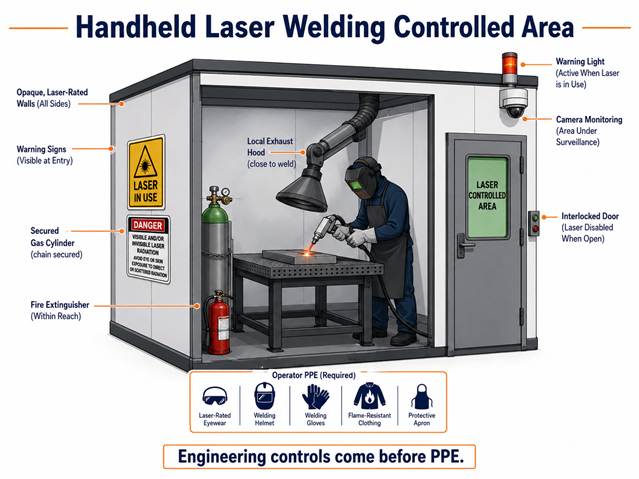
Learning Objectives Figure 3-1. Example of a controlled handheld laser welding area with access control, extraction, monitoring, and operator PPE. 3.1 Class 4 Means Immediate Hazard The U.S. Food and Drug Administration describes Class IV lasers as capable of causing immediate skin and eye injury from the direct or reflected beam and as presenting a … Read more

Handheld Laser Welding Safety

Summary Handheld fiber lasers (e.g., IPG’s LightWELD series) are booming in small shops and maintenance shops, offering faster, easier welds than traditional TIG/MIG. As these tools spread, it’s crucial that welders and managers learn the fundamentals of laser safety. Class-4 hand lasers demand engineered interlocks (e.g. gun-to-part clamps, fiber-break detectors), a keyed on/off switch, and … Read more