Modern motion controllers are amazing.
In laser processing, advanced algorithms can smooth corners, reduce vibration, improve path following, synchronize laser firing, and help squeeze more performance out of a machine. Features such as input shaping, look-ahead, contour smoothing, and frequency-response-based tuning are real tools that can make a good machine much better [1][2][3][4].
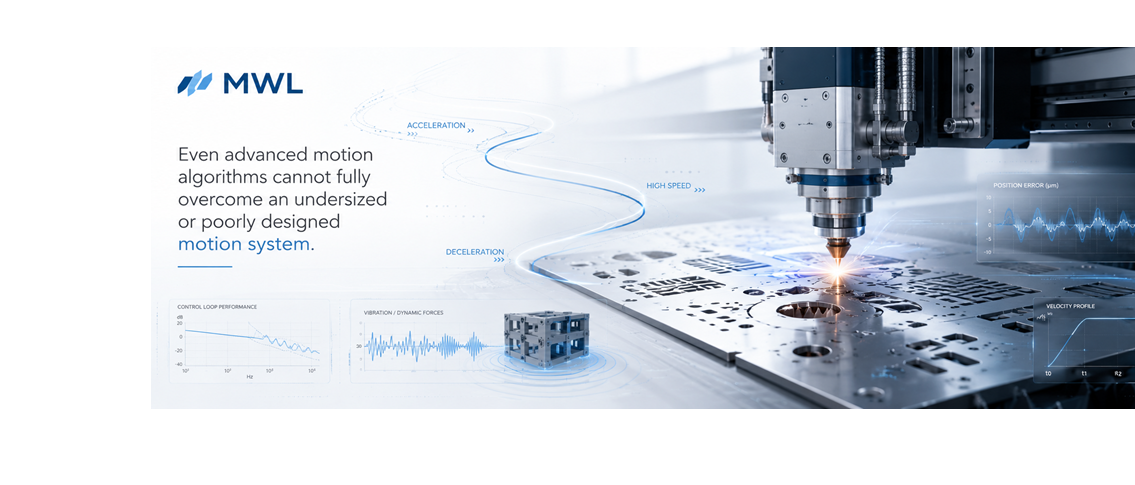
But they cannot turn an undersized or poorly designed mechanical system into a high-performance laser cutter.
That is the part young engineers and manufacturing engineers need to hear early: software can improve motion, but it cannot repeal physics.
The machine still has to move the mass
In laser cutting, especially when cutting small features, the machine is often the limiting factor. It is limited by motion.
Small holes, slots, tabs, corners, and fine contours require the cutting head to accelerate, decelerate, change direction, and settle very quickly. That means the axes spend much of their time accelerating and decelerating rather than cruising at a steady speed.
The basic physics is simple: force is tied to mass and acceleration. In SI units, a newton is the force required to accelerate one kilogram at one meter per second squared, and acceleration is measured as a change in velocity over time [5]. So when we ask a stage, gantry, or rotary axis to accelerate harder, we are asking the motor and drive system to produce more force or torque.
For a rotary motor, this shows up as torque demand. For a linear motor, it appears as a force demand. Either way, higher acceleration requires greater motor capability, higher drive current, greater stiffness, and better mechanical design.
Why small features can be harder than long cuts
A long, straight cut can look impressive because the machine can reach a high feed rate. But many real laser parts are not long straight cuts. They are filled with small geometry.
On small features, the machine may never reach the programmed feed rate before it has to slow down again. The cycle time becomes dominated by acceleration, deceleration, cornering, and settling.
That is why a machine can have a high advertised top speed and still be slow on real parts.
Top speed is easy to market. Acceleration, stiffness, servo bandwidth, cable management, and settling time often determine throughput in small-feature laser work.
What advanced algorithms can do?
Advanced motion algorithms absolutely matter.
Input shaping, for example, is designed to reduce motion-induced resonance at targeted frequencies. ACS describes its input shaping as a point-to-point profile algorithm intended to minimize resonances, with benefits including vibration-free motion, no impact on servo loop stability, and improved move-and-settle performance [1].
Smooth contouring tools also matter. ACS describes SmoothPath as an advanced contour motion algorithm for smooth, coordinated 2–6 axis motion. It is intended to improve throughput and reduce disturbances caused by discontinuities in CAD/CAM-generated paths [2].
For multi-axis laser paths, segmented motion and look-ahead can also help. ACS states that its Segmented Motion feature supports coordinated motion along multi-axis line and arc paths, with look-ahead velocity adjustment, corner processing, and synchronized digital outputs for lasers and other devices [3].
Good diagnostic tools help too. Frequency response analysis can identify stability limits, resonance points, bandwidth limitations, and cross-coupling between axes in multi-axis systems [4].
These are not gimmicks. They are valuable tools.
What advanced algorithms cannot do
They cannot make an undersized motor produce unlimited torque.
They cannot make a weak frame stiff.
They cannot make a heavy gantry behave like a light one.
They cannot fully hide poor cable routing, shaking fibers, loose mechanics, low structural natural frequency, or a base that rocks during aggressive moves.
This is where machine design matters. The Association for Advancing Automation explains that high inertia mismatch and mechanical compliance can create resonances that prevent the electrical controls from performing as required. The result can be overshoot, long settling times, or even runaway oscillation [6].
That is a big deal in laser processing because instability is not just a motion problem. It becomes a process problem.
If the cutting head shakes, the beam position shakes. If the fiber, assist-gas line, or cable carrier is whipping around, the head can feel changing forces during the cut. If the machine frame rings after every sharp move, the controller may be “in position,” but the process may still be moving.
The laser does not care that the encoder looks good. The cut quality cares where the beam actually is.
A simple way to think about it
Advanced algorithms are like a great driver.
They can brake smoothly, take a better line through a corner, avoid unnecessary steering corrections, and keep the car stable.
But if the car has weak suspension, undersized brakes, loose steering, and tires that cannot grip, the driver cannot set a track record.
Motion control is the same.
A good controller can help the machine move smarter. It cannot make a poor mechanical design disappear.
What to check before blaming the controller
Before assuming the motion controller is the problem, look at the system:
Is the motor sized for the required acceleration, not just the steady cutting speed?
Is the load inertia reasonable for the motor and drive?
Is the frame stiff enough, or does it shake during abrupt moves?
Are the cable carrier, fiber, gas line, and head plumbing being pulled along the axis?
Does the machine settle quickly after a move, or does it ring?
Have the resonant frequencies been measured?
Has the real part program been tested, not just a simple straight-line move?
This is where engineering judgment matters. A laser cutter should be evaluated using the type of motion it will actually run in production.
The takeaway
Advanced motion algorithms can improve stability, accuracy, path quality, and sometimes throughput. They are important, especially in high-performance laser systems.
But they work best when the machine is already mechanically sound.
For small-feature laser cutting, throughput often depends on acceleration, deceleration, torque, stiffness, and settling time. If the system is undersized, the controller may make it smoother, but it may not make it faster.
Good motion control starts with good mechanics.
Then the algorithms can do what they were designed to do.
References
[1] ACS Motion Control — Input Shaping: reduces motion-induced resonance at targeted frequencies and improves move-and-settle performance.
[2] ACS Motion Control — SmoothPath: coordinated 2–6 axis contour motion intended to improve throughput and reduce disturbances from CAD/CAM path discontinuities.
[3] ACS Motion Control — Segmented Motion: multi-axis line/arc contouring with look-ahead, corner processing, and synchronized laser outputs.
[4] ACS Motion Control — FRF Analyzer: identifies resonances, stability limits, bandwidth limitations, and axis cross-coupling.
[5] NIST — SI Units: acceleration is a derived SI quantity, and force is derived from mass and acceleration.
[6] Association for Advancing Automation — Understanding the Mysteries of Inertia Mismatch: high inertia mismatch and compliance can cause resonances, overshoot, long settling times, and unstable behavior.