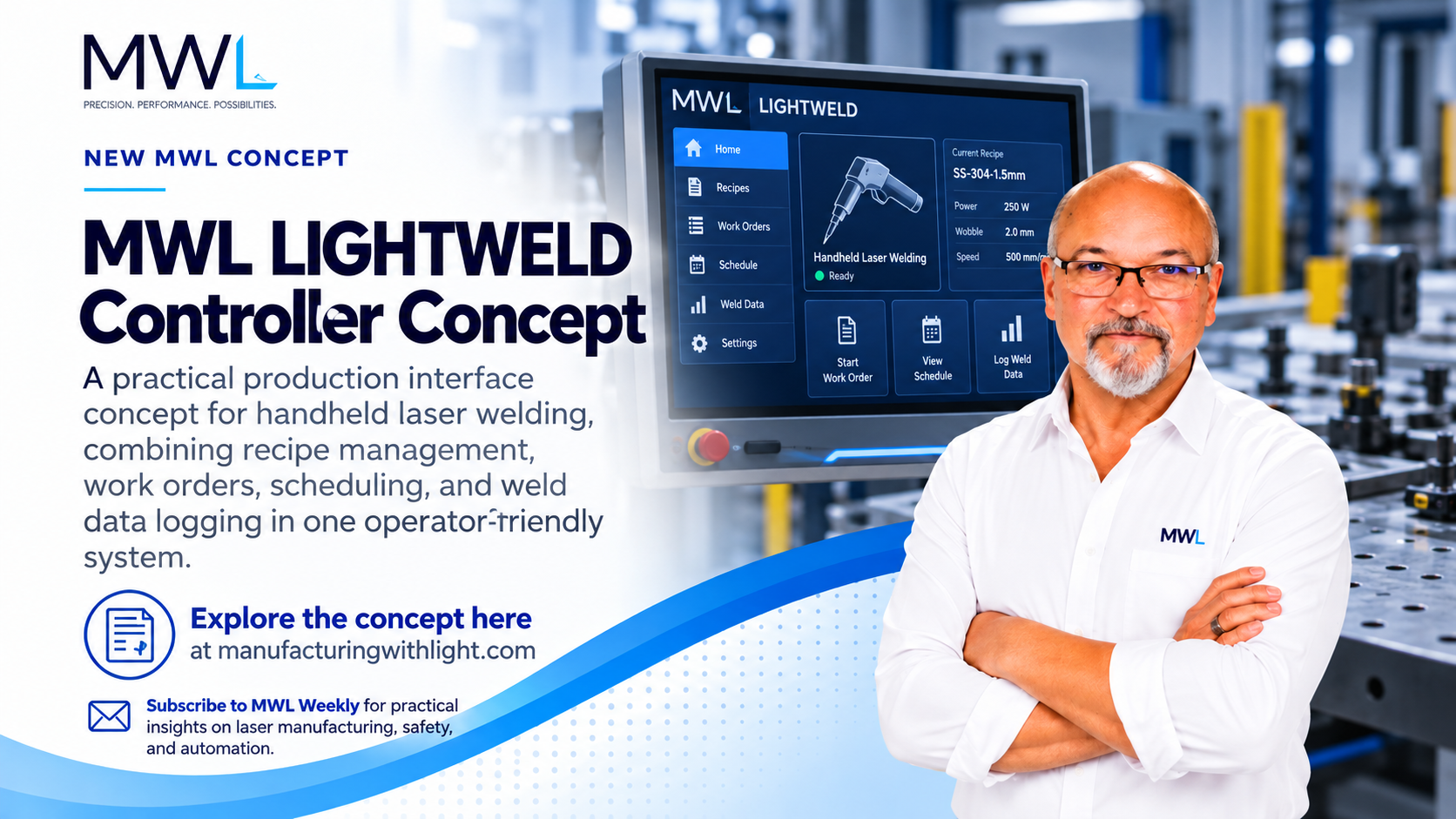
Handheld laser welding is becoming more than a standalone welding tool. As LightWELD moves into regular production and robotic cells, MWL is developing a customizable interface to connect the part, the operator instructions, the approved laser settings, and the production record.
LightWELD Is Becoming a Production Tool
I come from a background of building automated laser systems for production, so when I look at LightWELD, I tend to see more than the welding process itself.
A production laser system normally has quite a bit surrounding the laser: part identification, recipes, operator instructions, diagnostics, production counts, traceability, machine status, and often a safety system tying the entire work cell together.
As LightWELD moves beyond standalone handheld welding and into more structured production—and increasingly into robotic and cobot applications—I see an opportunity to add that layer.
Manufacturing With Light is beginning to work on that.
Start With the Production Part
I don’t want the first MWL version to become another large MES package.
The basic idea remains deliberately simple:
Part → Instructions → Approved Settings → Verify → Count → Record
A customer part would be associated with its approved LightWELD settings.
Before production starts, the controller could verify that the LightWELD settings match the settings approved for that part.
During production, it could maintain a part count and record the relevant settings and available operating information.
Production records could remain local, be exported to a customer’s database, or be made available through an industrial interface such as OPC.
The purpose is to put a useful production layer around LightWELD, not replace the LightWELD controls.
It Works for Handheld Production Too
Not every LightWELD application belongs on a robot.
Some parts are difficult to fixture. Some vary slightly from one piece to another. Sometimes there may be only a handful of expensive parts to make.
Programming, fixturing, and proving out a cobot may take longer than welding.
In those applications, the MWL controller could turn a handheld LightWELD station into a more controlled production workstation.
Select the part, and the operator could see its revision, approved LightWELD settings, weld sequence, setup information, photographs showing weld locations or fixture orientation, special instructions, target quantity, and completed quantity.
The goal is to connect:
the part → the instructions → the approved welding process
instead of scattering that information across a drawing, a setup sheet, a LightWELD preset number, and someone’s memory.
And When the Cell Gets More Complicated, Safety Changes Too
I recently wrote about another issue that becomes important as a simple laser workstation grows into a more complicated manufacturing cell:
A safety loop can look perfectly healthy while hiding a fault.
A simple system might have an E-stop and one interlocked access point.
But now add a cobot, multiple doors, additional E-stops, a rotary positioner, perhaps several enclosure panels, laser-enable circuitry and other safeguards.
At some point, simply adding more devices in series can create a system that is increasingly difficult to diagnose—and under the wrong architecture can actually hide certain faults.
That isn’t just a troubleshooting inconvenience.
ISO/TR 24119 specifically addresses fault masking when multiple guard-interlocking devices with potential-free contacts are connected in series. Fault masking can reduce diagnostic coverage and therefore limit the Performance Level that the overall safety function can achieve. ISO
That was the point of my recent article.
A dual-channel safety relay by itself does not make the entire machine a Category 3 or PL d safety system.
The complete safety function matters: architecture, devices, diagnostics, failure modes, common-cause considerations and validation.
ISO 14119 also makes clear that guard interlocking is part of a larger safety-related control system whose signal processing falls under standards such as ISO 13849-1 or IEC 62061. ISO
An Optional MWL Cell-Safety Package
For a simple handheld production station, a sophisticated safety controller may not be necessary. The correct design should come from the machine’s risk assessment.
But once the application becomes a more complicated work cell, I think MWL should be able to offer integrated work-cell safety as an option.
That might include a safety-rated controller monitoring functions such as:
- enclosure access doors and gates
- emergency stops
- laser emission permission
- robot or cobot safety interfaces
- positioners or other hazardous motion
- light curtains or presence-sensing devices where applicable
- external equipment whose operation is required by the risk assessment
Instead of putting every device into one long series string, we can monitor important devices individually where the safety design calls for it.
That also gives us something I consider extremely valuable:
diagnostics.
If the laser won’t enable, the operator shouldn’t just see:
SAFETY NOT OK
The HMI should be able to tell maintenance that:
Access Door 2 safety channel has not reset
or
Robot safety interface is preventing laser enable
or
External E-stop station is active.
The safety-rated system still owns the actual safety function.
The MWL controller provides the operator and maintenance technician with the information needed to understand why the cell is not ready.
That distinction is important.
Production and Safety Information in One Operator Environment
This begins to make the MWL controller more interesting.
The operator doesn’t need one screen for LightWELD, another for work instructions, another for production counts, and a row of safety relays in a cabinet that only an electrician can decipher.
The production interface can provide one view of the cell:
What part am I running?
Are the correct LightWELD settings loaded?
What am I supposed to weld?
How many have I completed?
Is the cell safe and ready to operate?
If it isn’t ready, why?
That does not mean the normal HMI software becomes the safety system.
It means the production system and the safety-rated system can be engineered together so the operator sees useful information from both.
The Differentiator Is Customization
This is also where I think MWL can offer something different from a standard manufacturer’s interface.
Every manufacturer works differently.
One customer may identify parts with barcodes.
Another may use work orders.
One may want photographs and detailed instructions.
Another may need production results written directly to an SQL database.
And one customer may only need the basic LightWELD production interface, while another needs a complete cell with multiple doors, robot safety, detailed diagnostics and controlled reset sequences.
The core can remain standardized while the application around it is customized.
That includes safety when the application requires it.
A Platform for Integrators and Distributors
I also see this as potentially useful for LightWELD distributors and system integrators.
An integrator might provide the:
LightWELD + cobot + enclosure + fixtures + safety system + MWL production controller
as one complete solution.
MWL could then provide the software and control platform as a private-label product, customized for the integrator and its customer.
The integrator would not need to develop recipe management, work instructions, traceability, data interfaces, detailed diagnostics, and potentially configurable safety-control structures from scratch for every project.
The concept becomes:
Your cell. Your brand. Your customer’s process.
Traceability Still Isn’t Weld Inspection
I also want to maintain an important distinction.
Verifying that the right LightWELD settings were used does not prove that a weld is good.
Likewise, displaying safety status on an HMI does not by itself make a machine safe.
Weld quality still requires whatever qualification, inspection, or monitoring the application demands.
And machine safety still requires a risk assessment, correctly designed safety functions, appropriate safety-rated components and validation of the finished system.
The MWL controller is intended to bring those pieces together into a system that is easier to operate, troubleshoot, and adapt to the customer’s production requirements.
That’s the Opportunity I See
Having spent much of my career building automated laser systems, I tend to think about the equipment surrounding the process almost as much as the laser itself.
As LightWELD moves deeper into production, I see a need for that same surrounding infrastructure.
For a basic handheld workstation, it might be:
Part → Instructions → Settings → Verify → Count → Record
For a more sophisticated robotic cell, we can add:
Safety → Diagnostics → Cell Status → Customer Integration
Not every customer needs all of it.
That’s exactly the point.
Build a standard core, then configure the production system around what the customer actually needs.
That’s what MWL is starting to explore.
External links: IPG LightWELD Cobot System, IPG LightWELD Handheld System, THG Robotic Laser Welding, Cyan-Tec Hyperion LightWELD, and FANUC LightWELD Cobot Case Study.
Manufacturing With Light
Practical information about laser materials processing, automation, motion control, safety, and the engineering required to turn laser technology into dependable manufacturing.
#ManufacturingWithLight #LightWELD #LaserWelding #HandheldLaserWelding #RoboticWelding #ManufacturingAutomation #Traceability #CobotWelding #AdvancedManufacturing