MWL Laser Manufacturing Weekly — Fourth Edition August 20, 2026

From LPBF Distortion to Machine Uptime: This Week in Laser Manufacturing

This week’s stories cover very different parts of manufacturing with light, but I think a common thread runs through them.

Getting a laser process to work is only part of the job. We also have to make it predictable, traceable, maintainable, and useful in production.

This week we look at LPBF distortion compensation, automated medical stent welding, growth in industrial laser applications, and using machine data to improve uptime. We are also introducing a new MWL Product Watch and our first recurring MWL Automation Note.
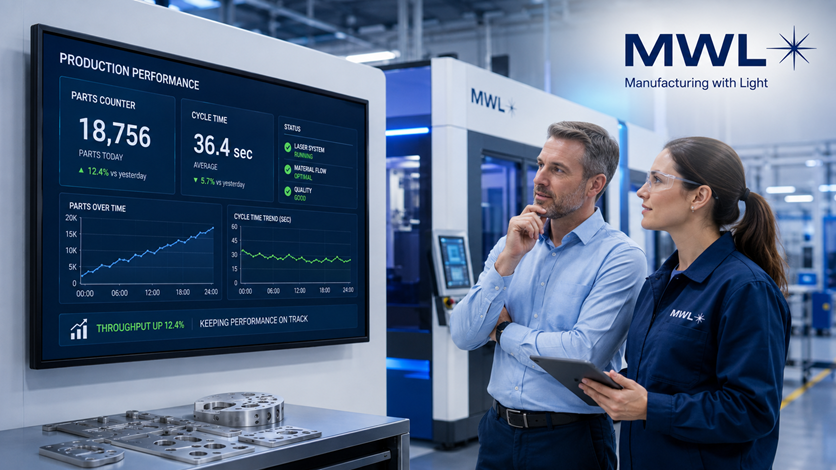
Your Laser Machine Works. But Can You Make It Run Faster?

Why higher programmed speed does not always mean more good parts per hour By William Kane | Manufacturing with Light (MWL) Eventually, almost every successful production machine gets the same request: “We need more parts per hour.” With a laser cutting machine, the first reaction is often obvious: increase the feed rate. If the process … Read more

MWL Laser Manufacturing Weekly Third Edition

A look at four developments in laser manufacturing that caught my attention this week — from precision motion for medical-device manufacturing to very-high-power cutting, semiconductor processing, and an interesting new approach to machining sapphire. Precision Motion Targets Medical Tube Laser Cutting Aerotech’s new LaserTurn280 motion platform is designed for cylindrical laser processing applications such as … Read more

What You Should Know Before Building a Precision Laser Cutting System

By William Kane | Manufacturing with Light (MWL) When people start discussing a new laser cutting system, the conversation usually starts with the laser. How much power do we need? Fiber or ultrafast? What wavelength? What spot size? What material thickness? Those are important questions and should be worked out in an applications lab before … Read more

What You Need to Know About Handheld Laser Welding

What You Need to Know About Handheld Laser Welding is a practical, safety-focused guide for shop owners, welders, supervisors, students, and anyone considering this rapidly growing technology. It explains how handheld laser welding works, what equipment and controls are required, how to develop a repeatable welding process, and why training, ventilation, documentation, and laser safety … Read more

Advanced Motion Algorithms Are Powerful — But Physics Still Gets a Vote

Modern motion controllers are amazing. In laser processing, advanced algorithms can smooth corners, reduce vibration, improve path following, synchronize laser firing, and help squeeze more performance out of a machine. Features such as input shaping, look-ahead, contour smoothing, and frequency-response-based tuning are real tools that can make a good machine much better [1][2][3][4]. But they … Read more

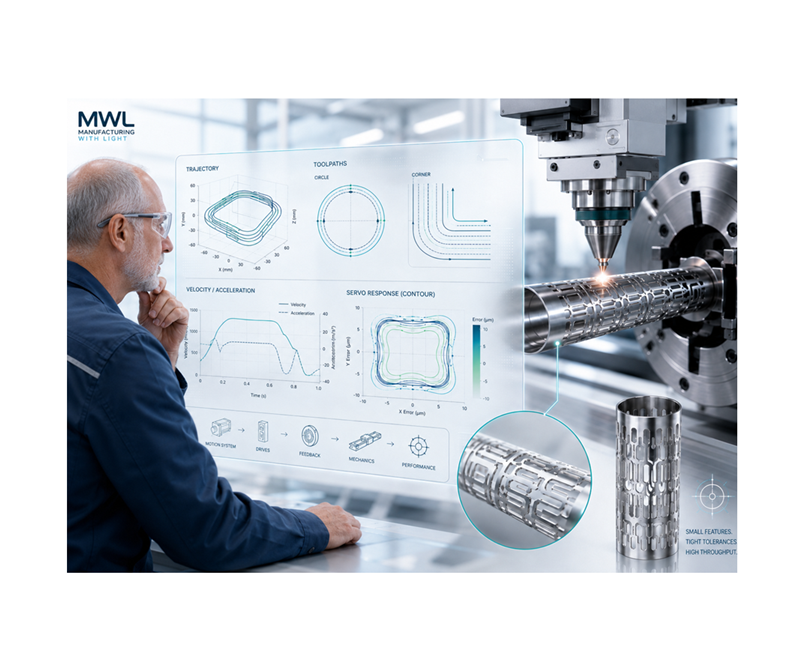
Small Features Change the Way We Size a Laser-Cutting Motion System

When people begin sizing a motion system for a laser-cutting machine, the conversation often starts with familiar numbers: Those questions matter, but they do not tell the whole story when the machine must cut small features at high production rates. A motion system can move very quickly across a large work area and still struggle … Read more

Practical Guide to the ACS Motion Control LCI

Setup, ACSPL+ structure, simplified examples, GSP integration, and a robust fixed-pulse-width M-code   For current ACS Motion Control users with programming experience   Initialize the LCI and establish a repeatable startup sequence   Understand the most useful structure fields and operating modes   Use PWM, fixed-distance pulsing, and segment gating   Expose LCI functions to … Read more