Learning Objectives
- Explain why most handheld laser welders are Class 4 systems.
- Describe the purpose of a Laser Controlled Area.
- Identify beam, reflection, fume, fire, gas, and electrical hazards.
- Understand the roles of engineering controls, work practices, and PPE.
- Build a basic safety-planning checklist.
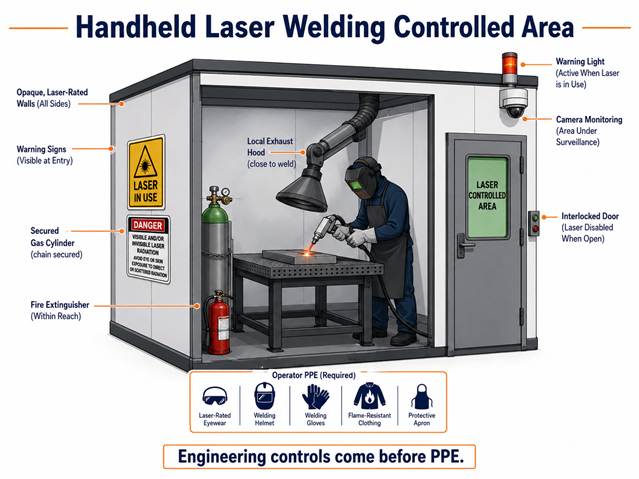
Figure 3-1. Example of a controlled handheld laser welding area with access control, extraction, monitoring, and operator PPE.
3.1 Class 4 Means Immediate Hazard
The U.S. Food and Drug Administration describes Class IV lasers as capable of causing immediate skin and eye injury from the direct or reflected beam and as presenting a possible fire hazard.1
Many handheld welding systems operate near 1,070 nm in the near-infrared range. That beam is invisible. The absence of visible brightness does not mean the beam is absent or safe.
A current manufacturer manual for a 2 kW handheld system identifies the processing beam as Class 4 and emphasizes direct, reflected, and scattered radiation, laser-controlled operation, training, PPE, fume extraction, and fire prevention. It also separates operating, advanced-operating, maintenance, electrical, and laser-safety responsibilities. Those divisions are a useful model for any shop introducing the technology.
3.2 The Laser Controlled Area
A Laser Controlled Area is a space where access and activity are controlled because hazardous exposure may be possible. In practical shop terms, this normally means a properly evaluated room or enclosure with:
- laser-resistant barriers,
- controlled and interlocked access,
- warning signs and status lights,
- key control,
- suitable viewing methods,
- beam stops or safe backstops,
- restricted occupancy,
- documented procedures,
- and supervision by a qualified Laser Safety Officer or equivalent responsible person.
The specific design must be based on the actual laser, wavelength, power, beam divergence, process head, expected reflections, room geometry, and applicable requirements.
SAFETY
A welding curtain intended for arc welding is not automatically a laser barrier. Use materials and viewing windows rated and evaluated for the laser wavelength and exposure.
3.3 Direct, Specular, and Diffuse Reflections
A mirror-like reflection is called specular. It can redirect a concentrated portion of the beam. A rough surface produces more diffuse scattering, but a high-power laser can still make scattered energy hazardous.
The reflection direction changes with:
- torch angle,
- part angle,
- material,
- surface finish,
- molten-pool shape,
- and beam motion.
Highly reflective metals require special care, but even steel can create hazardous reflections at the wrong angle.
Back-reflection hazard. A back reflection can return a concentrated portion of the laser energy toward the operator, the welding head, or another surface; on curved work, the likely reflection direction changes as the torch moves. IPG Photonics warns that secondary beams can occur at various angles and may remain intense enough to injure the eye, while the LightWELD 2000 XR manual warns that high-power specular reflections can travel long distances and endanger both eyes and skin.[23][11]
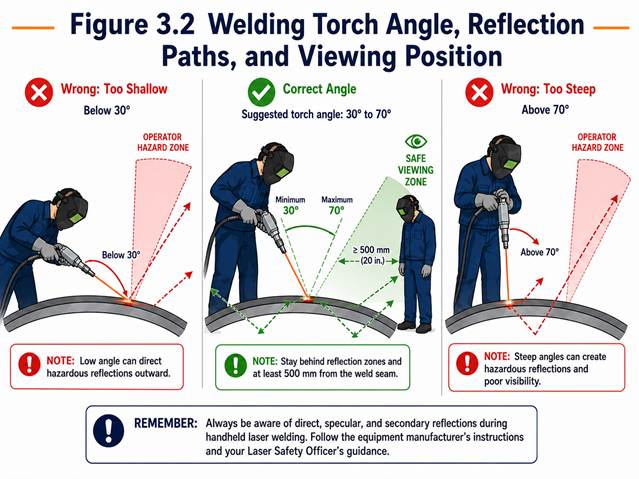
Figure 3.2. A curved surface changes the reflection direction as the torch moves. For the LightWELD 2000 XR, IPG specifies a torch angle from 30° to 70° and a viewing position at least 500 mm (20 in.) from the weld seam and behind the reflection zones.[11]
3.4 Eye and Face Protection
Laser eyewear must match the wavelength and expected exposure. Optical density is not a universal rating; it is meaningful only for the stated wavelength range and conditions.
The operator may also need a welding helmet or face shield to protect from:
- visible process brightness,
- ultraviolet and infrared process radiation,
- sparks,
- hot particles,
- and direct mechanical impact.
Do not select eyewear by lens color. Use the machine manufacturer’s requirements and a qualified laser-safety assessment.
Inspect eyewear before use. Remove it from service if it has:
- cracks,
- deep scratches,
- crazing,
- discoloration,
- damaged coatings,
- loose frames,
- or unreadable markings.
3.5 Clothing and Skin Protection
Class 4 radiation can injure skin. The welding process also creates UV, infrared, hot surfaces, and sparks. Typical protection may include:
- laser- and heat-resistant gloves,
- flame-resistant clothing,
- closed collar and cuffs,
- protective cap,
- leather or approved apron,
- safety footwear,
- and suitable helmet or face protection.
The exact ensemble should come from the hazard assessment and manufacturer instructions.
3.6 Welding Fumes Are Still Welding Fumes
Laser welding may produce less visible smoke in some conditions, but low visibility does not equal low exposure. Welding fumes are complex mixtures that depend on the base metal, filler, coatings, surface contamination, and process.
NIOSH notes that welding fumes contain metals and commonly include manganese. Inhaled manganese is a concern because it can affect the lungs and nervous system.2
NIOSH also identifies the eyes, skin, respiratory system, and central nervous system as target organs for welding-fume exposure.3
Materials that deserve particular attention include:
- stainless steel,
- galvanized steel,
- nickel alloys,
- chromium-containing alloys,
- painted or plated parts,
- lead- or cadmium-containing surfaces,
- and unknown repair parts.
3.7 Local Exhaust Ventilation
The preferred approach is to capture contaminants close to where they are generated. OSHA guidance for laser operations calls for adequate ventilation to control hazardous fumes and vapors from laser welding and other target interactions.4
A practical fume system should be:
- sized for the process,
- positioned close enough to capture the plume,
- arranged so it does not pull shielding gas away from the weld,
- equipped with suitable filtration,
- maintained on schedule,
- and evaluated with representative materials.
NIOSH documents source-capture methods as an effective engineering-control approach for welding fumes.5
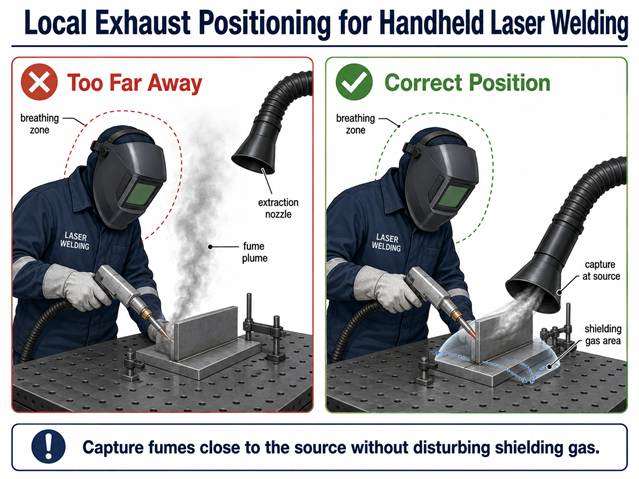
Figure 3-3. Local exhaust should capture the fume near its source without pulling shielding gas away from the weld.
3.8 Respirators
Respirators may be needed when engineering controls cannot adequately control exposure, during certain maintenance tasks, or while controls are being improved. A respirator is not just another piece of PPE to hand out. In the United States, required respiratory protection normally involves a formal program, medical evaluation, fit testing, selection, training, and maintenance.
An industrial hygienist can help determine whether air sampling is needed and what contaminants must be measured.
3.9 Fire and Explosion Hazards
Laser welding can ignite combustible material and can penetrate thin work. Before welding:
- remove flammable materials,
- check the far side of the joint,
- inspect cavities and hidden spaces,
- do not weld unknown containers,
- control sparks and hot metal,
- maintain appropriate extinguishing equipment,
- and use a hot-work permit where required.
A beam that passes through a seam can strike material behind the part. Provide a suitable laser-rated and fire-resistant backstop.
3.10 Gas Cylinder and Asphyxiation Hazards
Shielding gas cylinders must be secured, protected from damage, and used with compatible regulators and hoses.
Argon can displace oxygen. This is especially important in small rooms, pits, tanks, and other confined spaces. A room can look normal while oxygen concentration is becoming unsafe.
3.11 Electrical and Stored-Energy Hazards
High-power laser welders may require significant electrical service and include internal high-voltage components. Electrical installation should be performed by qualified personnel and follow the current manual and local electrical code.
Do not open the equipment unless the manufacturer specifically identifies the task as user-serviceable and the person is qualified to perform it.
3.12 Training and Roles
A responsible program distinguishes between:
- operator,
- advanced operator or process technician,
- maintenance technician,
- electrician,
- welding supervisor or engineer,
- inspector,
- and Laser Safety Officer.
The operator should know what can be adjusted and what must be escalated.
Safety Planning Checklist
- [ ] Current manufacturer manual available at the machine
- [ ] Qualified laser-safety review completed
- [ ] Controlled area designed and documented
- [ ] Barriers and windows rated for the laser
- [ ] Door interlocks and warning indicators tested
- [ ] Key-control procedure in place
- [ ] Reflection paths evaluated
- [ ] Fume extraction installed and verified
- [ ] PPE selected and inspected
- [ ] Fire hazards and back side of weld controlled
- [ ] Gas cylinders secured
- [ ] Operator training documented
- [ ] Emergency procedures posted
- [ ] Maintenance responsibilities assigned
Key Takeaways
- Class 4 hazards include direct, reflected, and scattered energy.
- Engineering controls come before PPE.
- Invisible fumes and invisible laser radiation must both be taken seriously.
- Safety is a system: enclosure, access control, extraction, procedures, training, and PPE.
Review Questions
- Why is lens color not enough to select laser eyewear?
- What is the purpose of a Laser Controlled Area?
- Why should the far side of a weld be checked?
- What factors change the composition of welding fumes?
- When might an industrial hygienist be needed?